
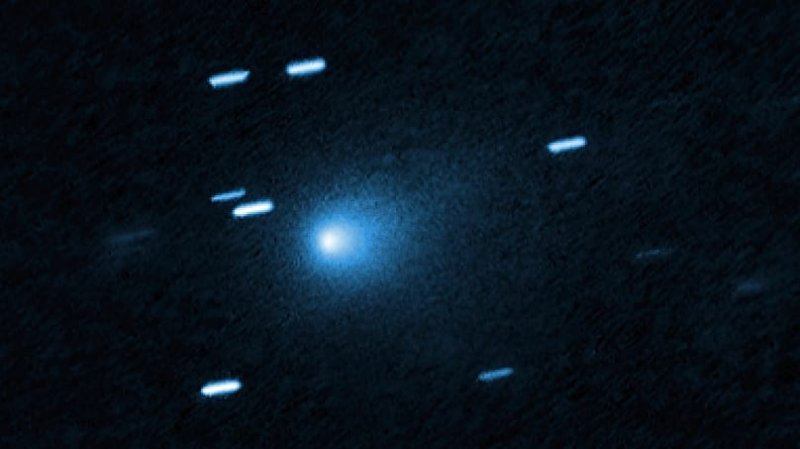
Two independent research teams studying the interstellar comet 3I/ATLAS have reported the direct detection of methane in its surrounding gas cloud and estimated that its nucleus is roughly 2.6 kilometers (1.6 miles) wide.
The findings, detailed in papers posted on arXiv, mark a rare scientific achievement for an object that formed around a star other than the Sun, News.Az reports, citing foreign media.
The significance of the discovery is heightened by the rarity of such objects. Only three confirmed interstellar visitors have ever been observed passing through the solar system, and each offers only a short and rapidly diminishing window to examine how planets and comets form beyond our own stellar environment.
As 3I/ATLAS continues its departure from the solar system, the newly identified chemical composition and refined size estimates provide researchers with important data to compare this object with typical comets that formed under the influence of the Sun.
One of the studies relied on observations from the James Webb Space Telescope, using its Mid-Infrared Instrument (MIRI) to capture spectral data—essentially chemical fingerprints—shortly after the comet passed perihelion, its closest point to the Sun. The observations revealed methane, along with signatures associated with water, carbon dioxide, and a nickel emission line.
The Webb research team found that methane production lagged behind water, indicating that methane closer to the surface may have been depleted earlier in the comet’s journey. This allowed methane from deeper layers to become detectable later. They also observed that overall outgassing—the release of gas as frozen material warms—declined over a period of about two weeks.
A separate study based on observations from the Hubble Space Telescope focused on determining the size of the comet’s nucleus. By applying a “nucleus extraction” technique to separate the faint signal of the solid core from the much brighter surrounding coma, the team estimated an effective radius of approximately 1.3 kilometers. This calculation assumes a comet-like reflectivity, or albedo, of 0.04.
The same study suggested that variations in the comet’s brightness could be consistent with an elongated nucleus, with an axis ratio of at least 2-to-1 and a rotation period longer than one hour. However, the researchers cautioned that these interpretations depend on the underlying cause of the brightness changes.
Harvard astrophysicist Avi Loeb, who has frequently commented on 3I/ATLAS, described the size estimate as the most critical parameter, stating that the nucleus appears to have an effective diameter of about 2.6 kilometers, with an uncertainty of roughly 0.4 kilometers.
The comet was first detected in July 2025 by the ATLAS survey telescope in Chile, triggering global interest as NASA and other agencies began tracking it with a range of instruments. NASA officials quickly dismissed speculation that the object might be artificial. Nicola Fox referred to it as “our friendly solar system visitor,” while astronomer Chris Lintott rejected claims describing 3I/ATLAS as an alien spacecraft, calling them “simply nonsense.”
Additional observations may still emerge. The European Space Agency has confirmed that its Jupiter-bound mission JUICE observed the comet. However, the mission’s science data is not expected until February, as the spacecraft is currently using its main antenna as a heat shield, limiting its data transmission rate.
The new findings come with caveats. Both studies are preprints and have not yet undergone peer review, and several key results rely on modeling assumptions. The Hubble size estimate depends on the assumed albedo, while interpretations of methane production require models of heating, dust behavior, and gas flow within an active cometary coma.
Even so, the Hubble team noted that their results suggest many objects similar to 3I/ATLAS may have gone undetected in earlier surveys, before the discoveries of ʻOumuamua in 2017 and Borisov. This implies that interstellar visitors could be more common than previously believed, though far more difficult to detect.