
The University of Pittsburgh Health Sciences announced the launch of the Trivedi Institute for Space and Global Biomedicine, one of the first dedicated institutes focused on applying insights from spaceflight to improve human health on Earth, on Jan. 29.
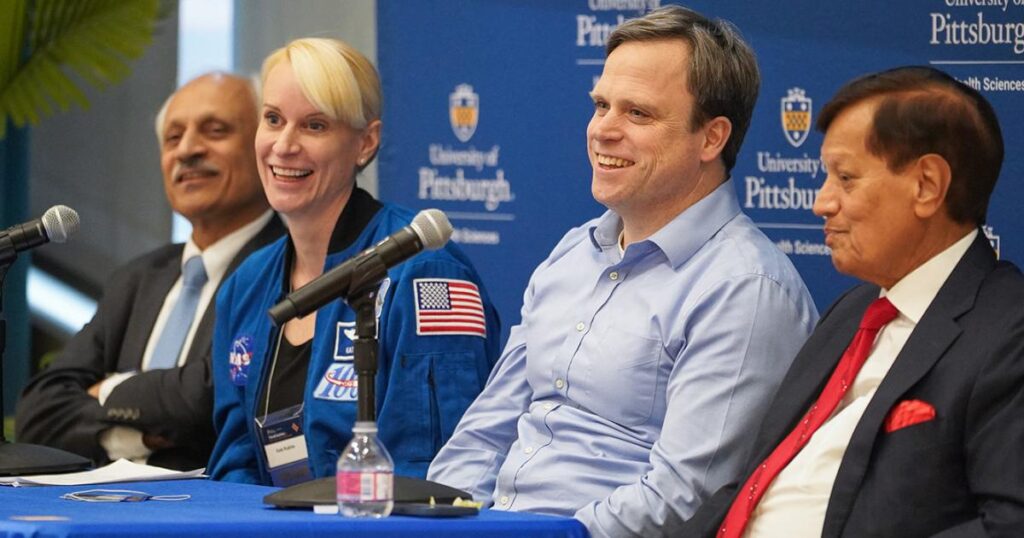
The $25 million institute will be led by Kate Rubins (pictured, second from left), who joined Pitt in October as professor of computational and systems biology, after a 16-year career as a NASA astronaut that included two long-duration missions and a total of 300 days in space. She was the first person to sequence DNA in space and led multiple investigations in genomics and human health under extreme conditions.
“Technologies developed for use in the severely resource-constrained circumstances of space travel can be repurposed for use in patients on Earth,” Rubins said. “These approaches are particularly powerful in settings with limited infrastructure, including disaster response, rural medicine, military operations and humanitarian missions.”
Through the Trivedi Family Foundation, Ashok Trivedi (pictured, at right), a Pittsburgh-based entrepreneur, investor and philanthropist, will be the new institute’s major donor. He believes the cutting-edge research facilitated through the institute and its world-class team will help define a new frontier of science that bridges human health on Earth and in space.
“By investing in science that improves quality of life — from fighting disease and discovering cures for terminal illness to understanding aging and preparing astronauts for the demands of space — the institute can have an impact on all of humanity,” he said.
“The Trivedi Institute is a next logical step in our longtime progression as a worldwide leader in biomedical research,” said Anantha Shekhar (pictured, at right), senior vice chancellor for the health sciences and John and Gertrude Petersen Dean of the University’s School of Medicine.
“Microgravity and radiation speed up processes like cell growth and disease progression, offering accelerated insights that could cut years off the discovery of major scientific breakthroughs. The harsh environment of space is also a prime testing ground for how to advance human health in low-resourced communities here on Earth, a key strategic goal of Pitt Health Sciences,” Shekhar said.
“Pitt is an institution defined by pushing boundaries,” said Chancellor Joan Gabel. “And through the new Trivedi Institute for Space and Global Biomedicine, we proudly add to this long-standing distinction at the intersection of space, health and possibilities.”
The institute’s leadership brings broad expertise across physics, medicine, spaceflight, synthetic biology, engineering and entrepreneurship.
“Advances in spaceflight, biotechnology, synthetic biology and new algorithms make it possible to systematically study human health under extreme conditions and rapidly translate those insights to Earth, in low-Earth orbit and soon, beyond Earth,” said geneticist and space biologist Christopher Mason, visiting adjunct professor of surgery at Pitt.
[Read more: Pitt’s School of Medicine shoots for the stars at space biomedicine symposium]
Key scientists helping to build the new institute include Afshin Beheshti, professor of surgery and director of the Center for Space Biomedicine, and Sylvain Costes, professor of radiation oncology and director of Center for Space Biomanufacturing, Synthetic Biology and Digital Health.
The Trivedi Institute is working with Carnegie Mellon University, other universities, space agencies, nonprofits and industry partners to build a global, cross-institutional research and training ecosystem.
“Carnegie Mellon University is thrilled to partner with Pitt on this new institute, which represents an important step forward in advancing human health,” said Theresa Mayer, Carnegie Mellon University vice president for research. “We see tremendous opportunity to leverage our complementary strengths in AI, computation and technology innovation to help drive new biological insight and medical innovation.”
The initiative will train the next generation of scientists, clinicians and entrepreneurs at the intersection of space biology, biomedicine and translational health, with missions and projects planned into the 2030s.
Photography by Rayni Shiring