
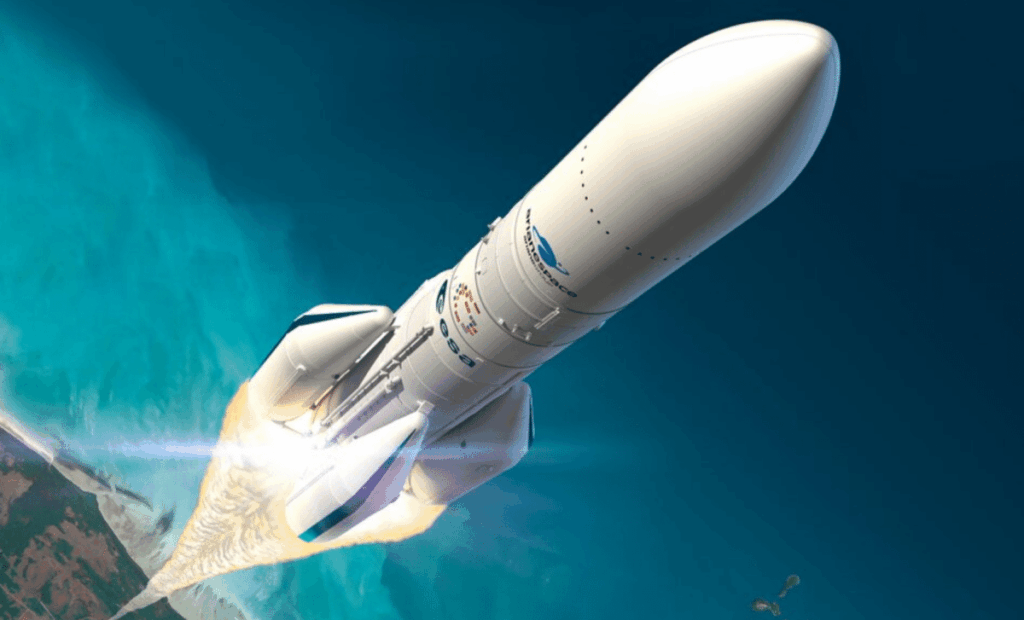
Ariane 6 is preparing for a decisive milestone as Europe readies the launcher’s first flight in its most powerful configuration, according to European Space Agency (ESA). The mission marks a major step in restoring independent European access to space and validating years of industrial development.
A Heavy-Lift Configuration Designed For Demanding Missions
The upcoming launch will showcase Ariane 6 equipped with four solid rocket boosters, a configuration intended for the most demanding institutional and commercial missions. This version is designed to deliver heavier payloads to higher orbits, including geostationary transfer orbit and complex multi-satellite deployments.
With four boosters firing simultaneously at liftoff, Ariane 6 will generate a significant increase in thrust compared with its two-booster variant. This performance margin is aimed at meeting Europe’s strategic needs, including large spacecraft, scientific missions, and security-related payloads.
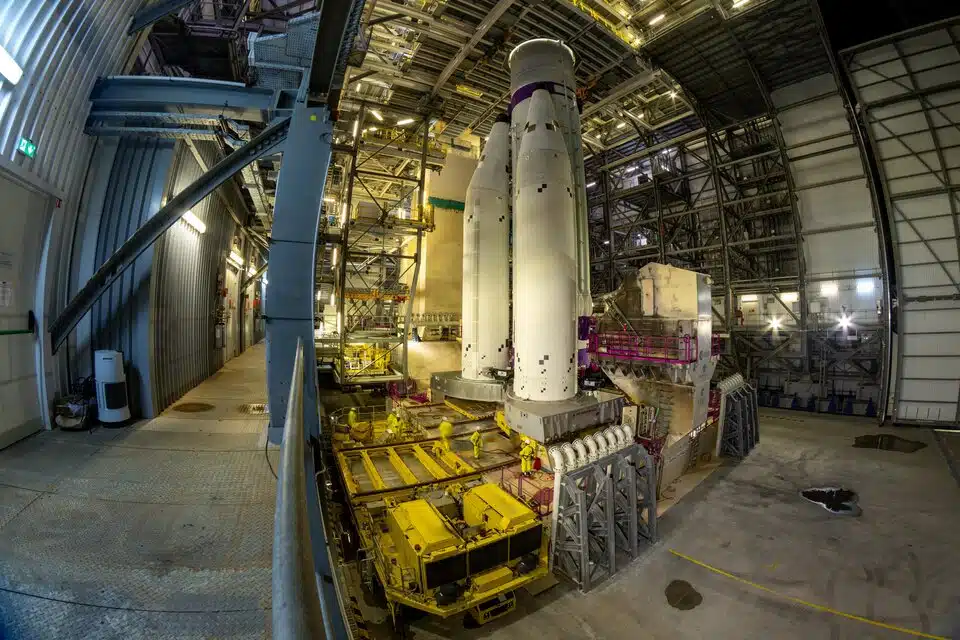 Technicians prepare Ariane 6 for flight VA267. Credit: ESA
ESA officials describe this flight as a validation step rather than a routine launch. Every phase of the mission will be closely monitored to confirm propulsion behavior, structural loads, and guidance performance under maximum stress conditions. The launcher’s modular design allows operators to tailor missions while relying on a common core stage and upper stage architecture. This flexibility stands at the center of Ariane 6’s long-term operational model.
In this context, ESA emphasized the broader meaning of the mission, stating:
“This flight will demonstrate Ariane 6 in its most powerful version. For the development of Ariane 6, the European Space Agency works with an industrial network in 13 European countries, led by prime contractor and design authority ArianeGroup.”
The statement underlines the scale of cooperation required to bring the launcher to flight readiness.
An Industrial Effort Spanning Thirteen European Countries
Ariane 6 is not the product of a single nation or company. Its development relies on a coordinated industrial network spread across 13 European countries, integrating expertise in propulsion, avionics, structures, and launch operations.
Each booster, stage, and subsystem reflects years of shared engineering standards and testing campaigns. The goal is to combine industrial efficiency with technical reliability, two priorities that shaped the program from its earliest design phases.
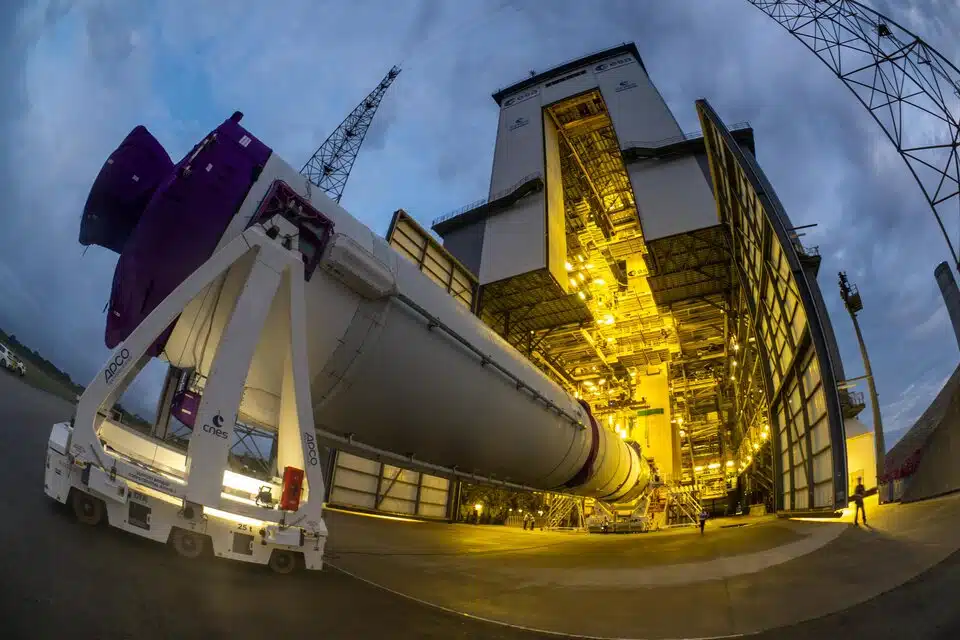 Ariane 6 central core for flight VA267 arrives at its launch pad. Credit: ESA
ArianeGroup, acting as prime contractor and design authority, coordinates this network to ensure consistency across suppliers and production lines. This structure is intended to support a steady launch cadence once Ariane 6 enters full operational service.
The four-booster configuration adds complexity, particularly in terms of synchronization and mechanical loads during ascent. Engineers have conducted extensive ground tests and simulations to anticipate these conditions.
According to ESA, the data collected during this flight will feed directly into certification activities and future mission planning. The agency identifies this launch as a reference case for high-performance missions.
The technical findings referenced in this section are based on analyses and program documentation published by ESA, which acts as the source of the study underpinning the launcher’s qualification strategy.
Strategic Stakes For Europe’s Independent Access To Space
Beyond its technical objectives, the four-booster Ariane 6 flight carries strategic weight. Europe seeks to maintain autonomous access to space amid increasing global competition and evolving launch markets.
Ariane 6 was conceived to address both institutional requirements and commercial realities, balancing cost control with mission versatility. Demonstrating its most powerful version is a signal of confidence in that balance.
For institutional missions, the heavy configuration expands options for launching large satellites without relying on non-European providers. For commercial operators, it offers a European alternative capable of handling complex payloads.
ESA views this flight as part of a broader transition phase, where Ariane 6 gradually assumes the role previously held by Ariane 5. Operational feedback from early missions will shape future upgrades and procedures.
The four-booster launch also serves as a benchmark for reliability, a key factor for customers planning long-term launch contracts.
As Europe watches the countdown approach, the mission stands as a test of engineering coordination, industrial cohesion, and strategic intent in space transportation.