
Physicists have put thousands of atoms into a “Schrödinger’s cat” state — smashing the record for the most macroscopic object to be observed in a quantum state.
In a new study, researchers observed nanoparticles of 7,000 sodium atoms acting as a cohesive wave, pushing the strange world of quantum mechanics to new limits. Building on this research, future experiments could finally put biological molecules into a quantum state, opening up new ways to investigate their physical properties.
You may like
Both here and there
In the quantum realm, particles can be both here and there. This strange phenomenon is known as quantum superposition.
The quantum physicist Erwin Schrödinger likened this to placing a cat in a sealed box with a vial of poison that is set to be released when a radioactive source decays, meaning the cat could be killed at any moment after the box has been sealed. This puts the cat into a superposition of being both dead and alive. It is only if the box is opened and the cat is observed that the superposition collapses and the cat is defined as either dead or alive.
Incredibly, this is how particles behave at the quantum scale; they are in multiple places at once and act as both a particle and a wave until they are observed.
This bizarre world raises a question: Where is the boundary between the quantum world and the one we observe every day? At what point does a particle start acting like a wave?
The reason we don’t see quantum superposition all around us is because of a process called decoherence. If something in a quantum superposition interacts with its environment, it will decohere and no longer be both here and there; instead, it will be forced into one place. Larger objects are constantly interacting with their environment, so they can’t maintain a quantum superposition. So the real challenge when trying to observe larger particles acting as a wave is to isolate them so they can stay in a coherent quantum superposition.
Searching for interference
For the new study, Pedalino attempted to observe the large nanoparticles of sodium in a quantum superposition. To do this, he and his team converted a few grams of sodium into a beam of nanoparticles, which he then aimed at a narrow slit.
You may like
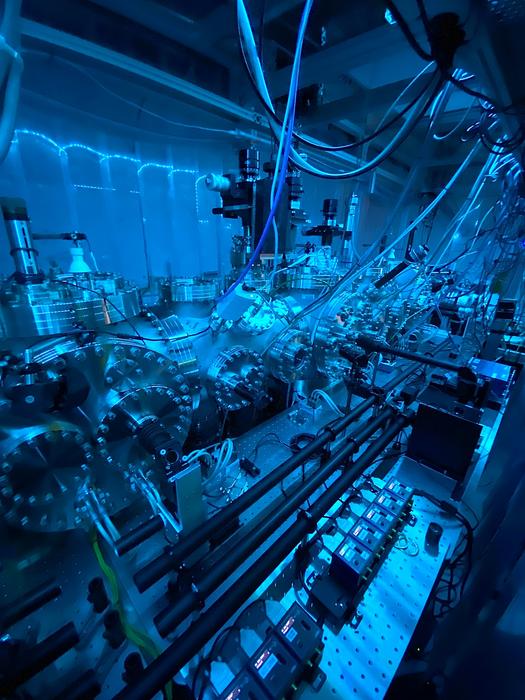
Multi-Scale Cluster Interference Experiment (MUSCLE) at the University of Vienna, where quantum interference of massive nanoparticles was detected. (Image credit: S. Pedalino / Uni Wien)
If the sodium nanoparticle was in a quantum superposition, this would mean that it spread out like a wave after passing through the slit. This would then produce an interference pattern. However, if it decohered and started acting like a normal particle, the sodium would pass straight through the slit and the team would see a flat line.
“For two years, I was looking at flat lines,” Pedalino said. “We were trying to see the interference pattern, but we had flat lines. And in the end, the flat line is not really helpful, as it is inconclusive.”
Finally, the single line they had been seeing on the detector widened and became the unmistakable interference pattern that meant the sodium nanoparticles were behaving as both particles and waves.
“That moment was unbelievable,” Pedalino said. “It was already late in the night, and I called my professor. And he came back to the lab, and we took measurements until 3 a.m., when we ran out of the sodium.”
The team determined the “macroscopicity” — a quantity that describes how much a quantum object pushes into the classical world — of the sodium nanoparticles to be 15.5, beating the previous record for macroscopicity by an order of magnitude.
This discovery opens the door for future experiments where scientists could feasibly observe biological materials, such as a virus or proteins, in a quantum superposition. The experiment represents a major step forward and brings this strange quantum phenomenon tantalizingly close to the real world.