
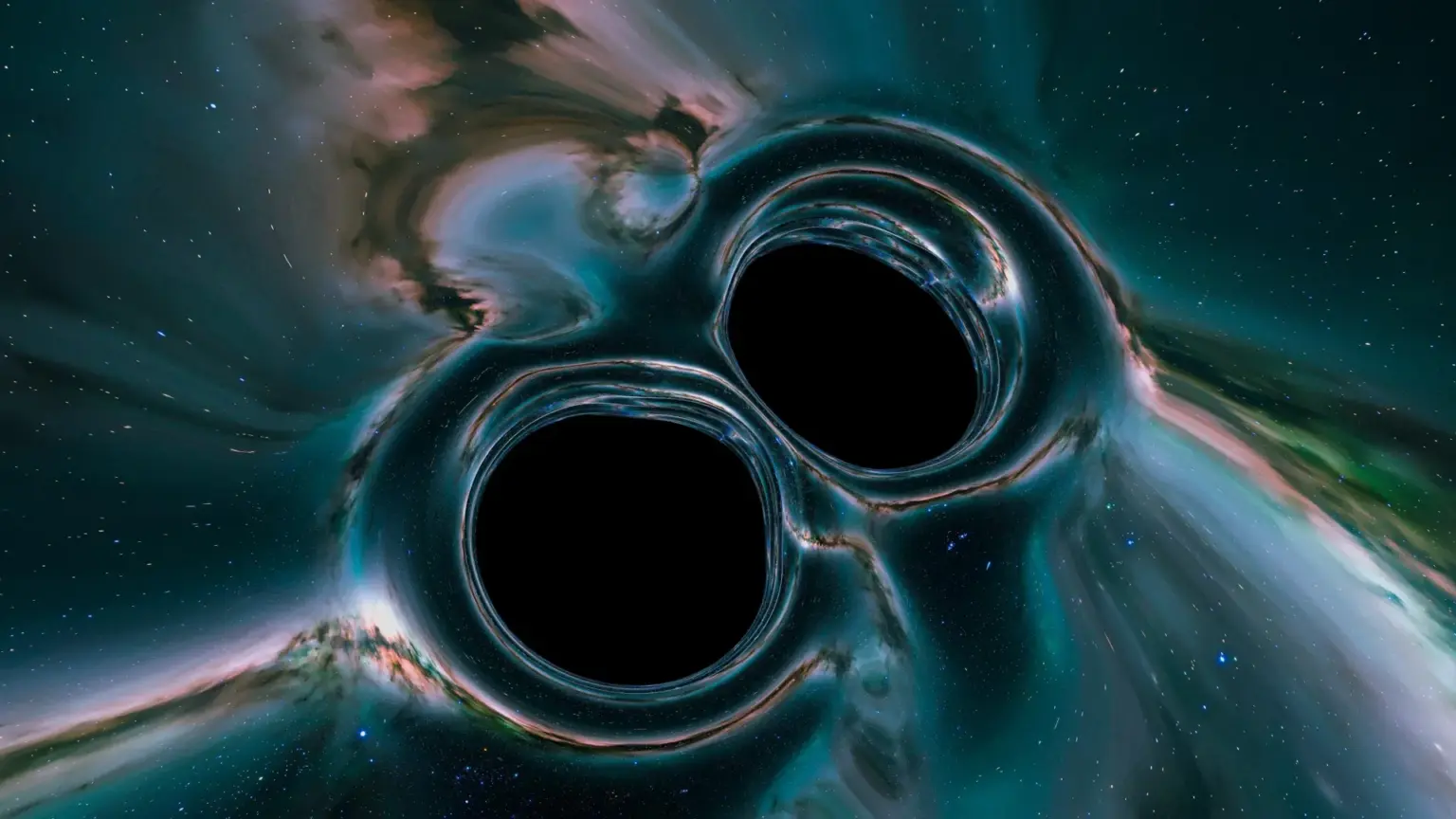
For scientists who track faint ripples traveling through the cosmos, GW250114 stands out. It is the clearest gravitational wave signal ever recorded from a pair of merging black holes, giving researchers an unusually sharp tool for testing Albert Einstein’s theory of gravity, called general relativity.
“What’s fantastic is the event is pretty much identical to the first one we observed 10 years ago, GW150914. The reason it’s so much clearer is purely because our detectors have become much more accurate in the past 10 years,” said Cornell physicist Keefe Mitman, a NASA Hubble Postdoctoral Fellow at the Cornell Center for Astrophysics and Planetary Science in the College of Arts and Sciences.
A Global Effort to Study Black Hole Collisions
Mitman is a co-author of the study examining this signal, titled “Black Hole Spectroscopy and Tests of General Relativity with GW250114,” which was published in Physical Review Letters on Jan. 29. The paper was produced by the LIGO Scientific Collaboration along with the Virgo Collaboration in Italy and the KAGRA Collaboration in Japan. Cornell scientists have played major roles in the LIGO-VIRGO-KAGRA project since it began in the early 1990s.
The gravitational wave known as GW250114 was created when two black holes collided, sending ripples through space-time. That signal reached the U.S.-based Laser Interferometer Gravitational-Wave Observatories (LIGO) on Jan. 14, 2025. Each gravitational wave is named for the date it is detected, and the LIGO-VIRGO-KAGRA team publicly announced this one in September 2025. According to the analysis by Mitman and his colleagues, the signal behaves exactly as general relativity predicts. At the same time, researchers believe not every black hole merger will follow Einstein’s rules so closely, which could open new doors in fundamental physics.
How Black Holes Reveal Their Secrets
When two black holes merge, the newly formed object vibrates, much like a struck bell. These vibrations produce distinct tones defined by two measurements, Mitman explained: an oscillation frequency and a damping time. Measuring a single tone allows scientists to calculate the mass and spin of the final black hole. Detecting two or more tones makes it possible to perform multiple, independent checks of those same properties, as predicted by general relativity.
“If those two measurements agree with one another, you are effectively verifying general relativity,” Mitman said. “But if you measure two tones that don’t match up with the same mass and spin combination, you can start to probe how much you’ve deviated away from general relativity’s predictions.”
In the case of GW250114, the signal was clear enough for scientists to measure two tones and place limits on a third. All of those results matched Einstein’s theory.
Searching for Cracks in Einstein’s Theory
What if the measurements had disagreed?
“Then we would have had a lot of work to do as physicists to try to explain what’s going on and what the true theory of gravity would be in our Universe,” Mitman said. He and his collaborators think it is possible that future gravitational wave signals will not fully align with general relativity, offering clues to long-standing mysteries.
Physicists already suspect that general relativity cannot be the final word on gravity. As Mitman noted, the theory does not explain phenomena such as dark energy and dark matter, and it fails when scientists try to reconcile it with the laws that govern the quantum world.
“There has to be some way to resolve this paradox to make our theory of gravity consistent with our theory of quantum mechanics,” Mitman said. “Along those lines, we expect there to be some deviation from Einstein’s classical prediction, where you might see signatures of quantum gravity imprinting themselves on these gravitational wave signals.
“The hope is that we’ll see these deviations one day and that will help guide us along what the true theory of quantum gravity might be.”