
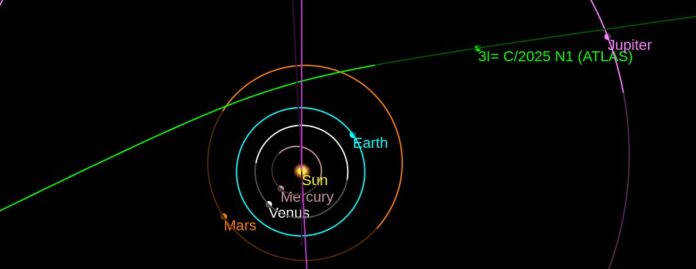
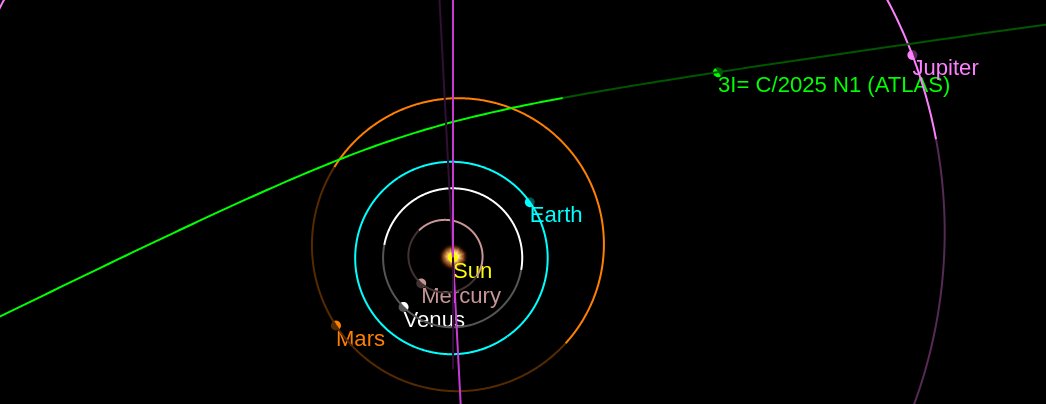
 Orbital trajectory diagram showing the interstellar object 3I/ATLAS (C/2025 N1) as it passes through the inner solar system and continues toward Jupiter, illustrating its steep, non-native path relative to the planetary orbits of Mercury, Venus, Earth, and Mars. The geometry highlights the object’s interstellar origin and its upcoming interaction with Jupiter’s powerful gravitational field. (Image credit: Public-domain orbital visualization; annotation for editorial and illustrative purposes under fair use, 17 U.S.C. §107.)
KEY FINDINGS
Interstellar object 3I/ATLAS is not done surprising scientists, and its most consequential moment may still lie ahead.
As the object approaches Jupiter’s immense gravitational field, researchers are closely watching for signs of structural stress that could alter 3I/ATLAS permanently.
If that happens, the solar system may receive its first unobstructed look inside a visitor that formed around another star.
Scientists say the object’s massive size and hardened outer shell make its upcoming passage a rare opportunity to glimpse what lies beneath
[USA HERALD] – Astronomers tracking interstellar object 3I/ATLAS are increasingly focused on its upcoming interaction with Jupiter, a gravitational encounter that could mark a turning point in humanity’s understanding of the object’s true nature.
Publicly available orbital modeling indicates that 3I/ATLAS will pass close enough to Jupiter for the planet’s enormous gravity to exert measurable tidal forces on the object. While such encounters are common for smaller comets, 3I/ATLAS is anything but typical.
Based on brightness measurements and assumed reflectivity, scientists estimate the object to be roughly 2.6 kilometers in diameter, with uncertainty margins that still place it among the largest interstellar objects ever observed. That scale makes it comparable in size to downtown San Francisco—far larger than the fragile, loosely bound comets that routinely fragment near planets or the Sun.
Yet despite its size and repeated exposure to solar heating, 3I/ATLAS has shown signs of an unusually resilient outer shell. Early observations revealed delayed volatile release, including methane and other organic molecules that only became detectable after the object passed closer to the Sun. This pattern suggests that hyper-volatile materials were not present near the surface, but instead trapped beneath an insulating outer layer.
That hardened exterior has become one of the central mysteries surrounding 3I/ATLAS.
According to planetary scientists, Jupiter’s gravity could change that. As the object enters the planet’s gravitational sphere of influence, differential forces may induce internal stress, particularly if the object is layered or contains voids beneath its surface. In some scenarios, those forces can produce fractures, expose deeper material, or alter rotation in ways that trigger new and unexpected outgassing.
None of this requires catastrophe. Even minor cracking or surface shedding could provide unprecedented insight into the object’s interior composition.
If 3I/ATLAS truly possesses a shell-like outer layer—whether formed through cosmic radiation processing, extreme age, or repeated stellar encounters—Jupiter’s gravity may act as a natural probe, revealing material that has been sealed away since before the solar system existed.
That possibility has heightened interest in the object’s internal structure. Scientists have not ruled out the presence of complex organics, volatile reservoirs, or chemically distinct layers that differ significantly from surface observations. The scale of the object alone means that its interior could preserve environments shielded from radiation for millions or even billions of years.
In planetary science, size matters. A body as large as 3I/ATLAS is not a simple snowball. Its mass allows it to retain heat longer, resist complete devolatilization, and potentially preserve internal complexity that smaller interstellar fragments could not.
ANALYSIS AND CONTEXT
The upcoming Jupiter encounter underscores a broader shift in how scientists approach interstellar objects. Rather than treating them as curiosities to be quickly classified, researchers are beginning to recognize them as archives—records of other planetary systems that may contain structures and materials unfamiliar to solar-system science.
The idea that 3I/ATLAS could conceal a radically different interior is not speculative fantasy; it is a direct consequence of physics, scale, and observed behavior. Layered bodies, rubble piles with hardened crusts, and chemically stratified interiors are all well-documented within our own solar system.
What makes 3I/ATLAS extraordinary is that it formed elsewhere.
If Jupiter’s gravity exposes interior material, the resulting data could recalibrate assumptions about interstellar object survival, planetary system formation, and the range of environments capable of preserving complex chemistry across interstellar distances.
As 3I/ATLAS moves toward its encounter with Jupiter, scientists are not waiting for spectacle, but for evidence. Whether the object cracks open or merely whispers clues through subtle changes, the moment represents a rare chance to look inside a traveler from another star—and to confront how little we truly know about what interstellar space may deliver next.