
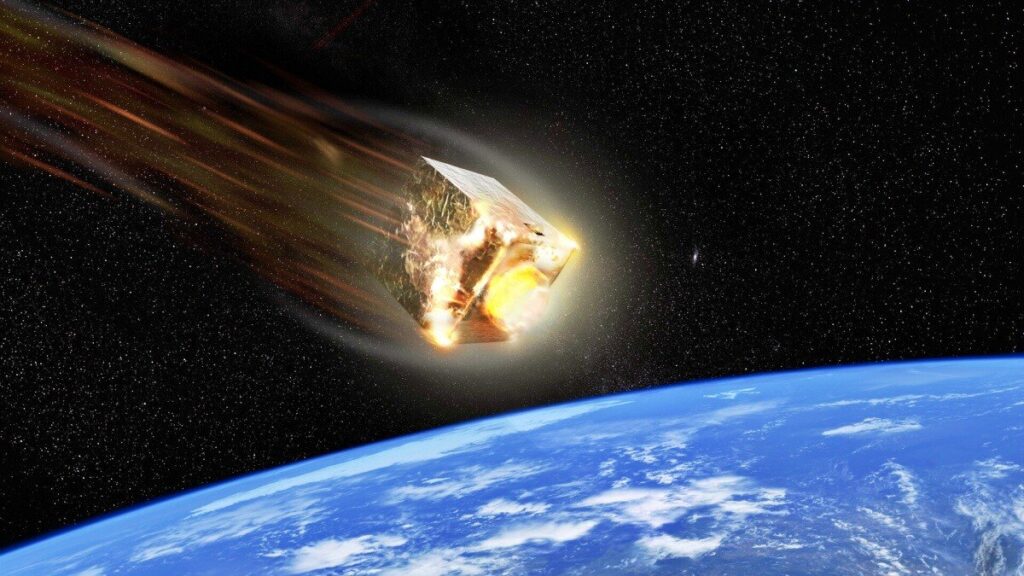
The European Space Agency (ESA) is gearing up for a bold experiment: intentionally crashing a small satellite called Draco into Earth’s atmosphere.
Roughly the size of a washing machine and weighing 150-200 kg, Draco will launch in 2027 on a suicide mission lasting just 12 hours, providing unprecedented data on satellite reentries amid rising space debris concerns.
CRASHING A SATELLITE
Over 70 years of spaceflight, nearly 10,000 intact satellites and rocket bodies have plunged back to Earth, yet their final moments remain poorly understood.
Draco, developed by Deimos under a €3 million ESA contract, addresses this gap. An indestructible 40 cm capsule packed with 200 sensors and four cameras will endure the inferno, measuring temperatures, structural strain, and atmospheric pressure as the satellite disintegrates.
“Reentry science is essential for our design-for-demise efforts,” says Holger Krag, ESA’s Head of Space Safety.
WHY IS EUROPE CRASHING A SATELLITE INTENTIONALLY?
The reason for the suicide mission is to better understand the satellite its fiery destruction from within as it enters Earth’s thick atmosphere.
The mission will validate models predicting how satellites burn up, ensuring they produce minimal debris. Unlike ground tests or wind tunnels, Draco mimics uncontrolled reentries, most common in orbit, where atmospheric drag rips craft apart at hypersonic speeds.
ESA’s Zero Debris approach aims to halt new space junk by 2030.
Satellites must either de-orbit swiftly post-mission or “design for demise,” fully vaporising on re-entry. Draco builds on past efforts, like the 2013 ATV cargo ship’s internal camera, but collects far richer telemetry: real-time footage, plasma dynamics, and material ablation.
Launched to a low 1,000 km orbit, Draco will passively spiral down over an uninhabited ocean zone. As it shreds, the capsule—tethered like an octopus to fraying sensors, stores data.
Post-breakup, a parachute deploys regardless of spin, linking to geostationary satellites for a 20-minute data dump before splashdown.
WHY IT’S A BIG DEAL?
Beyond debris, Draco probes reentry’s environmental toll: how vaporised metals and alloys seed the upper atmosphere, potentially altering chemistry as launch rates soar. Insights will guide sustainable designs, reducing by-products like aluminium oxides.
Project manager Stijn Lemmens notes virtual models need real calibration, Draco breaks the “chicken-and-egg” loop. Tim Flohrer, ESA Space Debris Office head, hails it as a game-changer for zero-debris tech.
This fast-track Space Safety mission underscores Europe’s push for cleaner orbits, turning a controlled crash into a leap for planetary stewardship.
– Ends
Published By:
Sibu Kumar Tripathi
Published On:
Feb 3, 2026