
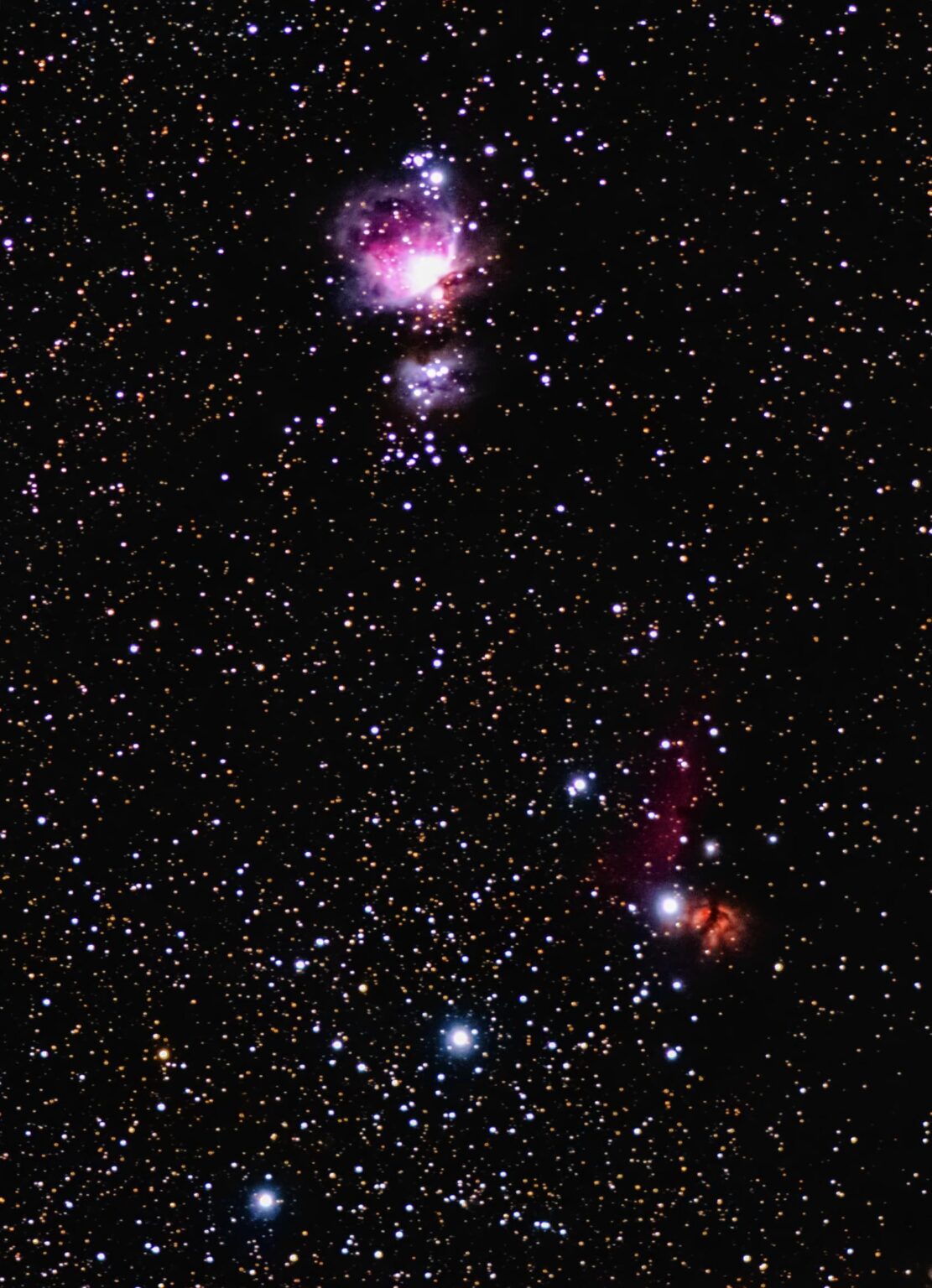
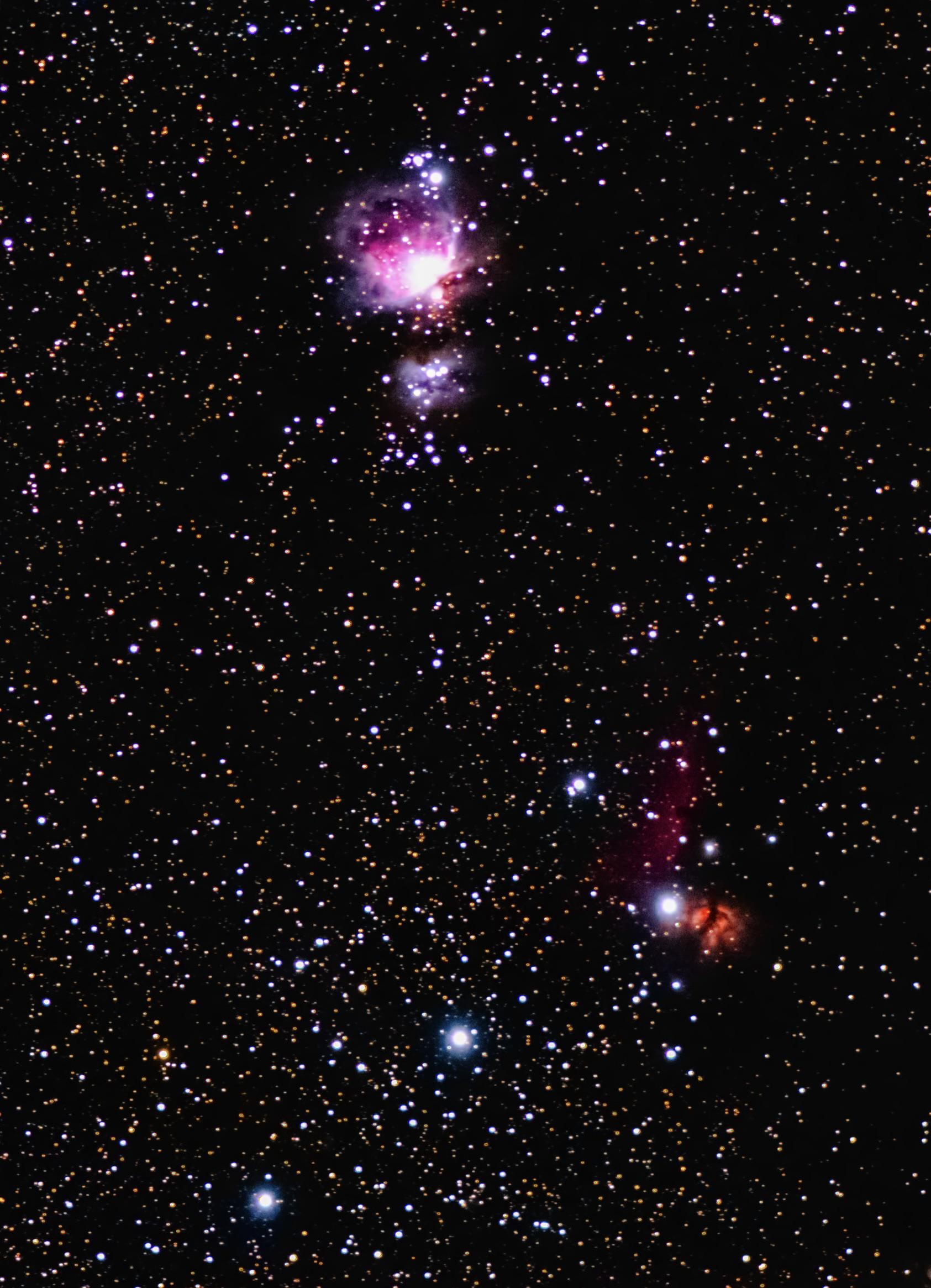
My imaging of Orion has definitely gotten better, but i still think there is something not quite right, it looks a little noisey and unclear and i’m not sure if it’s my camera, the fact i’m not using a star tracker, or potienally just my editing, but if anyone has any idea what i could do to improve my images please let me know!
Taken with a Nikon D90 with a nikon 105mm f/2.8 lens
untracked
a total of 1150 photos stacked with deep sky stacker
3 second exposure
1250 iso
edited with siril and photoshop
by Good_Fishing8089
3 Comments
When doing untracked, the source of noise you should be most concerned with is the read noise. It looks like you should/could increase your ISO to reduce the read noise. You’ll want the lowest ISO where the line “flattens out”, see here: https://www.photonstophotos.net/Charts/RN_e.htm
Also, it looks like you may be having a little bit of star trailing, so you may want to lower your exposure time from 3 seconds. I know the “500 rule” says you should be ok at your focal length, but that’s a bit outdated and I see some seemingly oval stars.
Overall though, looking good!
Edit: well, I learned something new since this didn’t apply to my DSLR… for the Nikon D90, higher ISO (2100+) is outside the analog range (meaning the light signals are digitally processed rather than a native and direct processing of the light reaching the sensor) and also the RAW files will have some noise reduction applied by the camera.
https://www.dpreview.com/forums/threads/photons-to-photo-doubt.4532128/
https://www.dpreview.com/forums/threads/iso-dynamic-range-noise-reduction-and-scaling.4810202/
It may be worth experimenting to see what happens at various ISO, but you’ll want to keep the lowest ISO that you’re fine with the noise level from in order to keep the highest dynamic range. (I.e., higher ISO = lower dynamic range)
As always, more exposure time (either greater number and/or longer) will always give a better signal-to-noise ratio and make the image less noisy.
A tip I found to avoid quite so crunchy edges to nebulae is to now lower the background quite to black, as I found that can make noise more obvious
If you feel comfortable sharing your data, I would be happy to process it myself and share my workflow/steps with you. Sometimes it’s hard to tell how much detail is hidden in an image! Feel free to dm me 🙂