
TOLEDO, Ohio (WTVG) – A comet is a ball of ice and rock and is a leftover fragment from the formation of the solar system. Comets generally live very far away from the Earth, but occasionally they will get knocked into our inner solar system.
Michael Cushing is the Director of the Ritter Planetarium and Brooks Observatory at the University of Toledo. He explains the scientific process of the characteristics of a comet,
“The heat from the sun will start to turn the ice into water vapor. And when this happens, the water vapor comes off the comet, and it drags off some of the dust that goes with it. And that’s what develops those beautiful tails from the comets,” Cushing said.
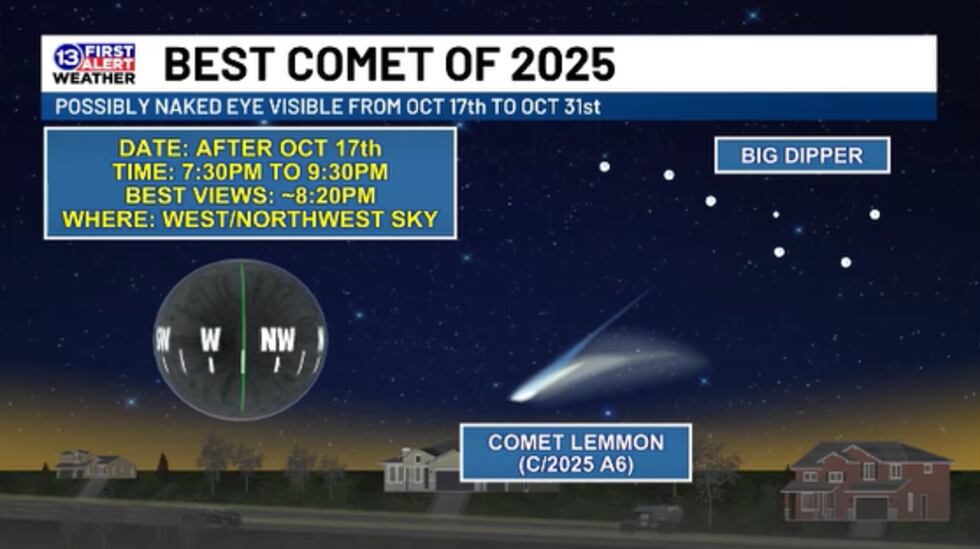
Going into the end of October, there are two different comets that have the potential to be viewed with the naked eye. The first is Comet Lemmon.
“Comet Lemmon will be visible for the next two weeks or so, with the best chance of seeing it towards the end of the month, kind of coming up on Halloween […] You are going to want to look in the west-northwest sky. It’s relatively low on the horizon, so you are going to need a clear view,” Cushing said.
 wtvg(wtvg)
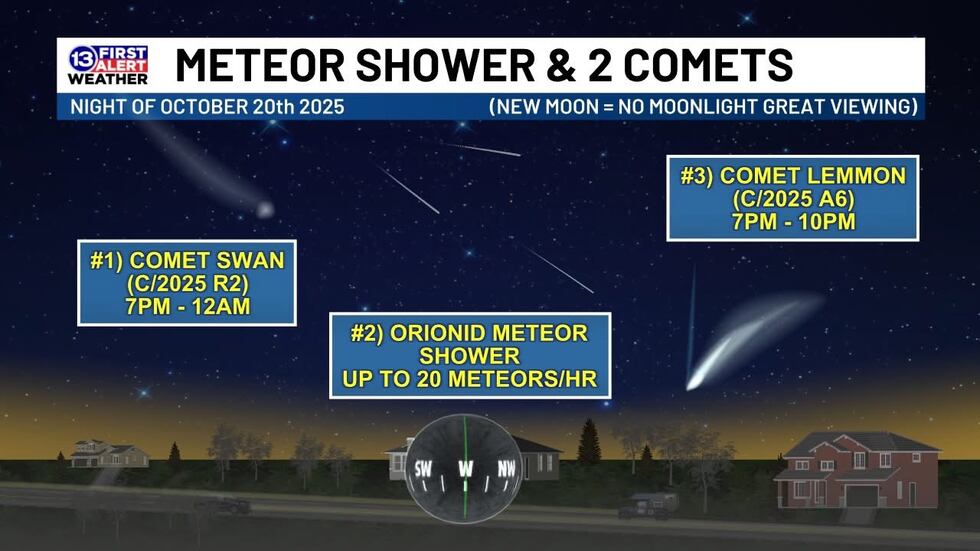
Comet Lemmon will be visible just after sunset and set around 10 p.m. The second comet is Comet Swan. This one will be out for a little longer, but might not be as bright.
“Comet Swan is predicted to be best visible, sort of, between Oct. 18 and the 21st […] Comet Swan in principle could be easier to see because it is going to be higher in the sky […] it will set somewhere around midnight, so you have to go out somewhere between sunset and midnight,” Cushing said.
 wtvg(wtvg)
A dark location away from city lights will be the best way to view these two comets. A stargazing app can help navigate the night sky and locate these two comets, and binoculars could be used to catch a better view.
Latest Local News | First Alert Weather | Crime | National | 13abc Originals
Copyright 2025 WTVG. All rights reserved.