
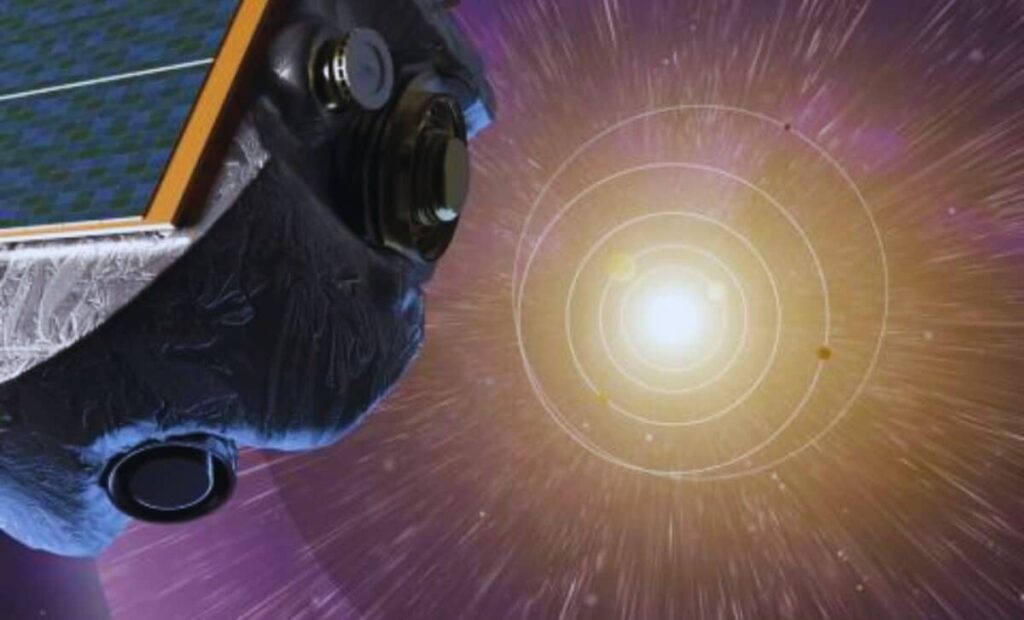
A NASA spacecraft has just reached its permanent observation point to begin a mission unlike any before. Known as IMAP, the Interstellar Mapping and Acceleration Probe will track invisible particles that emerge where our Solar System ends and interstellar space begins. It may soon reveal the first accurate map of that boundary.
Though it launched in September 2025, IMAP has only recently arrived at its operational position near Earth. From this spot, it will study how solar wind interacts with matter from outside our Solar System, offering insight into the heliosphere, the vast bubble surrounding our star where solar particles dominate. What lies beyond remains mostly uncharted, and IMAP is built to change that.
The Perfect Spot To Watch The Solar System End
For decades, scientists have tried to define where the Solar System ends, but only Voyager 1 and Voyager 2 have actually crossed that threshold. These aging spacecraft recorded the passage through the heliopause, where the solar wind slows and collides with the interstellar medium.
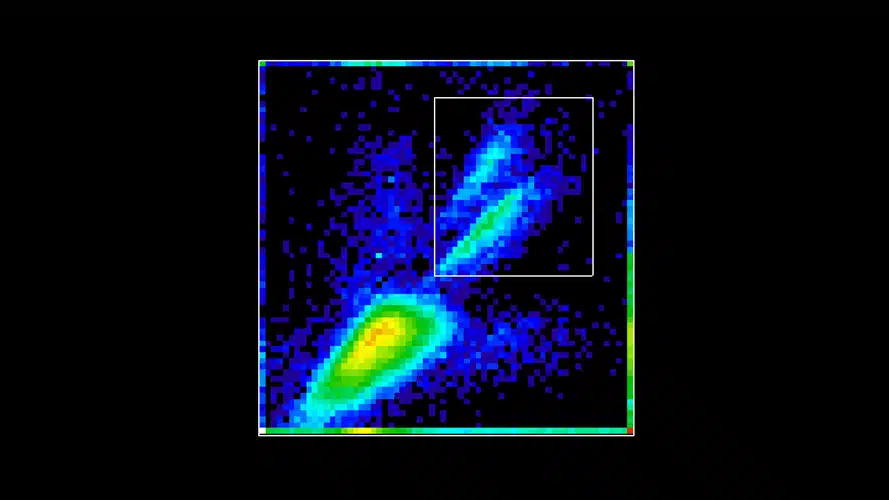 First-light image from NASA’s IMAP mission, capturing energetic neutral atoms (ENAs) from the edge of the heliosphere. Credit: NASA
Unlike the Voyager spacecraft, IMAP will not travel to the edge of the Solar System. Instead, it has settled into orbit around Lagrange Point 1, or L1, located roughly 1.5 million kilometers from Earth in the direction of the Sun. This position allows the spacecraft to maintain a stable view of both the Sun and the broader heliosphere. As reported in NASA’s IMAP mission statement, this location was chosen specifically because it offers a constant vantage point for observing incoming particles from all directions.
At this location, IMAP is designed to detect energetic neutral atoms (ENAs) created when fast-moving particles from the Sun crash into slower particles drifting in from interstellar space. These ENAs carry information about where they originated, effectively allowing scientists to trace back the conditions at the heliopause and surrounding regions. The spacecraft has a 360-degree field of view, enabling it to create a full-sky image over time.
IMAP Kicks Off with Powerful First Signals
Although the mission doesn’t officially start until February 1, IMAP’s team has already begun analyzing preliminary readings. During commissioning, all ten scientific instruments were activated and tested, and the early results have impressed mission leaders. As explained by David McComas, principal investigator and professor at Princeton University:
“It’s just astounding that within the first couple weeks of observations, we see such clear and consistent ENA data across the factor of 10,000 in energy covered collectively by the three imagers.”
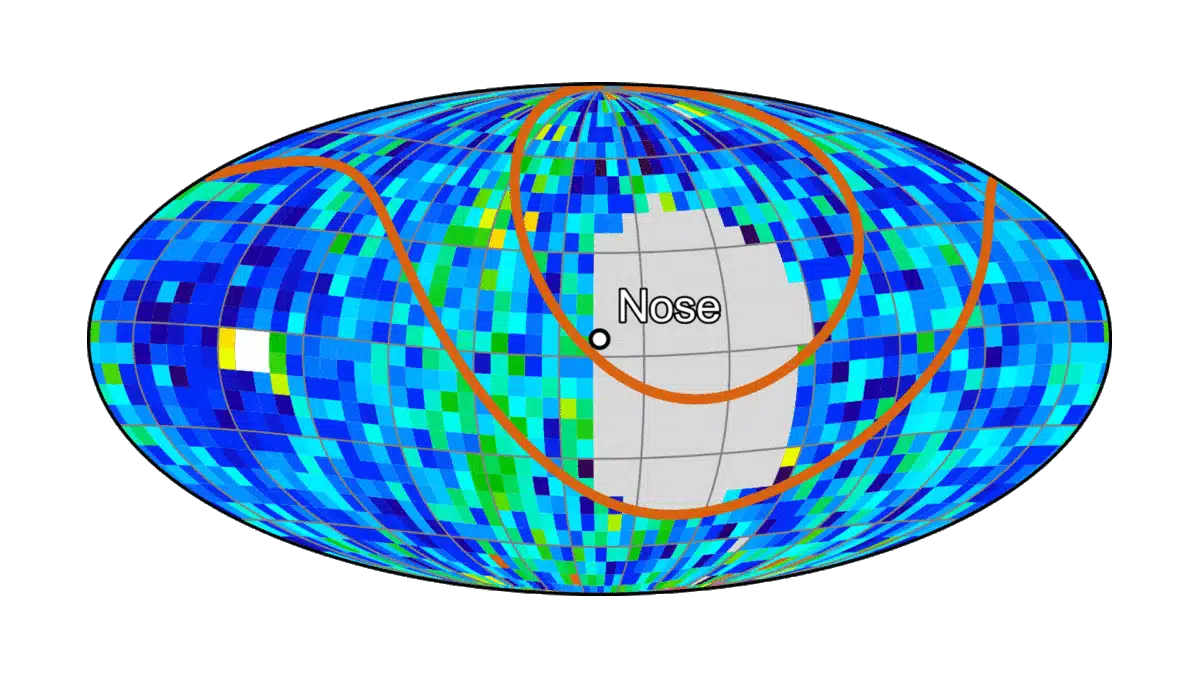 All-sky map generated from early IMAP data, showing the distribution of energetic neutral atoms (ENAs) across the heliosphere. Credit: NASA
Each instrument onboard IMAP serves a different purpose, but collectively they provide overlapping measurements of incoming neutral atoms and solar radiation. According to NASA:
“This, plus excellent first light data from all seven of the other instruments, makes for a 10 out of 10, A-plus start to the mission.”
Filling The Gap Left By Voyager
Voyager 1 and 2 remain the only human-made objects to leave the heliosphere and enter interstellar space. They provided point-based measurements as they passed through the boundary, offering a narrow glimpse into the structure of the heliopause. But these missions were never designed to map the entire edge or track how it changes. IMAP, in contrast, is specifically built to provide an all-sky view, capturing data that Voyager could not.
The boundary between the Solar System and interstellar space is not fixed. It shifts with solar activity, expanding and contracting like a balloon. IMAP’s objective is to capture this variability in detail. For now, it stands as the most advanced attempt to visualize the shape, size, and dynamic behavior of the Solar System’s outer edge from a stable orbit near Earth.