
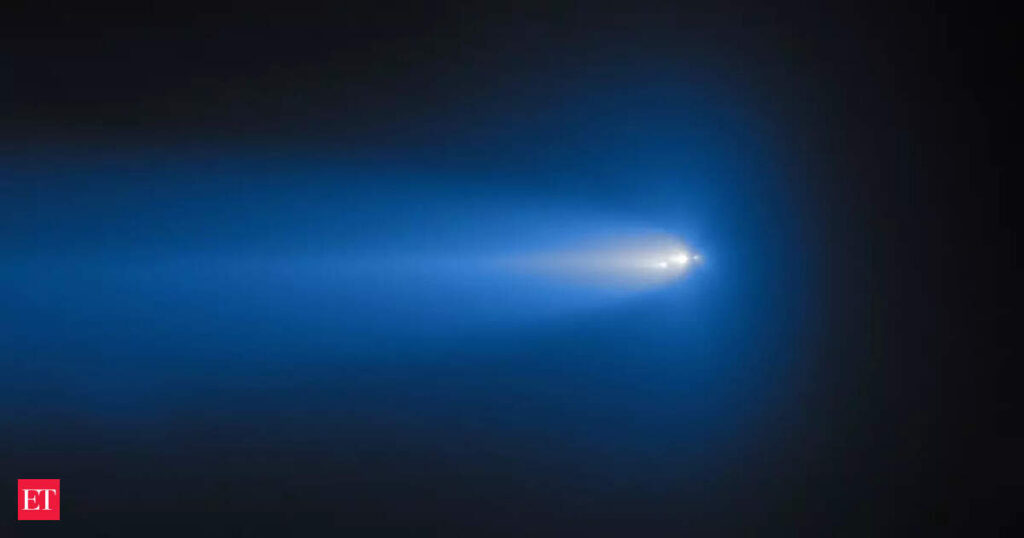
Comets have always kept astronomers on the edge of their seats, especially those studying the early solar system. According to NASA, comets are cosmic snowballs of frozen gases, rock, and dust that orbit the Sun. A powerful telescope in Hawaii has captured one on camera as it fell apart. According to Space.com, in new footage captured by the Gemini North telescope atop Mauna Kea in Hawaii, Comet C/2025 K1 (ATLAS) was seen crumbling. The 8.1-meter diameter optical/infrared telescope caught glowing pieces of the comet. The telescope is part of a twin pair of telescopes at the International Gemini Observatory.
C/2025 K1 (ATLAS) was discovered in May 2025 using the Asteroid Terrestrial-impact Last Alert System (ATLAS). It is a solar system comet that likely was formed in the Oort Cloud, which is a large group of icy bodies past the orbit of Neptune.
What do the new images show?
Pieces of Comet C/2025 K1 tumbling apart were seen in new imagery of the comet, which was released on Thursday, January 29, 2026. The separate pictures were obtained on November 11, 2025, and December 6, 2025. Live Events“On 11 November and 6 December 2025, the Comet C/2025 K1 (ATLAS) soared in the skies above Maunakea, Hawaii, where Gemini North captured it in action!” according to NOIRLab.
Comet C/2025 K1 (ATLAS) crumbled. (Photo Credit: International Gemini Observatory/NOIRLab/NSF/AURA/B. Bolin)
Gemini North is one half of the International Gemini Observatory, supported in part by the U.S. National Science Foundation and operated by NSF NOIRLab. The nucleus of the comet C/2025 K1 (ATLAS) started breaking apart as early as October 2025.
C/2025 K1 (ATLAS) originated in the Oort cloud and survived its closest approach to the Sun in October 2025, according to NOIRLab. Things have changed now. Since it has experienced the intense heat and gravity of the Sun, it has been tough for it to hold together, resulting in crumbling.
The comet broke apart into multiple pieces due to the strong solar gravity and the pressure of the solar wind, or possibly due to any other reason, according to Space.com.
Add  as a Reliable and Trusted News Source