
by Clarence Oxford
Los Angeles CA (SPX) Feb 02, 2026
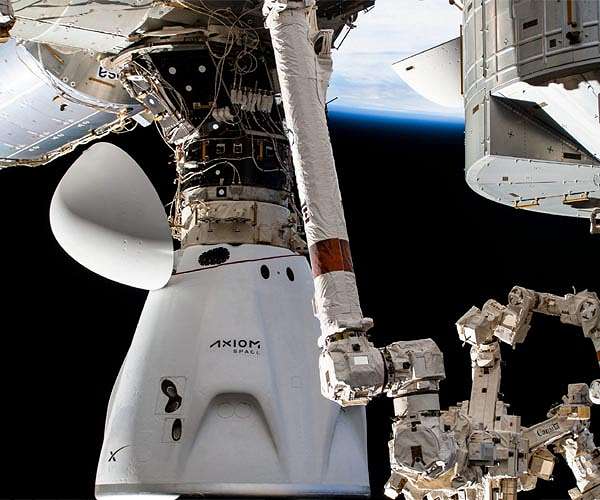
NASA has ordered a fifth private astronaut mission to the International Space Station from Axiom Space, targeting a launch no earlier than January 2027 from the agency’s Kennedy Space Center in Florida. The flight, designated Axiom Mission 5, continues the series of commercially sponsored crewed missions to the orbital laboratory under NASA’s commercial space strategy.
NASA Administrator Jared Isaacman said the new mission underlines that commercial space activity has become a present reality rather than a distant prospect. He added that expanding access and competition in low Earth orbit helps build capabilities that NASA will use as it pushes human exploration outward to the Moon, Mars and beyond.
Axiom Mission 5 is expected to spend up to 14 days aboard the international outpost. The final launch date will depend on overall spacecraft traffic to the station and other operational planning factors, reflecting the need to coordinate visiting vehicles and on-orbit activities.
Dana Weigel, manager of NASA’s International Space Station Program at the Johnson Space Center in Houston, said the station remains a critical platform for enabling commercial industry in low Earth orbit. She noted that private astronaut missions allow the complex to serve as a proving ground for new markets and technologies while also supporting science, research and outreach that contribute to a growing space economy.
Under the mission order, Axiom Space will propose four crew members for review by NASA and its international partners. Once the crew is approved and confirmed, they will undergo joint training with NASA, partner agencies and the launch provider in preparation for the flight and on-orbit operations.
Jonathan Cirtain, president and CEO of Axiom Space, said the company is honored to receive the fifth human spaceflight mission from NASA. He said the four earlier Axiom missions have expanded the global community of human space explorers, diversified scientific investigations in microgravity and yielded insights that support development of the company’s planned commercial Axiom Station.
Cirtain added that the latest mission award reinforces Axiom Space’s commitment to redefining access to space, fostering international collaboration and enabling research opportunities in low Earth orbit for the benefit of a broad set of users. The company intends Axiom Station to succeed the International Space Station as a next generation commercial platform once the current laboratory is retired.
For Axiom Mission 5, Axiom Space will purchase a range of mission services from NASA, including crew consumables, cargo delivery, storage and other in-orbit resources needed for daily operations. In turn, NASA will acquire from Axiom Space the capability to return scientific samples that must remain cold during transit from the station back to Earth, supporting continued research continuity.
NASA selected Axiom Mission 5 from proposals submitted in response to a March 2025 NASA Research Announcement seeking additional private astronaut missions. The agency is also finalizing the mission order for a sixth private astronaut flight to the station and plans to release further details once that agreement is complete.
Private astronaut missions are one element of a broader portfolio of activities on the International Space Station that advance scientific knowledge and test new technologies for future human and robotic exploration. These efforts feed into NASA’s Moon to Mars exploration approach, including lunar missions conducted under the Artemis campaign that will prepare for eventual human journeys to Mars.
NASA’s commercial space strategy aims to transition low Earth orbit services to private providers while the agency concentrates on deep space exploration. The continuing series of Axiom flights forms part of that transition, demonstrating how commercial companies can provide transportation and on-orbit services while government agencies focus on setting requirements and enabling new markets.
Related Links
Commercial Space at NASA
Rocket Science News at Space-Travel.Com