
In the heart of modern-day Turkey, hidden among the jagged limestone outcrops of the ancient Hittite capital Hattusa, lies one of the most enigmatic open-air sanctuaries of the Bronze Age: Yazılıkaya (literally "Inscribed Rock"). While most ancient temples are built of brick and mortar, Yazılıkaya was carved directly into the living rock, creating a series of roofless chambers that some believe functioned as a massive, prehistoric cosmic clock. What makes Yazılıkaya truly "strange" isn't just the artistry; it’s the layout and the cryptic nature of the figures.
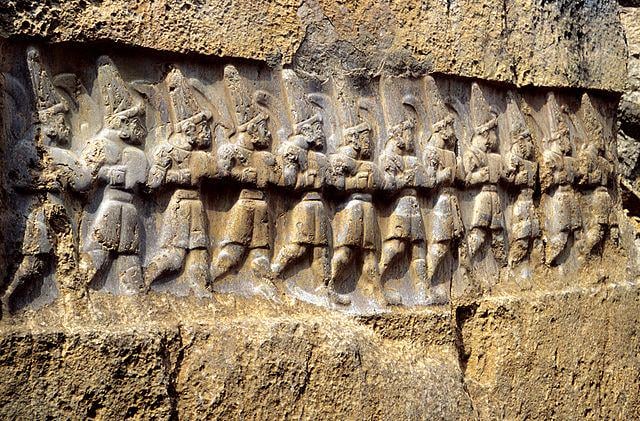
This strangeness is most evident in the "Procession of the Underworld" found in Chamber A and Chamber B, which contain reliefs of 63 deities. The most striking is the procession of 12 identical gods of the underworld, all moving in unison with sickles in their hands. In Chamber B—a narrow, 18-meter-long corridor guarded by lion-headed "demons"—the atmosphere changes completely. This area was filled with earth until the 19th century, preserving some of the most chilling images of the ancient world.
Adding to the enigma is the mystery of the "Sword God" (Nergal), one of the most bizarre carvings in Chamber B. It depicts a colossal sword stuck vertically into the rock, with the hilt formed by four lions and a human head. It’s an image that feels more like something out of a fantasy novel than 13th-century BC history. Why would a civilization obsessed with the "Storm God" (Teshub) and the "Sun Goddess" (Hepat) dedicate such a prominent, eerie space to a deity represented as a weapon thrust into the earth?
This leads many to ask: is this a prehistoric portal or a galactic map? Recent archaeoastronomical research (such as by Eberhard Zangger) suggests the entire sanctuary was a functional lunar-solar calendar. Every figure, every shadow, and every stone served to track the movement of the heavens. But for the paranormal community, the "Green Stone" in the Great Temple nearby and the specific alignment of the 12 gods suggest something deeper. Some claim the site marks a "portal" where the boundary between the underworld and the celestial realms was thinnest.
The way the Hittites used natural light to illuminate specific gods at specific times of the year shows a level of astronomical precision that seems almost impossible for the time. Even today, standing in Chamber B, visitors report a heavy, magnetic stillness that is hard to explain. Was Yazılıkaya just a place for "New Year" celebrations, or was it a high-tech observatory built to commune with what the Hittites called the "Thousands of Gods"?
References for the curious:
- Official Museum Records:Yazılıkaya Open Air Temple – Ministry of Culture
- Digital Archives:Inscribed Rocks of Anatolia – Koç University Library
- Academic Study: Arı, Bülent. "The Court of the Ottoman Sultan" (General context on Hittite continuity).
- Astronomy Theory: Zangger, E., & Gautschy, R. (2019). "Celestial Aspects of Hittite Religion: An Investigation of the Rock Sanctuary Yazılıkaya."
- Image Credit: Klaus-Peter Simon, CC BY 3.0. This relief from Chamber B shows the 12 gods of the underworld I mentioned in the post. Notice the synchronicity of their movement.
by bortakci34