
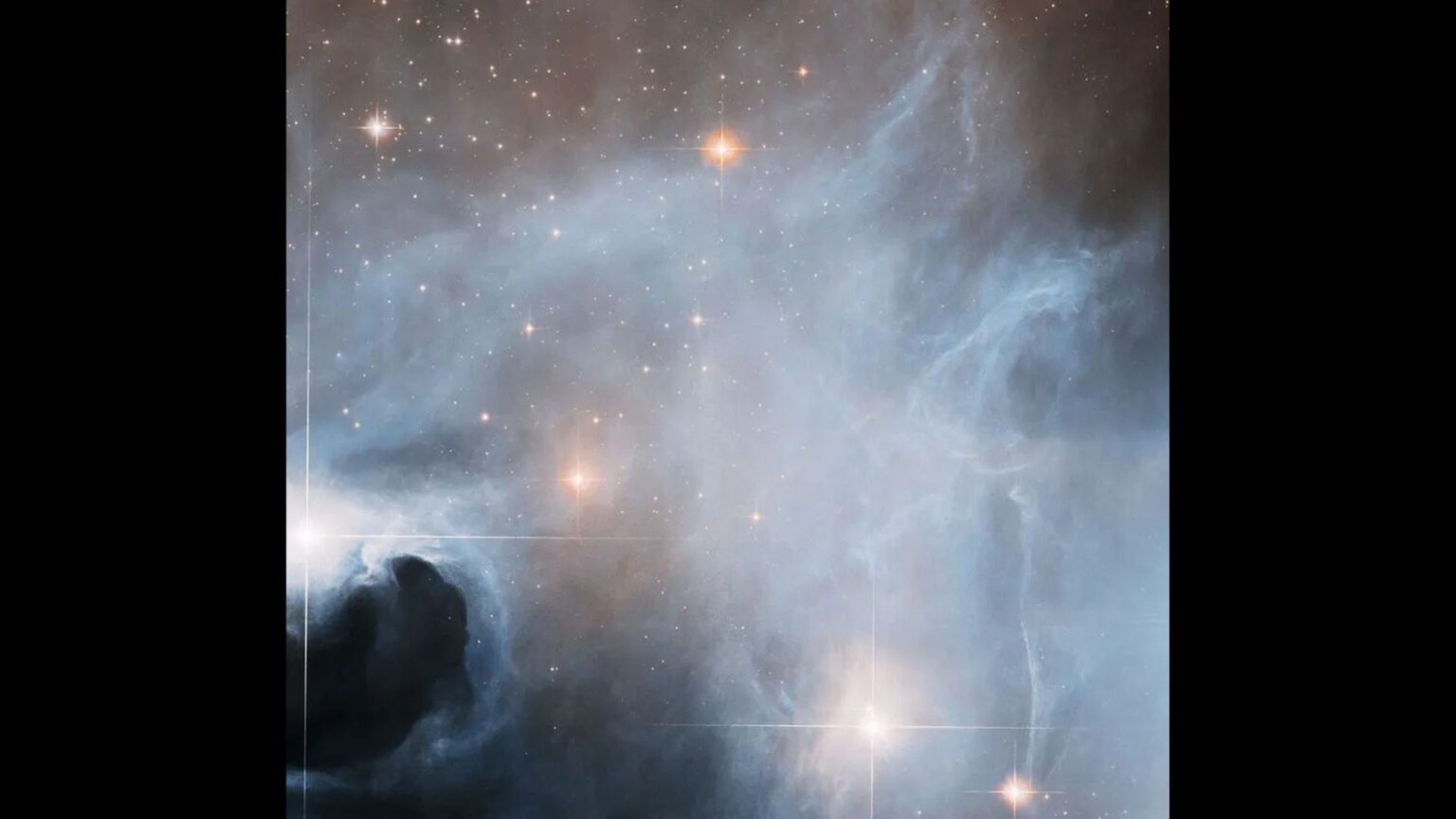
quick facts
What it is: Lupus 3 (GN 16.05.2 and Bernes 149) molecular cloud
Where it is: About 500 light-years away, in the constellation Scorpius
When it was shared: Jan. 26, 2026
A tranquil-looking cloud of gas and dust might not sound like much to get excited about, but it’s home to one of the most fundamental phenomena in astronomy: star formation.
Look carefully at this hauntingly beautiful image of Lupus 3 captured by NASA‘s Hubble Space Telescope. Serene yet full of energy, bluish fingers of gas and dust curl toward a dark dust cloud in the lower-left corner. Those fingers are where young stars of a particular type are born, but they can be spotted throughout the image, chiefly at the center left, bottom right and upper center. Called T Tauri stars, they’re young — less than 10 million years old, so newborns in a cosmic sense — and show dramatic variations in brightness as they grow and evolve.
You may like
T Tauri stars are special. They’re rare to spot in the Milky Way and excite astronomers because they represent the earliest stages of a star’s life, during which they continue contracting under gravitational forces.
They also gradually begin the nuclear fusion process that will define them as stars. But the chaos all around them — from powerful stellar winds to material falling onto the stars — causes the light reaching Hubble’s 7.8-foot (2.4 meters) mirror and Wide Field Camera 3 to fluctuate. T Tauri stars often unleash massive flares and change in brightness over longer periods because giant “sunspots” on their surface rotate in and out of view.
Most of Lupus 3 is dark, with starlight from those T Tauri stars lighting up some of the molecular cloud to create the blue reflection nebula called GN 16.05.2 or Bernes 149. By observing in multiple wavelengths of light, Hubble can pierce through the obscuring dust to see what’s going on inside molecular cloud complexes like Lupus 3, as well as the iconic Orion, Rho Ophiuchi and Taurus molecular cloud complexes, and the Eagle Nebula (M16).
Such images have helped astronomers glimpse processes that are invisible to ground‑based telescopes to refine our models of how stars and planetary systems originate.
For more sublime space images, check out our Space Photo of the Week archives.