
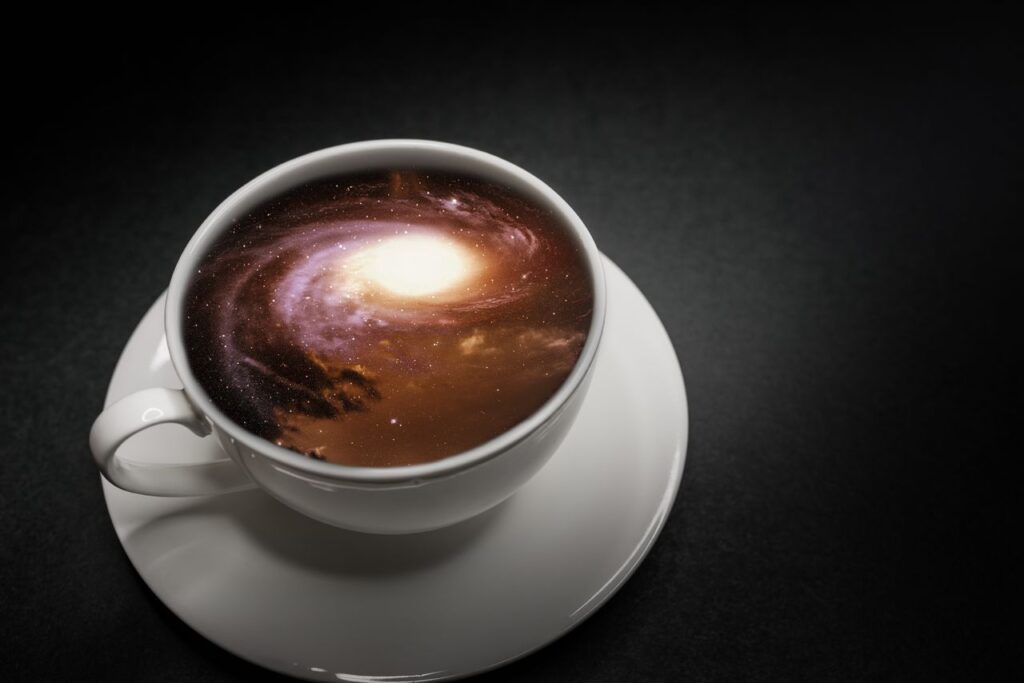
 Most scientists love coffee or a latte – so the Universe matching that colour is a bit of a win.
  Zeus Valtierra Meteored Mexico 31/01/2026 15:00 4 min
The night sky looks black, sure – but that’s just what our eyes get from one direction at a time. Add up the light from huge numbers of galaxies and you get a very different “average” shade.
If you had to guess the Universe’s colour, you’d probably say black, with a scatter of bright white bits – like chocolate sprinkles on a very dark cake. Fair. That’s what it looks like when you glance up from your street and squint at the stars.
But here’s the trick: the sky isn’t “black” as a property of the Universe – it’s black because there isn’t enough light hitting your eyes from every direction at once. So astronomers have asked a slightly nerdier question: if you add up all the visible light from galaxies and average it out, what colour do you actually get?
Adding up all starlight
To do it, researchers working with the 2dF Galaxy Redshift Survey took the light from huge numbers of nearby galaxies and built what’s called a “cosmic spectrum” – basically the blended fingerprint of the Universe’s starlight. In the version described in this article, that meant spectroscopic data from more than 160,000 galaxies, combined to measure the average light output per chunk of space.
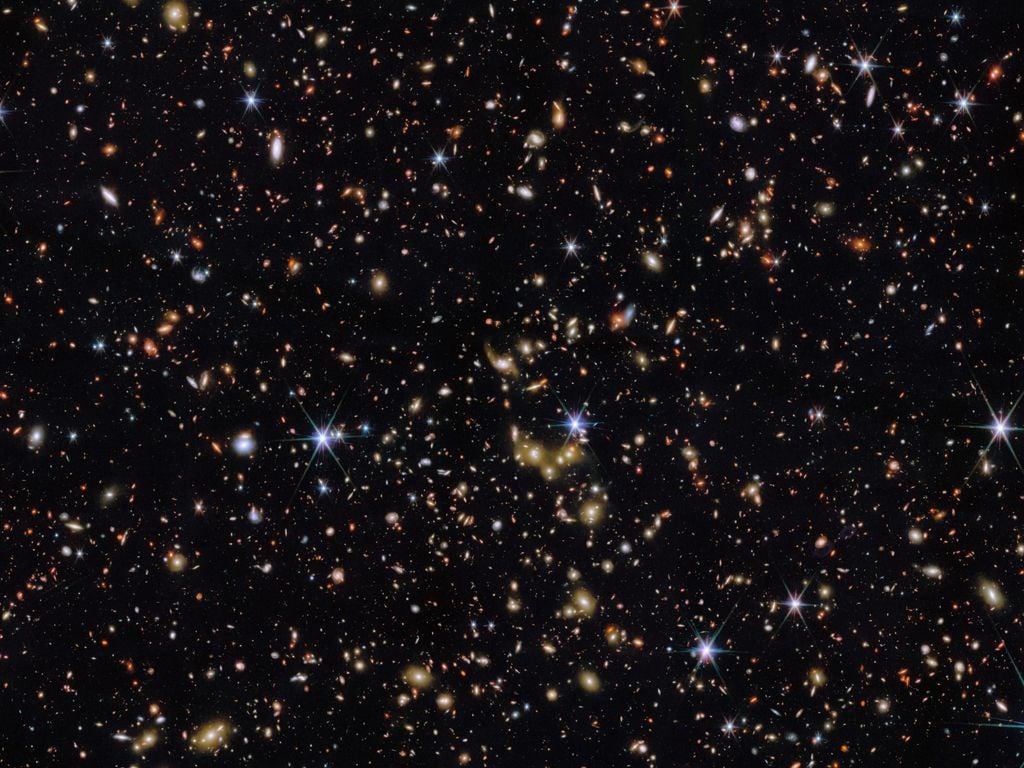 A staggering number of galaxies, from nearby stars to galaxies billions of light-years away. Credit: JWST/NASA/ESA/CSA.
At first, the maths suggested the Universe should look like a faint, pale turquoise. Then the team adjusted their modelling of human colour perception – essentially fixing how “white balance” should work for an average human observer – and the result flipped into something far less sci-fi and far more… coffee shop.
The final shade was a warm, creamy beige that became known as “Cosmic Latte”. The colour is commonly given as Hex #FFF8E7 (RGB 255, 248, 231). Yes, it really does look like a milky coffee.
Why is it beige?
The colour isn’t just a cute trivia answer – it’s telling you something about the Universe’s stellar population. Young, hot stars throw out more blue light. Older stars lean redder. When you average everything, the mix is dominated by mature, longer-lived stars, nudging the overall colour towards that soft beige instead of bright blue.
 This is the colour of the “Cosmic Latte”, found by mixing the light of stars, galaxies and other cosmic objects.
The article also points to wider survey work, including the Sloan Digital Sky Survey, to underline that the “average spectrum” holds up across different sets of galaxies.
And it links back to a bigger trend: star formation has been slowing down for billions of years, so the Universe has gradually shifted from bluer in its youth to more muted now.
So, even if the night sky still looks dark from your back garden, the Universe as a whole is basically giving… cosmic latte energy.
Reference of the news:
The 2dF Galaxy Redshift Survey: Constraints on Cosmic Star Formation History from the Cosmic Spectrum. 2018. Baldry, Ivan K.; Glazebrook, Karl; Baugh, Carlton M.; et al.