
January 31, 2026
1 min read
 Add Us On GoogleAdd SciAm
Largest galaxy survey yet confirms that the Universe is not clumpy enough
The six-year results from the Dark Energy Survey highlight unresolved tensions in standard cosmological theory
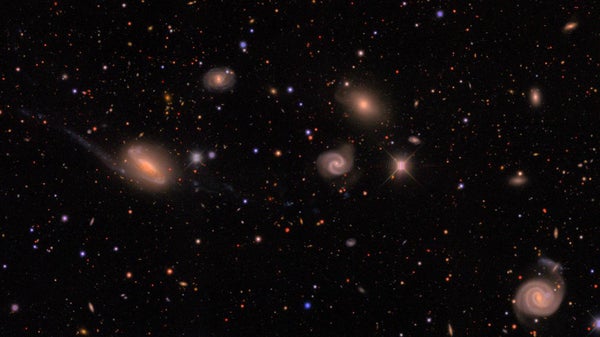
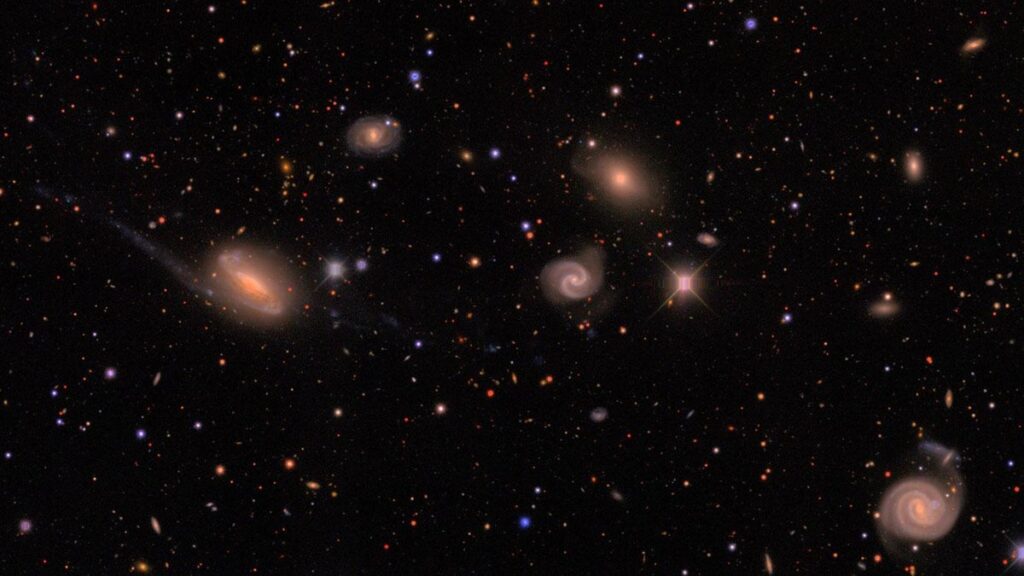
The Dark Energy Survey observed around 150 million galaxies visible in Earth’s southern sky.
Erin Sheldon and the Dark Energy Survey Collaboration
Astronomers have released the most ambitious cosmic map assembled so far, confirming that matter in the Universe is less clumpy than standard cosmological theory would predict.
From 2013 to 2019, the Dark Energy Survey (DES) team repeatedly imaged a large section of Earth’s southern sky to collect the positions, colours and shapes of around 150 million galaxies. Using a telescope at the Cerro Tololo Inter-American Observatory in Chile, the team also detected and studied more than 1,500 supernova explosions of a type that can be used to track the expansion history of the Universe.
The team analysed four different aspects of the data: the brightness and other characteristics of the supernovae; the clustering of galaxies across space and time; the evolving size of remnants of pressure waves generated in the Universe’s infancy; and the distortion of images of background galaxies by large concentrations of intervening invisible ‘dark matter’.
On supporting science journalism
If you’re enjoying this article, consider supporting our award-winning journalism by subscribing. By purchasing a subscription you are helping to ensure the future of impactful stories about the discoveries and ideas shaping our world today.
The combined results refine previous DES measurements to confirm that gravity has not clumped galaxies together as much as as much as observations of the early Universe would lead us to anticipate, were the standard theory of the Universe’s evolution correct — an ongoing puzzle for cosmologists.
This article is reproduced with permission and was first published on January 30, 2026.
It’s Time to Stand Up for Science
If you enjoyed this article, I’d like to ask for your support. Scientific American has served as an advocate for science and industry for 180 years, and right now may be the most critical moment in that two-century history.
I’ve been a Scientific American subscriber since I was 12 years old, and it helped shape the way I look at the world. SciAm always educates and delights me, and inspires a sense of awe for our vast, beautiful universe. I hope it does that for you, too.
If you subscribe to Scientific American, you help ensure that our coverage is centered on meaningful research and discovery; that we have the resources to report on the decisions that threaten labs across the U.S.; and that we support both budding and working scientists at a time when the value of science itself too often goes unrecognized.
In return, you get essential news, captivating podcasts, brilliant infographics, can’t-miss newsletters, must-watch videos, challenging games, and the science world’s best writing and reporting. You can even gift someone a subscription.
There has never been a more important time for us to stand up and show why science matters. I hope you’ll support us in that mission.