
INSIDE THIS REPORT
The story of 3I/ATLAS did not end when it passed the Sun. In many ways, it is just beginning.
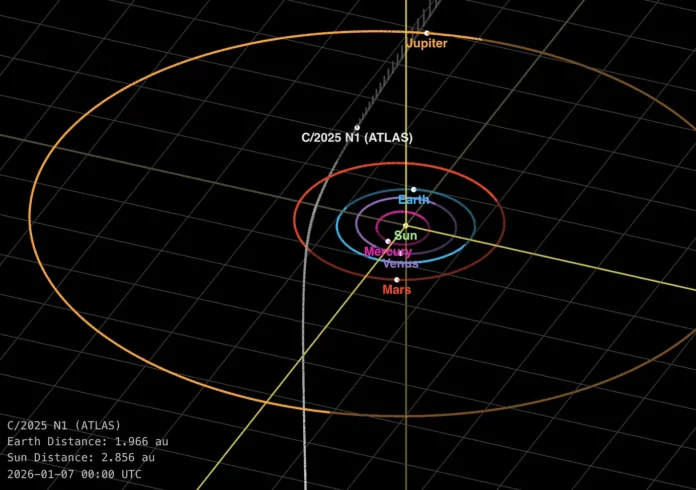
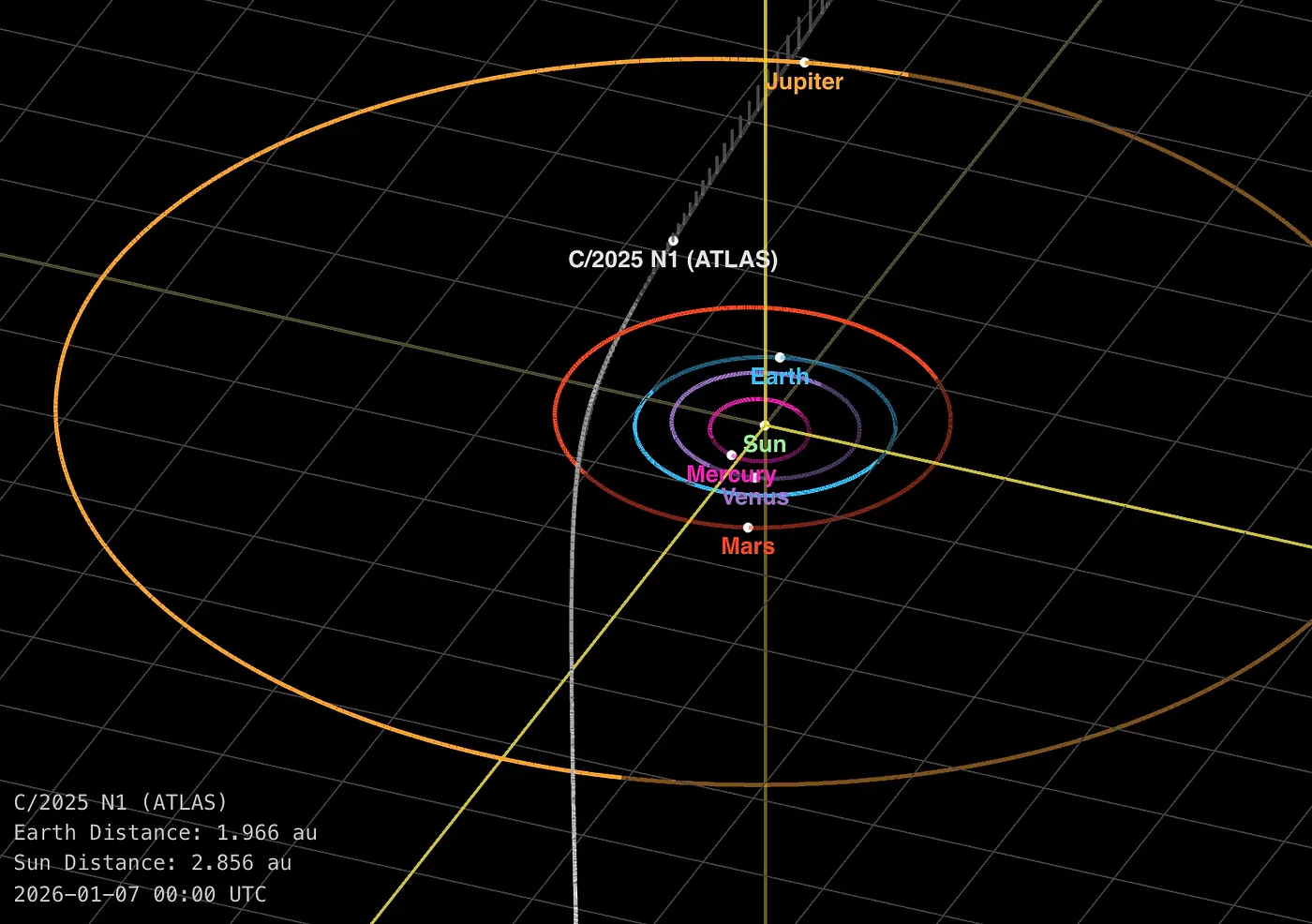
On March 16, 2026, the massive interstellar object will pass through Jupiter’s gravitational sphere of influence, setting the stage for one of the most scientifically valuable encounters of its journey.
What astronomers learn during that moment may reshape how humanity prepares for the next interstellar visitor—especially if the next one does not arrive at a safe distance.
As the interstellar object 3I/ATLAS approaches Jupiter in March 2026, scientists expect a rare natural experiment that could expose its hidden structure and test humanity’s readiness for future cosmic threats.
[USA HERALD] – Newly released data from the Hubble Space Telescope and the James Webb Space Telescope has already transformed scientific understanding of 3I/ATLAS, revealing a city-sized nucleus, unexpected methane production, and chemical behavior unlike any known comet. But according to researchers tracking the object, the most revealing phase of its journey may still lie ahead.
On March 16, 2026, 3I/ATLAS is expected to pass relatively close to Jupiter, the most massive planet in the solar system. While this will not be a collision or a dramatic flyby visible to the naked eye, the encounter is scientifically significant because Jupiter’s immense gravity acts as a natural stress test for passing objects.
Data released by astronomers indicates that Jupiter’s gravitational pull could subtly alter 3I/ATLAS’ rotation, surface activity, and internal stress patterns. If the object contains structural weaknesses, layered volatiles, or loosely bound material beneath its surface, Jupiter’s influence may expose them.
In simple terms, Jupiter has a history of pulling secrets out of cosmic visitors.
Comets that pass near the gas giant often experience changes in brightness, sudden outbursts of gas, or shifts in their spin states. In extreme cases, such as Comet Shoemaker–Levy 9 in 1994, Jupiter’s gravity tore an object apart entirely. While no such breakup is expected for 3I/ATLAS, scientists believe even minor gravitational torques could trigger fresh outgassing or expose deeper layers that sunlight alone could not reach.
That possibility is especially important given what Webb has already revealed. According to the new spectroscopic data, methane production on 3I/ATLAS appeared later than expected, despite methane being one of the most volatile ices known. This suggests that methane-rich material may be buried beneath a depleted outer crust.
A close encounter with Jupiter could change that.
Publicly available modeling indicates that tidal stresses during the March 2026 passage could crack or thermally disturb surface layers, allowing scientists to observe new gases, dust, or even changes in the object’s acceleration. Any such changes would provide direct insight into the internal structure of an interstellar object—something never previously measured with this level of precision.
The chemical implications are just as significant. If new methane, carbon monoxide, or other volatiles are released during or after the Jupiter encounter, it would help confirm whether 3I/ATLAS formed in a colder, more distant stellar environment than typical comets in our own solar system. Nickel detections already point to unusual chemistry, and further observations could refine models of how interstellar material is assembled and preserved over billions of years.
According to scientists involved in tracking 3I/ATLAS, March 2026 also offers a practical advantage: geometry. The object’s position relative to Earth, Jupiter, and the Sun will allow telescopes to observe it under different illumination and phase angles, improving measurements of its dust, gas composition, and rotation state. These conditions are rarely available for interstellar objects, which often move too quickly or fade too fast for extended study.
Beyond the science, the stakes are larger.
3I/ATLAS has already exposed uncomfortable truths about global readiness. Archival data now shows that the object was present in earlier observations months before its official identification, and its true size and composition were only revealed well after perihelion. According to experts, this delay highlights gaps in detection pipelines, classification protocols, and coordinated response.
What makes that troubling is not 3I/ATLAS itself, which poses no known threat. It is what it represents.
Interstellar objects are not theoretical curiosities anymore. They are real, frequent visitors, and some are large enough to rival major cities. As the authors of recent studies estimate, there may be more than one 3I/ATLAS-sized object passing through the inner solar system at any given time, many of them undetected.
If a future object were on a more dangerous trajectory—approaching Earth rather than Jupiter—the margin for error would be far smaller.
Tracking 3I/ATLAS through its Jupiter encounter is therefore not just an exercise in curiosity. It is a rehearsal. Scientists are learning how these objects behave under gravitational stress, how their chemistry evolves, and how quickly meaningful conclusions can be drawn from limited data. Each lesson feeds directly into planetary defense planning, early-warning systems, and the broader question of how humanity responds to rare but high-consequence cosmic events.
USA Herald’s Analysis and Contextual Insight
USA Herald’s review of the available data suggests that 3I/ATLAS is functioning as a real-world stress test for modern astronomy. The object is massive, chemically complex, and fast-moving—precisely the type of visitor that exposes institutional blind spots.
The March 2026 Jupiter encounter offers a unique opportunity to close some of those gaps. If scientists can successfully track changes in structure, chemistry, and motion during this phase, it will mark a major step forward in interstellar object monitoring. If not, it will underscore how much remains unresolved.
Either outcome matters.
As 3I/ATLAS heads toward its encounter with Jupiter, it carries more than ice and dust from another star system. It carries lessons about preparedness, perception, and humility. The universe has now shown that large interstellar objects are not rare anomalies but recurring visitors. The question is no longer whether another one will arrive—but whether humanity will be ready when it does.
About the Author
Samuel Lopez is an investigative journalist and legal analyst with more than twenty years of experience examining complex scientific, legal, and institutional issues. Writing for USA Herald, Lopez is known for rigorous, evidence-driven reporting that bridges advanced research and public accountability. His coverage of interstellar objects and planetary risk focuses on translating high-level astrophysical data into clear, real-world implications, with particular attention to preparedness, detection gaps, and the societal consequences of emerging space threats.