
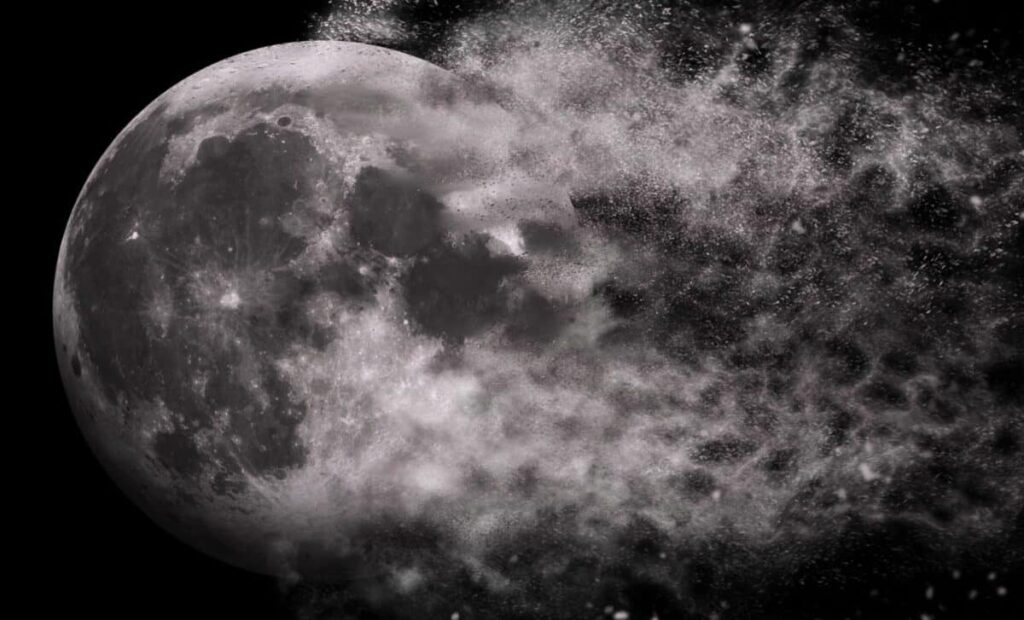
A 60-meter-wide asteroid could slam into the moon on December 22, 2032. Although the odds are slim (around 4%) the consequences could be massive. From a scientific standpoint, the impact would offer a rare opportunity to study the moon’s surface, interior, and surrounding space environment in unprecedented detail.
While the event poses certain risks, especially to satellites and regions directly under the projected meteorite fallout, researchers see it as a potential goldmine. Using detailed simulations, including orbital propagation and seismic modeling, scientists from Tsinghua University and other global institutions have already drafted an ambitious multi-platform observation plan, according to a study posted on the arXiv preprint server and covered by Universe Today.
What makes asteroid 2024 YR4 particularly interesting is not its size, but where it might land. If it strikes, the energy released would equal about 6.5 megatons of TNT, comparable to a medium-sized thermonuclear explosion. For the moon, that would be the most energetic impact ever recorded. Scientists plan to monitor the event live, capturing optical flashes, thermal radiation, seismic reverberations, and even fragments returning to Earth, turning this potential impact into a comprehensive natural experiment.
A Crater Bigger than Anything Seen in Modern History
The expected impact would form a 1-kilometer-wide crater on the moon’s surface with a depth of up to 260 meters. That’s a massive leap from the last major lunar collision in 2013, which produced a crater just 40 meters across. According to Universe Today, the force would vaporize rock and plasma, triggering an optical flash visible to the naked eye in parts of the Pacific region. “It will release enough energy to be the equivalent of smacking our nearest neighbor with a medium-sized thermonuclear weapon,” wrote journalist Andy Tomaswick.
Infrared telescopes, including the James Webb Space Telescope, would monitor the cooling of a 100-meter melt pool at the crater’s center for days after the event. The afterglow would gradually drop from 1500 K to around 300 K. Meanwhile, lunar orbiters like LRO would track thermal evolution and surface changes, providing a complete view of crater formation in real time, as described in the arXiv study led by Yifan He and colleagues.
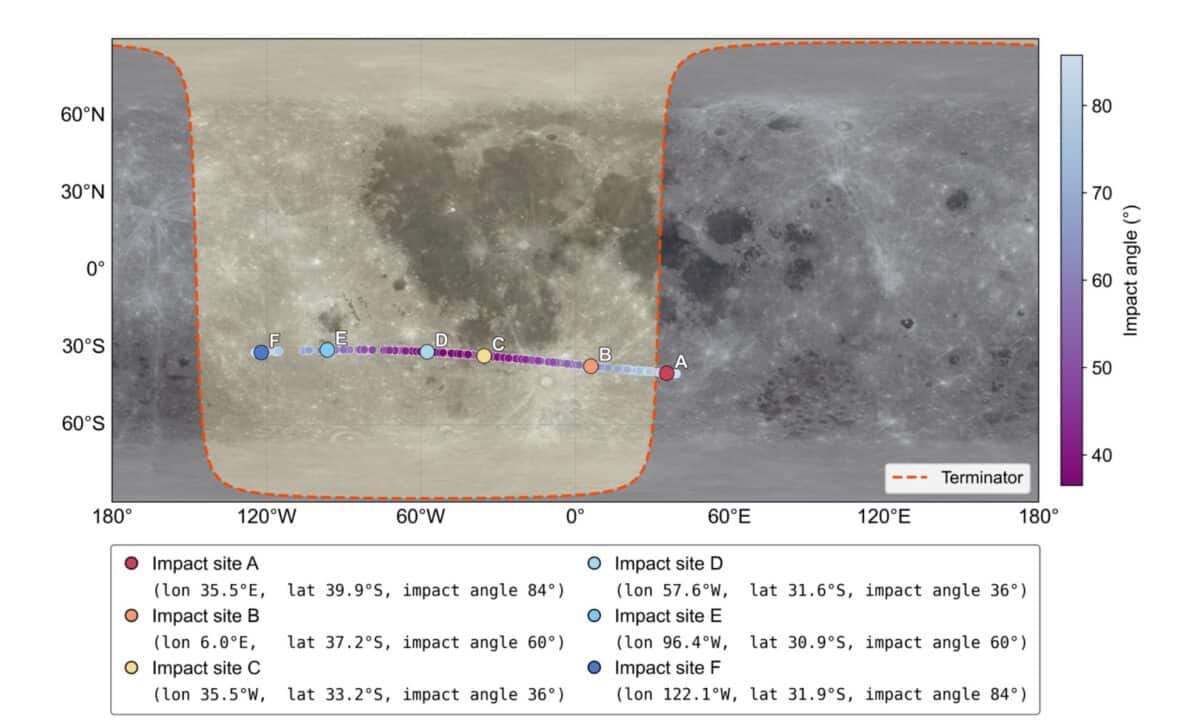 Map of the Moon’s entire surface showing the 4.3% 2024 YR4 impact corridor (with impact angle) and the dawn/dusk terminator (orange) on 22 December 2032 at 15:19 UTC. ©arXiv
A Global Moonquake, Shaking the Lunar Crust
Seismometers across the moon (including new instruments expected to be deployed in the coming years) could record a global-scale seismic event. The collision would likely trigger a moonquake of magnitude 5.0 to 5.1, releasing seismic energy equivalent to 3 × 10¹² joules. This would far exceed any lunar seismic activity detected to date, including past Apollo experiments.
According to the Tsinghua-led study, the resulting Rayleigh waves would be strong enough to reach seismometers on the lunar farside and at the poles. Expected peak ground velocities could range from 0.09 to 0.17 mm/s. These signals would allow scientists to probe the moon’s interior structure, including crustal composition and attenuation patterns. Researchers say the seismic wave propagation offers a unique view into lunar geophysics, without needing to artificially generate the energy.
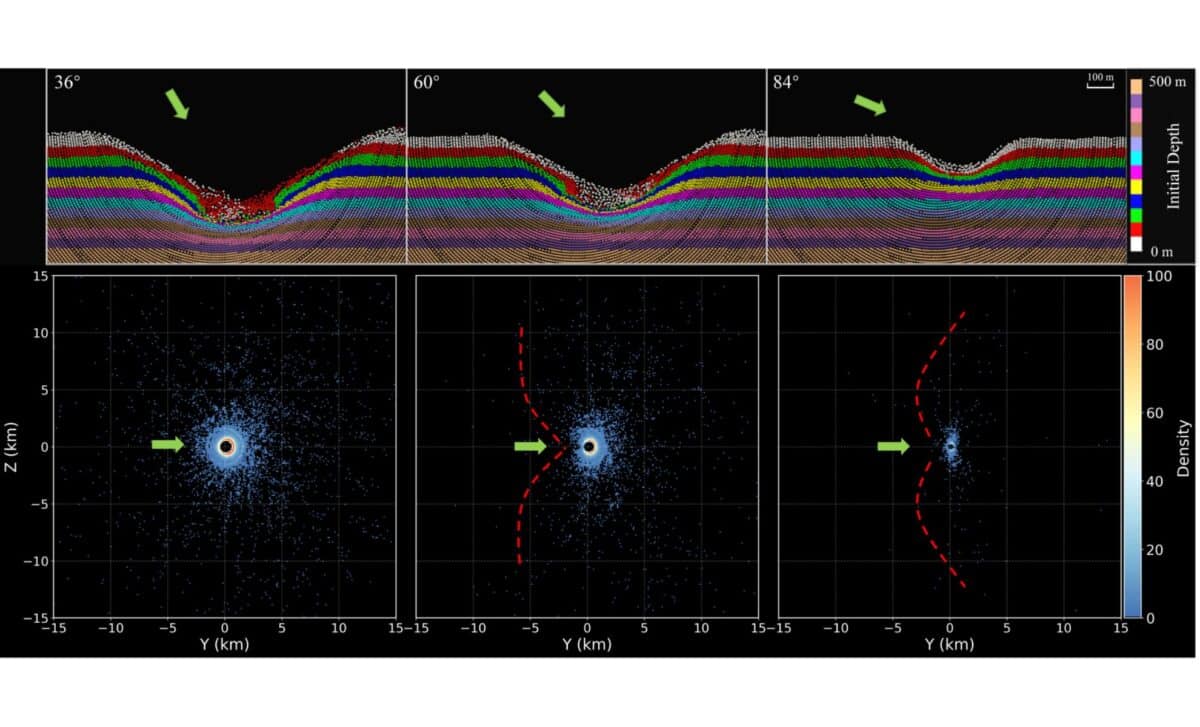 SPH outcomes for three incidence angles (36◦ , 60◦ , 84◦ ). ©arXiv
Lunar Ejecta Might Fall Back to Earth, and Hit Hard
If the asteroid hits, up to 400 kg of lunar material could survive the journey back to Earth as meteorites. According to Universe Today, this returning debris would mark an accidental but large-scale lunar sample return mission. Simulations estimate an intense meteor storm peaking around Christmas 2032, with as many as 20 million meteors per hour in some parts of the atmosphere, including 100 to 400 fireballs per hour.
However, those meteors must land somewhere. The projected fallout zones include South America, North Africa, and the Arabian Peninsula. While many of these areas are sparsely populated, the risk remains: even a small meteorite hitting an urban area could cause serious damage. Additionally, fragments large enough to remain in orbit could threaten satellite constellations, raising concerns about potential Kessler Syndrome, a chain-reaction of orbital collisions that could render Earth’s orbit unusable for years.
Whether or not asteroid 2024 YR4 collides with the moon, the event has already sparked extensive preparations and scientific planning. With observation timelines mapped out and instruments set to capture every detail (from the initial optical flash to the last seismic echoes) this might become one of the most well-documented natural impacts in human history. Scientists may soon find themselves watching live as the moon takes a hit, and reveals its secrets.