
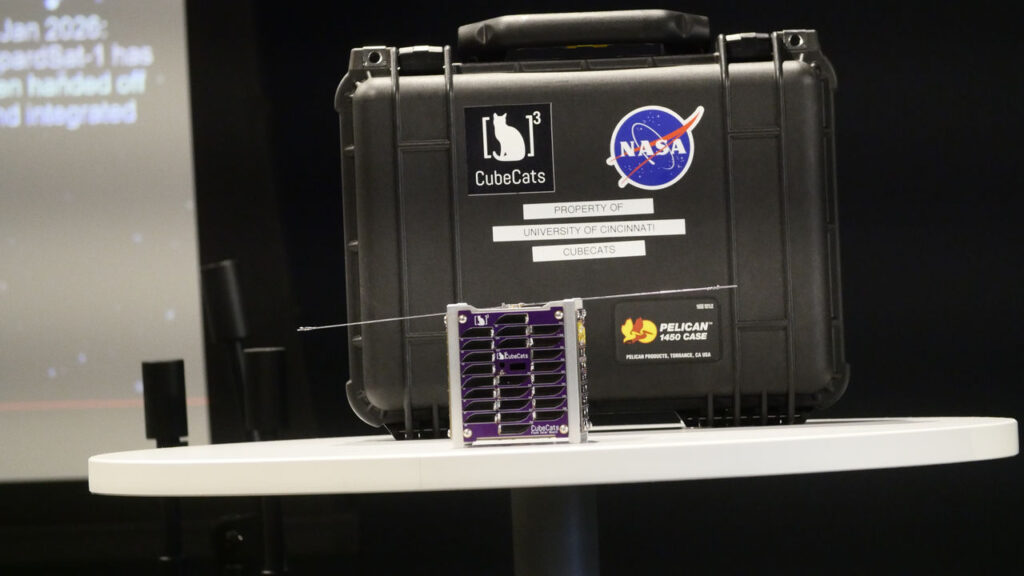
The milestone was celebrated at the UC 1819 Innovation Hub with an appreciation event bringing together students, faculty, alumni, industry partners, sponsors, community leaders and media. Attendees viewed an exact replica of the satellite and participated in a digital “time capsule,” leaving messages to be transmitted once LEOPARDSat-1 goes into orbit. The Cincinnati Observatory is featuring the mission in its exhibit on Ohio’s aerospace legacy, connecting the satellite to state icons like Neil Armstrong and John Glenn.
LEOPARDSat-1, short for “Low Earth Orbit Platform for Aerospace Research and Development Satellite-1,” will test a lightweight material designed to shield humans from space radiation, providing an alternative to heavy shielding materials like water and lead. After completing full system validation in December 2025, it’s flight-certified for NASA’s NG-24 resupply mission, with launch from Cape Canaveral and deployment from the International Space Station planned for spring 2026.
“This moment represents years of engineering, persistence, redesigns, testing cycles and unwavering belief from generations of students, faculty and partners,” Nguyen says. “The mission also highlights UC’s growing aerospace and innovation ecosystem. What began as a student-driven vision has become a flight-ready spacecraft.”
The students were “over the moon“ with excitement when the Ohio House of Representatives officially recognized the students’ work on LEOPARDSat-1 as a momentous occasion.
“We’re honored to carry the spirit of Ohio’s deep legacy of aerospace innovation forward and prove what’s possible when students are trusted and empowered to build something meaningful,” Kohls said.