
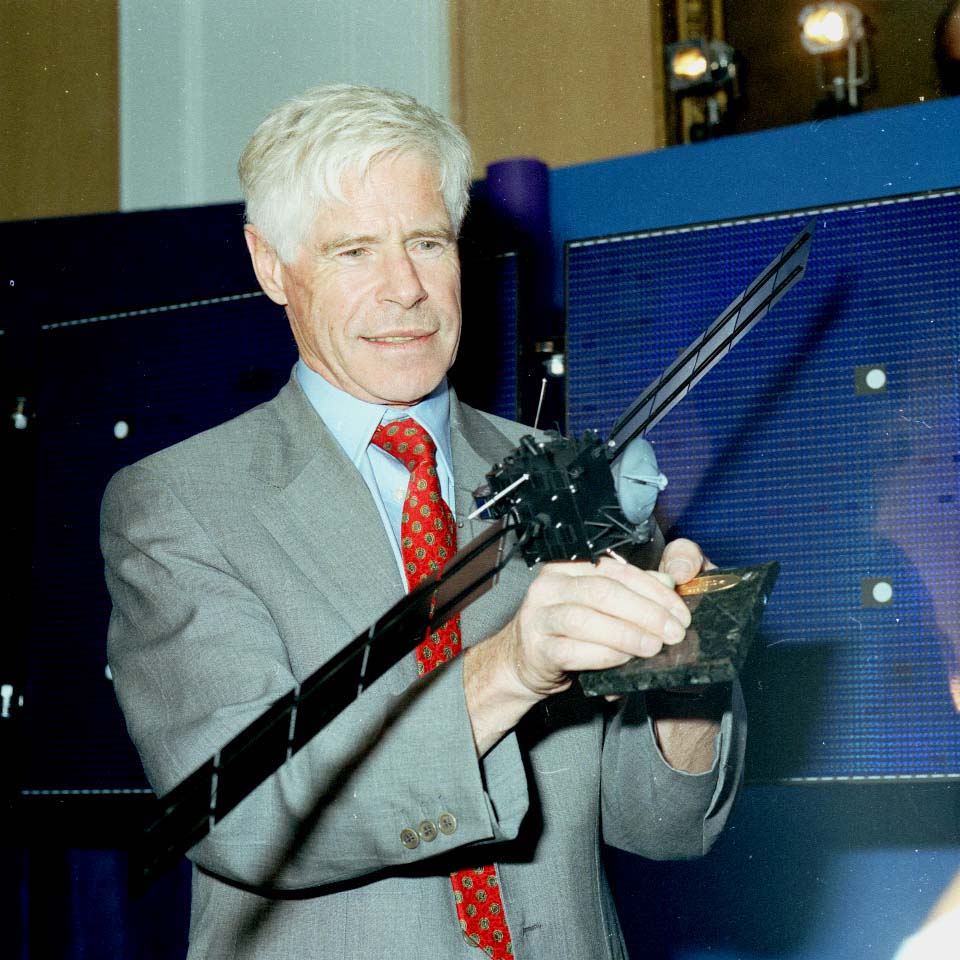
The Royal Astronomical Society (RAS) would like to pay tribute to Honorary Fellow and “icon of European space science” Roger-Maurice Bonnet, who has passed away aged 88.
Professor Bonnet, the Director of Science at the European Space Agency (ESA) from 1983 to 2001, created the first long-term science programme, Horizon 2000, which ensured Europe’s place at the forefront of space science.
He was also instrumental in forging international collaborations, championing science missions and making sure programmes under his leadership were delivered successfully and efficiently.
President of the RAS, Professor Mike Lockwood, said: “Roger Bonnet will be remembered for his visionary leadership and stewardship of ESA’s space science programme and his lasting contribution to European space research.
“I will never forget the honourable way he responded to the Cluster 1 disaster by ensuring the mission was rebuilt and refusing to abandon the scientists like me who were ready to analyse the first three-dimensional measurements of space.”
Former RAS President Professor John Zarnecki, a past chair of the ESA Space Science Advisory Committee, added: “The current ESA Space Science programme owes an enormous debt of gratitude to Roger Bonnet.
“Under his leadership, the first long term science programme, Horizon 2000, was established and it ensured Europe’s place amongst the leaders in space science.
“His combination of scientific, technical and political skills were needed to implement the programme and all of us in the space science community have benefitted from his inspirational leadership of the programme.”
Born in Dourdan, France, Professor Bonnet studied physics and astronomy and focused on solar physics at the beginning of his career.
Among his early work was the building of the Transition Region Camera experiment in collaboration with the Lockheed Solar Physics group in Palo Alto, California, which obtained the best-ever pictures of the Sun in the Lyman-alpha radiation.
At the Laboratoire de Physique Stellaire et Planétaire LPSP, where he was Director from 1969 until 1983, he developed several space experiments with his teams.
His laboratory was involved in the development of the infrared spectrometer on board the VEGA-1 and VEGA-2 Soviet missions, while he also played a pivotal role in the telescope for the Halley Multicolour Camera that flew on board ESA’s Giotto mission, which obtained the first image ever of the nucleus of a comet in 1986.
Professor Bonnet was the author of more than 150 articles and scientific publications, with his final book to be published this year.
He received numerous international honours, including being made an Honorary Fellow of the RAS in 1986, and was also appointed Officier of the French Légion d’Honneur.
ESA Director General Josef Aschbacher said: “This is a sad day for ESA but we are incredibly proud of what Roger achieved and how he moved the agency forward in so many spheres. Dozens of ESA missions came to be because of his foresight and his scientific skill.
“We offer our condolences to his loved ones and hope they will be comforted by his amazing contribution to science and international cooperation, which will live long among the stars. Roger will remain forever an icon of European space science.”