

Bill Nye let a packed crowd at the Orange Convention Center know that it’s not a good idea to send a human on a one-way trip to Mars.
“Although there’s a few I wouldn’t mind,” he said earning another chuckle during his hour-long, humor-filled speech at SpaceCom, the big event during Commercial Space Week which draws players from government and private industry each year to Orlando.
Nye, known to many a grown-up kid as Bill Nye the Science Guy, is now the CEO of The Planetary Society, a nonprofit group that has spent the last nine months going all in to thwart President Trump’s proposed budget for NASA.
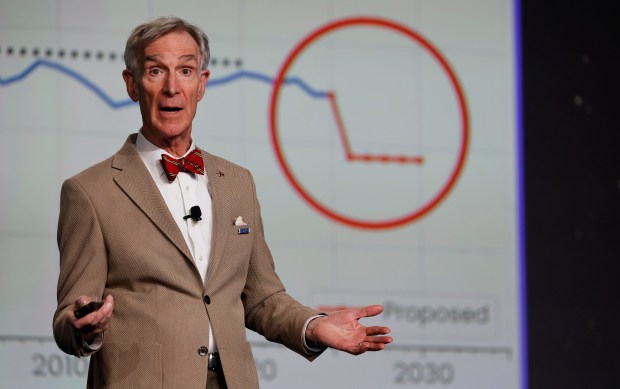 Bill Nye, CEO of The Planetary Society, with a chart of NASA’s budget over time, as he delivers the Day 1 Closing Keynote: How the Nation’s Science Shapes Commercial Opportunity; during the SpaceCom 2026 conference at the Orange County Convention Center, on Thursday, January 29, 2026. (Ricardo Ramirez Buxeda/ Orlando Sentinel)
Nye had put up a chart of NASA’s budget since before the Apollo era, during which it shot up to nearly $70 billion in the late 1960s as the U.S. threw money at its space program to land the first man on the moon. It then dipped back down in the mid-1970s, staying mostly in the $20-$30 billion dollar range ever since.
It’s been around $25 billion each year this decade, but Trump’s proposed budget that came out last May wanted to chop it to under $19 billion.
If adopted, it would have been the smallest NASA budget since 1961. The Planetary Society called it an “extinction-level event” for NASA’s science efforts, noting it would kill 41 science projects, or 1/3 of NASA’s science portfolio.
Nye was not a fan, but he then moved to the next slide.
“Here’s a picture from the congressional House of Representatives showing everybody in Congress who supported this cut,” he said.
It was an empty chamber and once again earned laughter from the crowd.
“There’s no one, zero. No one supported the cut. Everybody has NASA in his or her congressional district. Everybody,” he said.
This month, Congress passed and Trump signed a minibus bill that kept NASA’s budget levels intact at just shy of $25 billion, including continued funding for much of the existing science missions.
“So we, the Planetary Society, led the charge. We organized 19 other science organizations. We got our members, 40,000 people, maybe some of you, wrote letters and emails, and we had visits to Capitol Hill,” he said. “We went to our congressional office, senatorial office, and said, ‘Look, NASA is a big deal. You don’t want to cut NASA.’”
Their efforts paid off, but Nye issued a warning.
“Here’s the thing, this could happen again. Three months from now, the same thing could happen. The same president’s budget request could come out. The same pushback will be required. If we don’t push back, then the NASA budget will get cut,” he said.
He reminded the crowd that some of these missions would be dead in the water with no chance for revival.
“You can’t just stop these things. You try to restart it,” he said. “You just can’t keep the mission going if you keep stopping.”
And while commercial industry has been picking up the gauntlet of much of the science, NASA still provides the majority of funding.
“So this is just a real concern for people in our business. If NASA, who pays a lot of the bills, cuts us off, then we’re going to have difficulty staying in business,” he said.
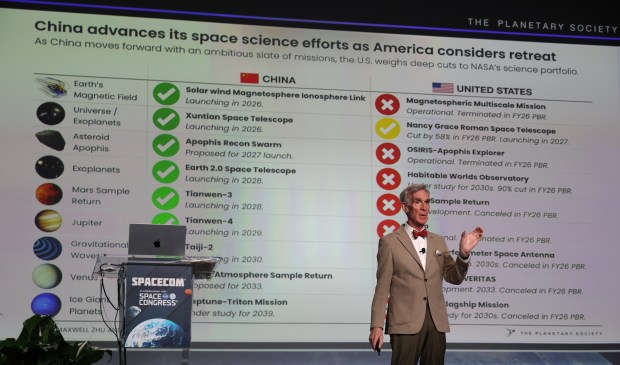 Bill Nye, CEO of The Planetary Society, contrasts the Chinese and proposed United States space science efforts with the proposed budget during the Day 1 Closing Keynote: How the Nation’s Science Shapes Commercial Opportunity; during the SpaceCom 2026 conference at the Orange County Convention Center, on Thursday, January 29, 2026. (Ricardo Ramirez Buxeda/ Orlando Sentinel)
Nye also pointed out that the proposed budget was taking the U.S. a step backward. Meanwhile, China keeps moving forward across a whole range of science missions.
“I just want to congratulate our colleagues from China National Space, they are doing just amazing, cool stuff. So some China National people here. Thank you. You’re doing wonderful stuff. You are influencing the future,” he said.
One slide showed missions to Venus, Jupiter, the asteroid Apophis, exoplanets and more, and that China was funding missions to each. But under Trump’s proposed budget, only the Nancy Grace Roman Telescope mission was funded.
“This was the comparison. Cancel everything. Cancel every one of these planetary missions, and one of the planets is the Earth — Earth’s magnetic field,” he said. “That was their proposal, the president’s budget request, just let the U.S. drop out of all of these missions, many of which were planned, many of which were started.”
He noted after the pushback from Congress, each of those missions were back.
“Except, for some reason, the Mars Sample Return mission is still in limbo, probably because all the bids have been too high, wink wink,” he said. “Somebody can come up with a new, cheaper scheme. I’m just sayin’.”
He then stumped for why the Mars Sample Return is worth Earth’s time. He began by showing a rock located in Antarctica in 1984 that was proven to be a Martian rock. When looked at microscopically, there were patterns that suggested the possibility of life on Mars at one time.
That was the impetus for NASA’s Martian rovers, including this century’s Curiosity and Perseverance missions, which are still active today. Nye showed images Perseverance found that showed Martian rocks with “mythic, dare I say it, leopard spots.”
“And these leopard spots, as they’re called, resemble stromatolites, things we find on Earth, of fossils, of ancient living things,” he said.
He let that sink in.
“My friends, people, if we were to find evidence of life on another world, it would change this world,” he said. “It would change the way everybody thinks about being a living thing in the cosmos. It would change everything. I’m not saying we start driving on the left, but it would change you.”
The idea we would send people to retrieve the samples already gathered by Perseverance is not some Nye can get behind.
“If you want it to get really expensive, if you want it to be inconclusive, send people, because people are just bags of microbes, and they will contaminate the site before we can figure this out,” he said. “I want, before anybody goes to Mars and starts walking around and spitting on things, I wanted to get at least one of these back to see if this hypothesis is is reasonable.”
He took his final moments to encourage the commercial companies at the site to keep the science engine running.
“I just want you all in commercial space to consider investing in science. Hire some scientists. Make a deal with space agencies to do some science for them,” he said. “So everybody, if we invest in science, I claim, we can, dare I say it, change the world!”