
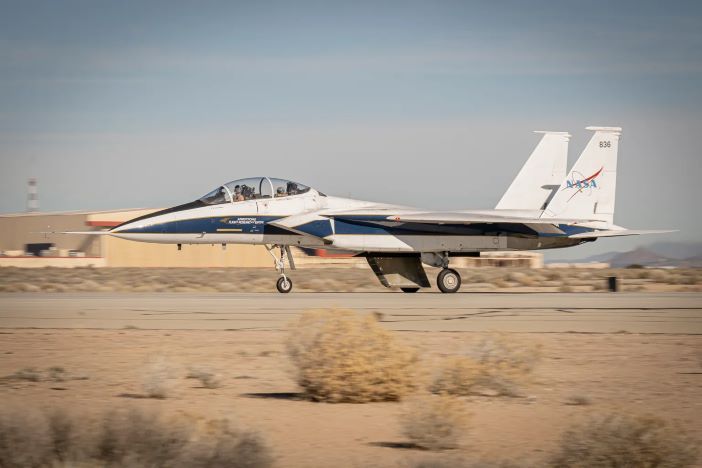
Researchers at NASA have tested a wing design that aims to increase laminar flow on swept wings at transonic speeds this month.
The test at Armstrong Flight Research Centre attached a 3ft (1m) scaled model of the wing vertically under the belly of an F-15 testbed jet, which then reached a speed of 144mph (230km/h) during taxiing.
The wing is a concept NASA calls Crossflow Attenuated Natural Laminar Flow (CATNLF), which aims to increase laminar flow on swept wings at transonic speeds. Reducing laminar flow reduces wind resistance, saving fuel and money when operating commercial aircraft.
Laminar flow
NASA research done between 2014 and 2017 estimates that applying a CATNLF wing design to a large, long-range aircraft like the Boeing 777 increases laminar flow and could achieve annual fuel savings of up to 10%. Although quantifying the exact savings this technology could achieve is difficult, the study indicates it could approach millions of dollars per aircraft each year.
“Even small improvements in efficiency can add up to significant reductions in fuel burn and emissions for commercial airlines,” said Mike Frederick, principal investigator for CATNLF at NASA’s Armstrong Flight Research Center in Edwards, California.
Subsonic commercial aircraft applications
This article was originally published by NASA.