
Two representatives from NASA have joined the team of U.S. Drought Monitor authors.
The monitor is hosted by the National Drought Mitigation Center at the University of Nebraska–Lincoln and produced through a partnership between the drought center, U.S. Department of Agriculture, National Oceanic and Atmospheric Administration and now NASA.
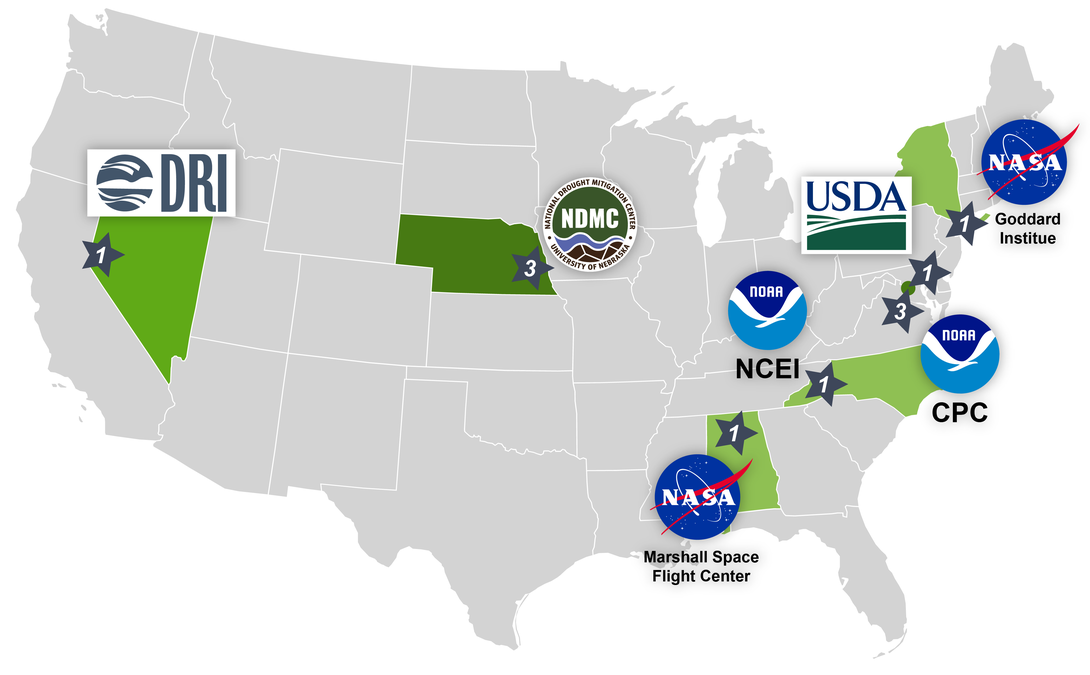
The new authors are Ben Cook, with the NASA Goddard Institute for Space Studies at Columbia University, and Jonathan Case, with the NASA Marshall Space Flight Center and the University of Alabama-Huntsville.
“Since the inception of the U.S. Drought Monitor in 1999, it has been a uniquely collaborative product,” said Mark Svoboda, director of the drought center. “We are very excited about this partnership, which marks a new step in joint efforts between NASA and the Drought Monitor authoring team.”
This is the first time NASA has contributed authors to the monitor’s development process. To mark their involvement, the administration’s logo now appears in the lower-right corner of the Drought Monitor map.
Karen St. Germain, director of NASA’s Earth Science Division, said NASA Earth science has been proud to contribute unique data and expertise to the monitor effort for years.
“This agreement formalizes our partnership and incorporates NASA scientists as key members of the expert team that produces the weekly maps that are the gold standard for observing and forecasting drought,” she said. “This is one of many ways that NASA’s Earth science and data power the operational services that U.S. farmers, ranchers and resource managers rely on.”
The Drought Monitor is a weekly map showing the location and severity of drought across the United States and its territories, using six classifications to designate the extent of abnormal dryness or drought.
Authors are from the partner organizations, and the new NASA authors bring their number to 11. Each week, one of the authors uses dozens of indicators from multiple data sources, including NASA, to update drought levels across the U.S. and territories. A network of drought experts from each of the 50 states and Puerto Rico also provide input on local conditions.
Cook and Case have been added into the author rotation and will each complete their first two-week shift later this year.