
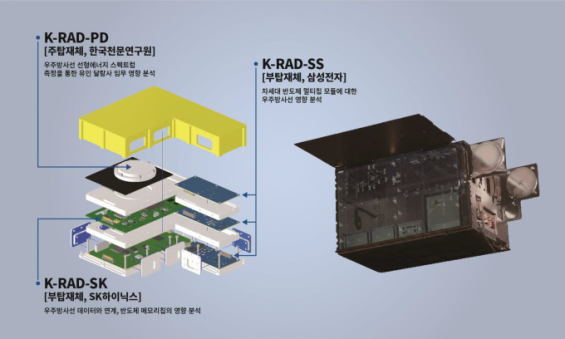
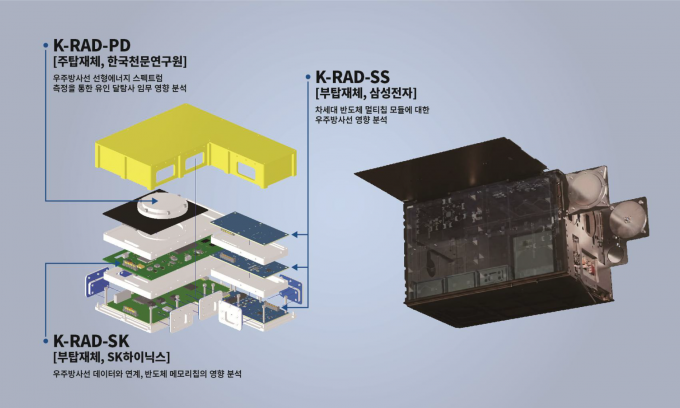
K-RadCube, which will be carried on Artemis II, contains a space radiation analyzer from the Korea Astronomy and Space Science Institute and secondary payloads from Samsung Electronics and SK hynix to analyze the effects of space radiation on semiconductors.
Semiconductors from South Korea’s leading chipmakers, Samsung Electronics and SK hynix, will be launched aboard NASA’s manned lunar exploration rocket, Artemis II, to gather data for improving their durability in the space environment.
On the 29th, the Korea AeroSpace Administration (KASA) and the Korea Astronomy and Space Science Institute (KASI) announced that the CubeSat ‘K-RadCube,’ set to be carried on Artemis II, has completed ground preparations and is scheduled for launch from Kennedy Space Center in Florida between February and April. The earliest possible launch date is February 6.
The Artemis II mission is a test flight for a manned lunar landing. It will verify the flight path and procedures to the vicinity of the Moon through an actual flight. Comprising the Space Launch System (SLS) rocket and the Orion spacecraft, its mission is to fly around the Moon without landing or entering lunar orbit.
K-RadCube will be carried as a secondary payload on the Orion spacecraft and deployed into a high Earth orbit (HEO) 5 hours and 7 minutes after launch. It will fly in an elliptical orbit that traverses the Van Allen radiation belts, where high-energy particles are trapped by Earth’s magnetic field. The satellite will precisely measure space radiation conditions in the Van Allen belts and analyze their potential impact on astronauts during future Earth-Moon transits.
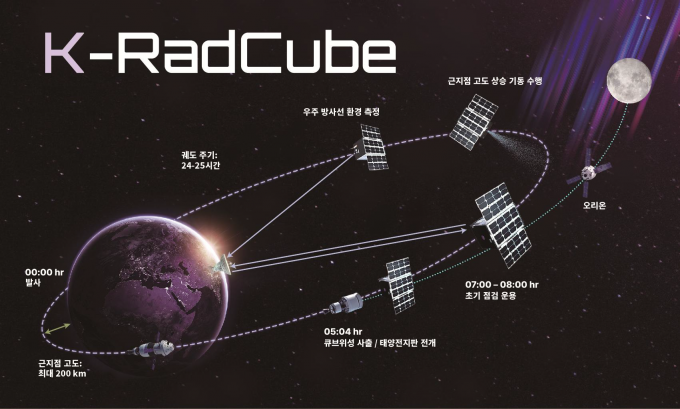
Operational overview of ‘K-RadCube.’ Deployed in high Earth orbit (HEO), it will fly in an elliptical orbit with a 24-25 hour period, traversing the Van Allen radiation belts where high-energy particles are trapped by Earth’s magnetic field. Provided by Korea AeroSpace Administration
K-RadCube’s mission orbit is intentionally challenging. It will perform its mission in a large orbit with a period of 24-25 hours, ranging from 150-200 km at its closest point to Earth to a maximum of 70,000 km. The plan is to use its onboard thrusters to precisely and incrementally raise its altitude as it passes through perigee in its initial orbit.
“The Van Allen belts are a high-energy region with concentrated radiation, an area that CubeSats usually avoid. But being on Artemis II, we saw it as an opportunity to better measure this radiation environment,” explained Shim Chae-kyung, head of KASI’s Planetary Exploration Center. “It’s a risky and challenging orbit, involving communication with Earth from 70,000 km away and a low-perigee flight that risks atmospheric reentry.”
Since Artemis II is a crewed mission, K-RadCube had to pass stringent safety standards for crewed payloads, in addition to standard tests like thermal runaway and destructive tests. It also had to withstand the intense vibration environment of the SLS launch vehicle. While typical launch vehicles generate vibrations of 10-14 times Earth’s gravitational acceleration (G), payloads on the SLS are required to endure 20 Gs. G is the unit of gravitational acceleration.
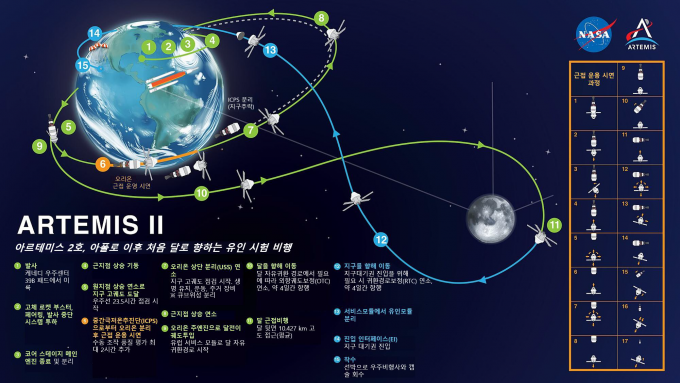
Key mission phases of Artemis II. NASA image.
The tight preparation schedule also had to be overcome. “The most difficult part was the 11-month development period within the total project timeline of 1 year and 1 month, during which we had to handle everything from design to manufacturing and launch preparation,” said Park Jae-pil, CEO of Nara Space, the domestic space company that led the satellite’s development. “I believe we were able to develop it within the timeframe by applying our proprietary artificial intelligence (AI) design technology.”
RadCube also carries domestically produced semiconductors from Samsung Electronics and SK hynix. The goal is to collect data on the degradation and failure processes of these chips in a high-radiation environment, which will be used for research on radiation-hardened semiconductors. As the space industry grows, the technology to create radiation-resistant semiconductors is gaining attention as a key competitive advantage.
“We already design our devices considering cosmic radiation that reaches the ground,” said Choi Shin-kyu, a team leader in Cell Development Device at SK hynix. “The purpose is to see how semiconductors in space lose their functionality due to the effects of radiation.”
While exposure to space radiation can be simulated on the ground, recording a history in the unpredictable real space environment is crucial. “It’s the difference between practicing running and competing in an actual marathon,” Choi added, offering an analogy.
“As devices become smaller and more miniaturized, even minute amounts of radiation can cause defects,” explained Han Jin-woo, a Vice President at Samsung Electronics. “This mission is about accumulating knowledge on situations involving exposure to space radiation.”
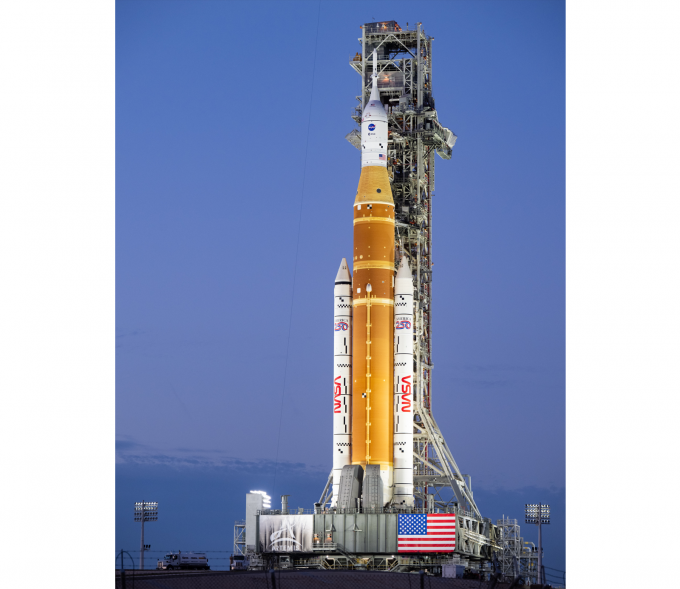
On the 17th (local time), the Space Launch System (SLS) rocket and Orion spacecraft are positioned on Launch Pad 39B at NASA’s Kennedy Space Center in Florida. NASA/Keegan Barber.
The satellite’s operations will be primarily managed from KT SAT’s Yongin Satellite Center and its satellite control room. Observed data and satellite status will be transmitted to KASI for real-time monitoring. Five antennas at four overseas ground stations will be used to receive satellite operations and scientific data collected by K-RadCube. Chile will handle the majority of the command and control, accounting for about 90%, with Spain covering 8%. The remainder will be managed by stations in Hawaii, USA, and Singapore.
Due to exposure to the high-energy radiation environment, the mission duration is expected to be shorter than that of a typical low-Earth orbit satellite.
A division head explained, “It is difficult to incorporate all high-reliability components into a small CubeSat in a short period. If it survives for more than two weeks while repeatedly flying through the inner radiation belt, the observation mission will be considered a sufficient success.”
He added, “To monitor space weather, we need to continuously study the dynamic relationship between solar activity and Earth’s magnetic field. As the level of particles from recent solar activity has increased significantly, we will analyze the data in detail later on.” The acquired data is scheduled to be released to the public worldwide six months after the launch.
CubeSats from Germany, Argentina, and Saudi Arabia are also awaiting launch alongside K-RadCube on Artemis II. If the scheduled February launch is delayed, K-RadCube’s orbit will need to be adjusted. “We are not just preparing for a February launch scenario,” CEO Park explained. “We are also analyzing orbits to ensure the mission can be successfully carried out for launch cases in March and April.”
Copyright ⓒ DongA Science. All rights reserved.