
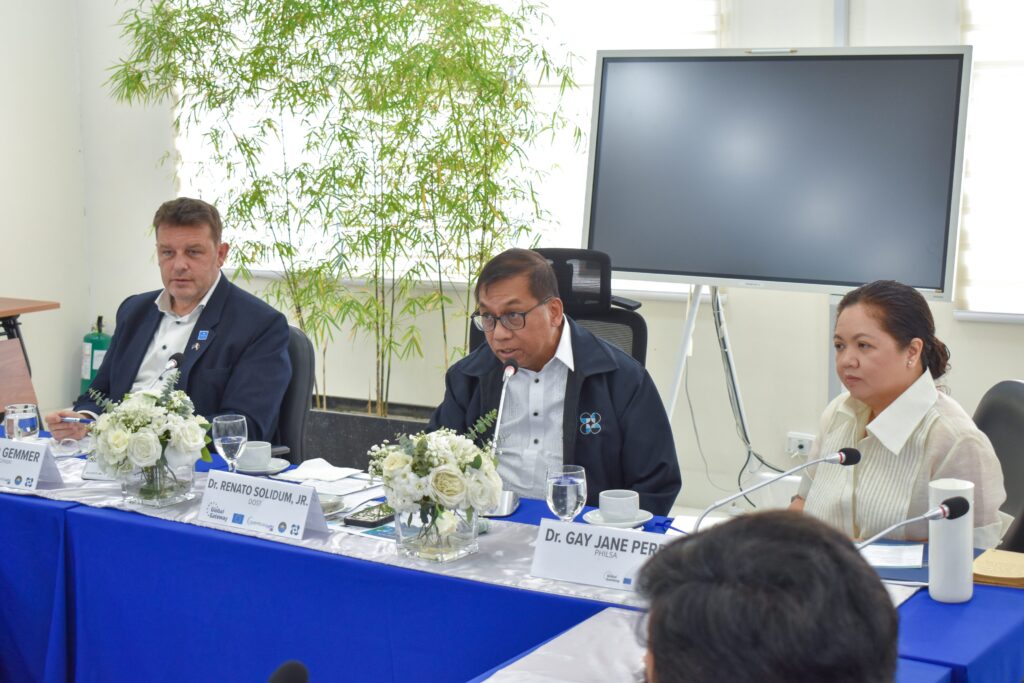
CopPhil Steering Committee Meeting discusses strengthening EO initiatives across PH
(L-R) EUDEL to the Philippines Head of Cooperation Marco Gemmer, Ph.D., DOST Secretary Renato Solidum, Jr., PhD., and PhilSA Director General Gay Jane Perez, Ph.D. lead discussions on advancing EO use and cooperation at the 3rd EU CopPhil Steering Committee meeting.
The Philippine Space Agency (PhilSA), the European Union Delegation (EUDEL) to the Philippines, and Department of Science and Technology (DOST) conducted the third Steering Committee meeting of the EU National Copernicus Capacity Support Action Programme for the Philippines or CopPhil on 26 January 2026.
The meeting was joined by representatives from national government agencies including the Department of Agriculture (DA), Department of Human Settlements and Urban Development (DHSUD), Department of Information and Communications Technology (DICT), DOST–Advanced Science and Technology Institute (ASTI), Philippine Information Agency (PIA), Office of Civil Defense (OCD), and Mindanao Development Authority (MinDA). International partners in attendance included Collecte Localisation Satellites (CLS), CopPhil‘s technical partners, and European Space Agency (ESA) partners.
The Steering Committee outlined priorities for CopPhil’s next implementation phase, emphasizing the expansion of operational Earth observation (EO) services, the transition of pilot initiatives into sector-ready applications, stronger inter-agency coordination, and wider adoption of Copernicus data across government operations.
PhilSA Director General Gay Jane Perez, Ph.D. noted that this is a significant time for CopPhil as the programme enters implementation phase. This transition enables partners to evaluate early outcomes, identify areas for refinement, and direct collective efforts toward achieving greater and more sustained impact.
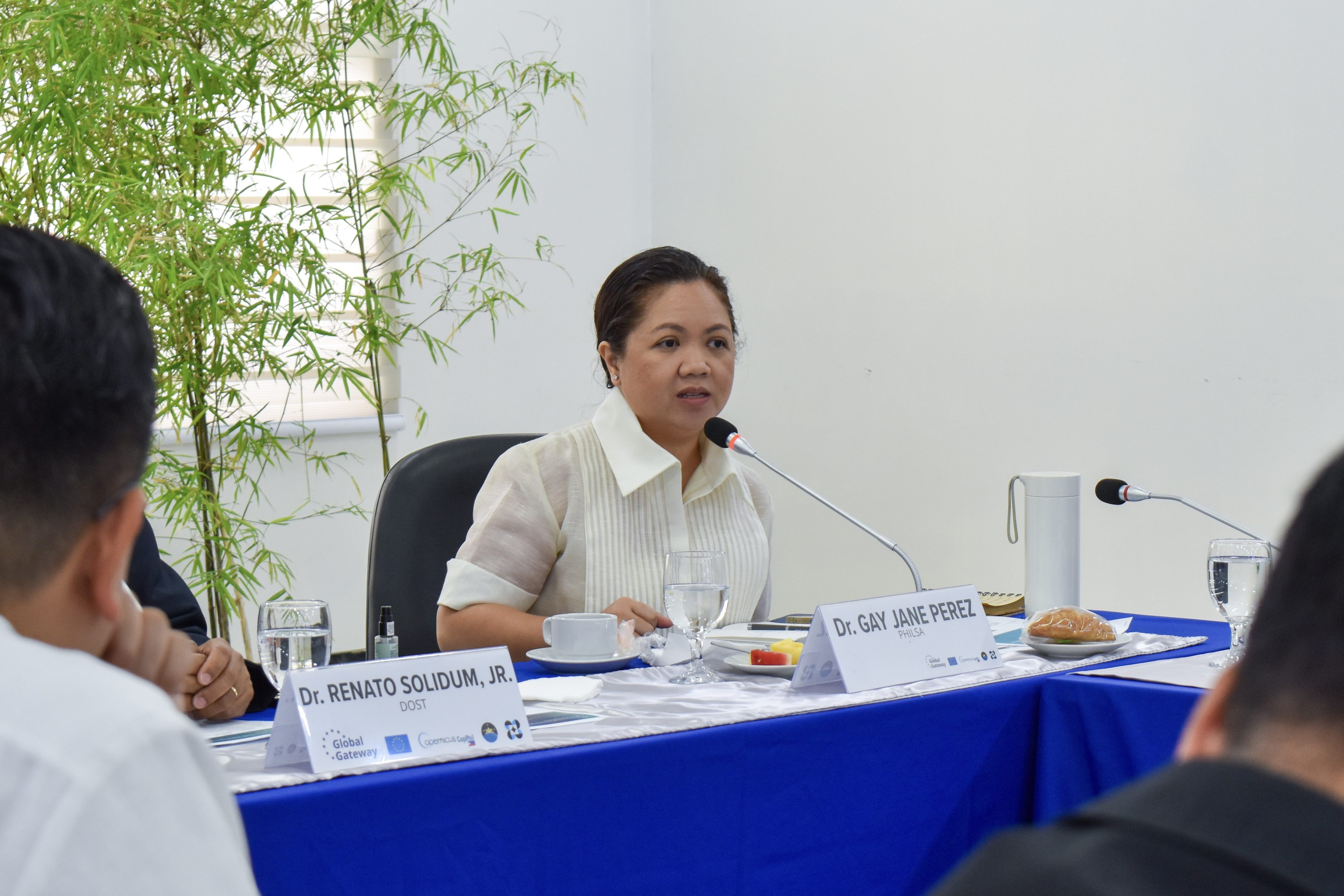
PhilSA Director General Perez, Ph.D. also mentions that as CopPhil continues to evolve, its value increasingly lies in how its components connect and reinforce one another―how improved data access enables services, how services generate demand for skills, and how partnerships help sustain these gains.
Building on this transition to a more operational phase, discussions centered on expanding EO pilot services that utilize satellite data into practical tools for priority sectors. These include ground motion monitoring, land cover, forest and crop mapping, and benthic habitat monitoring in collaboration with PhilSA, DOST, DOST–Philippine Institute of Volcanology and Seismology (PHIVOLCS), National Mapping and Resource Information Authority (NAMRIA), and DA–Bureau of Soils and Water Management (BSWM).
Progress on the Copernicus Mirror Site was also tackled, highlighting its role in improving local access to EO data and supporting faster and more efficient EO data retrieval in the Philippines.
Another key topic covered was the SCOPE DIGITAL initiative, focusing on the expansion of EO-enabled services across Southeast Asia, starting with Thailand and Indonesia. Discussions highlighted applications such as fire monitoring, land cover mapping, and ground motion monitoring, as well as opportunities to strengthen regional collaboration, service deployment, and capacity-building efforts.
The Steering Committee underscored the importance of integrating Copernicus data into national government operations, including its growing use under DOST’s Geospatial Analytics and Technology Solutions (GATES) Program, an integrated geospatial analytics and EO data platform. Agencies such as the Office of Civil Defense (OCD) were identified as key beneficiaries, particularly for climate resilience, disaster preparedness, and risk management. Members further emphasized the need to develop EO products that meet specific agency needs for effective decision-making.
Capacity building remains a central pillar of CopPhil as upcoming outreach, visibility, and stakeholder engagement activities were discussed. These aim to broaden stakeholder participation, encourage youth involvement, and increase awareness and adoption of Copernicus services.
In line with the Philippines’ ASEAN Chairmanship, discussions also explored space-related priorities and opportunities to deepen regional and international cooperation in EO and space initiatives. These exchanges underscored the country’s growing role in regional knowledge-sharing, service deployment, and advancement of space-enabled development.
As CopPhil advances into its next implementation phase, partners reaffirmed their commitment to scaling EO-driven services, strengthening inter-agency coordination, expanding regional collaboration, and sustaining Copernicus infrastructure and applications in the Philippines. The Third EU CopPhil Programme Steering Committee meeting marked a continued step toward enhancing the country’s capacity to harness EO and space technologies in support of national development priorities and the EU Global Gateway strategy.
About CopPhil
The EU Copernicus Philippines programme is funded by the EU with a 10 million euro (624 million PHP), implemented by the Philippine Space Agency and European Space Agency in coordination with the Philippines Department of Science and Technology (DOST). The programme supports the adoption of advanced technology to help local public administration, institutions and companies prevent natural disasters, protect the environment, and manage national resources. The project involves three elements: developing a Copernicus data centre in the Philippines, piloting services showcasing the practical applications of EO data (ground motion monitoring; land cover, forests and crop mapping, and marine environment monitoring) and supporting the country to strengthen local capacities and promoting education in the field of EO. Copernicus services have already demonstrated its value to the local authorities, when the satellites were activated from Europe last July to map an oil spill caused by the sinking of MT Terra Nova following the heavy rains and rough waters from super typhoon Carina.
CopPhil is a flagship programme of the European Union Global Gateway Strategy, which aims to engage with partners globally around shared priorities such as the transition to a green economy, education and research, or digital infrastructure. To learn more about the impact of CopPhil on the Philippines and its neighbours, click here.
About PhilSA
The Philippine Space Agency (PhilSA) is the central government agency of the Philippines that plans, develops, and promotes the national space program in line with the Philippine Space Policy. Created in August 2019 under Republic Act No. 11363, or the Philippine Space Act, PhilSA is an attached agency of the Office of the President of the Philippines for purposes of policy and program coordination and to ensure alignment in national policies and priorities.