
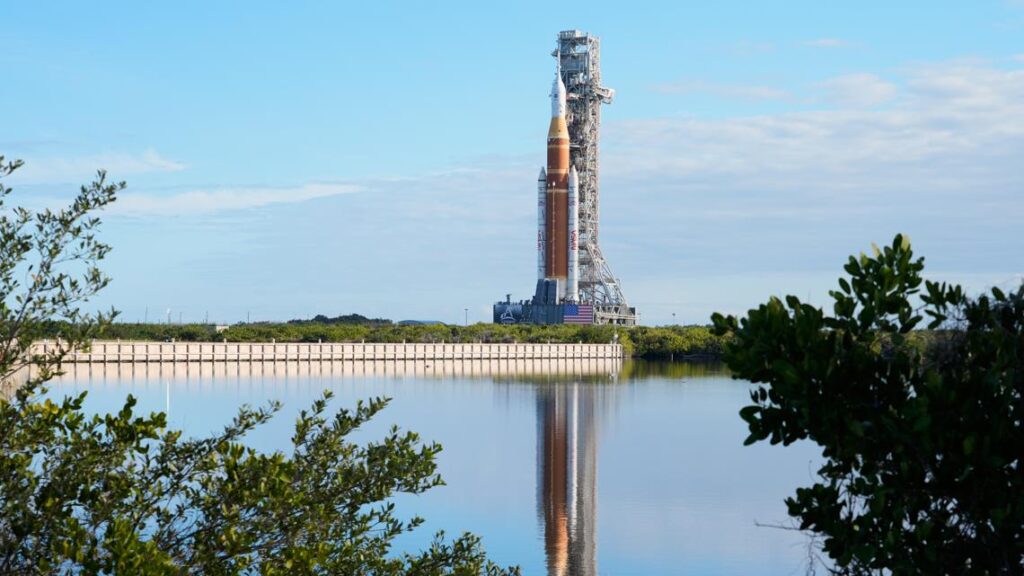
If the launch for the crewed mission to the moon isn’t able to take place in early February, NASA will have opportunities again in March and April.
CAPE CANAVERAL, Fla. — The historic Artemis II mission is slated for a possible early February launch.
A crew of astronauts will be the first people to fly to the moon since Apollo 17’s Gene Cernan and Harrison Schmitt closed out the triumphant lunar-landing program in 1972.
Astronauts are set to return to the moon with the Artemis III mission, but why is the U.S. attempting to return to the moon?
Reasons to return
NASA gives three main reasons for returning to the moon: scientific discovery, economic benefits, and inspiration for a new generation of explorers.
But there’s an even larger reason.
The Artemis moon missions are meant to learn how to live and work on another world in preparation for human missions to Mars.
Artemis I
Artemis I was an uncrewed flight meant to test the Space Launch System and the Orion spacecraft around the moon.
Mission facts
Launch date: Nov. 16, 2022Mission duration: 25 days, 10 hours, 53 minutesTotal distance traveled: 1.4 million milesRe-entry speed: 24,581 mph (Mach 32)Splashdown: Dec. 11, 2022

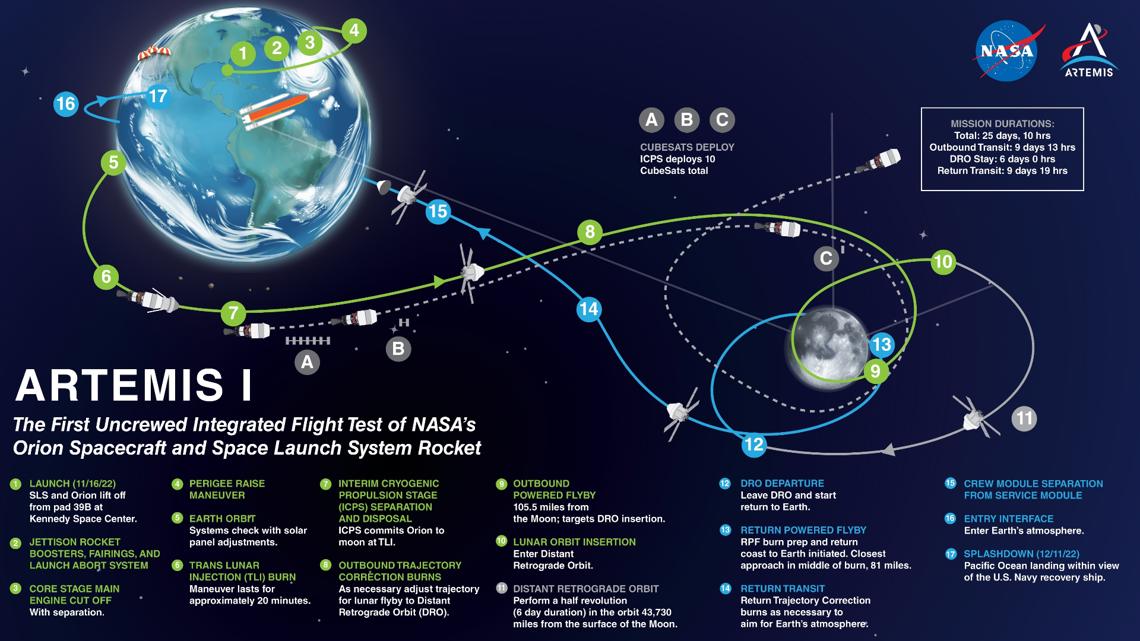
Damage to the heat shield and other capsule problems during the initial test flight required extensive analyses and tests, pushing back the Artemis II crew moonshot until now.
The Artemis I took a distant orbit around the moon with tests of the Space Launch System and Orion capsule ahead of the crewed missions.
Artemis II
Artemis II will be a crewed mission around the moon, though astronauts won’t touch down on the moon until the Artemis III mission.
The goal of the Artemis II mission is to confirm all of the spacecraft’s systems operate as designed with crew aboard in the actual environment of deep space.
A series of potential launch days have been scheduled around Feb. 6. If those launch windows do not work, NASA has additional opportunities in March and April.
The mission itself is expected to last 10 days for the four crew members.
The crew


Three longtime NASA astronauts with spaceflight experience—crew Cmdr. Reid Wiseman, pilot Victor Glover, and Christina Koch—will be joined on the 10-day mission by Canadian astronaut Jeremy Hansen, a former fighter pilot awaiting his first rocket ride.
After launch, the crew will spend about two days checking out Orion’s systems and performing a targeting demonstration test relatively close to Earth before then beginning the trek toward the moon.
The crew will then test the Space Launch System rocket and Orion spacecraft around the moon.
“The crew will assess the performance of the life support systems necessary to generate breathable air and remove the carbon dioxide and water vapor produced when the astronauts breathe, talk, or exercise,” according to NASA.
What this crew does will pave the way for lunar surface mission and long-term lunar science and exploration.
Artemis III
Artemis III will return humans to the moon’s surface with astronauts exploring the lunar south pole.
The mission itself is expected to last about 30 days and is set to launch by 2028.
The crew of four will travel to the moon, with two crew members boarding the SpaceX Starship Human Landing System in lunar orbit. They will then descend to the surface, spending about a week at the moon’s south pole.
Nine potential landing sites have been identified. Crew members will be making observations, collecting samples and performing science experiments.
“Artemis will return humanity to the moon and visit unexplored areas. NASA’s selection of these regions shows our commitment to landing crew safely near the lunar South Pole, where they will help uncover new scientific discoveries and learn to live on the lunar surface,” said Lakiesha Hawkins, assistant deputy associate administrator, Moon to Mars Program Office.
NASA said the south pole sites are a completely different environment from where astronauts landed during the Apollo missions.
“It offers access to some of the moon’s oldest terrain, as well as cold, shadowed regions that may contain water and other compounds,” said Sarah Noble, Artemis lunar science lead at NASA Headquarters in Washington. “Any of these landing regions will enable us to do amazing science and make new discoveries.”
When the crew completes its lunar surface mission, they will then return to lunar orbit and join up with their fellow crew members before making the return trip to Earth.
Artemis IV
Artemis IV will be the start of long-term exploration at the moon.
Whereas Artemis III astronauts will spend a week on the lunar surface, Artemis IV astronauts will be establishing the first lunar space station: Gateway.
Gateway will orbit the moon, passing over the north and south pole areas.
NASA says Gateway will provide “unparalleled opportunities for science and access to the lunar surface.”
Prior to the actual mission, parts for Gateway will be sent to lunar orbit with the first elements, taking about a year to arrive. The habitation part of Gateway will arrive with the Artemis IV crew. The crew will use SpaceX’s Starship Human Landing System for the mission to the lunar surface and the SpaceX Dragon XL logistics module to carry experiments and supplies for the missions.
Two crew members will spend about six days on the moon’s surface. They will conduct field geology, deploy instruments, and collect samples before returning to Gateway and then to Earth.
Gateway will be set to continue in the moon’s orbit until astronauts return.