
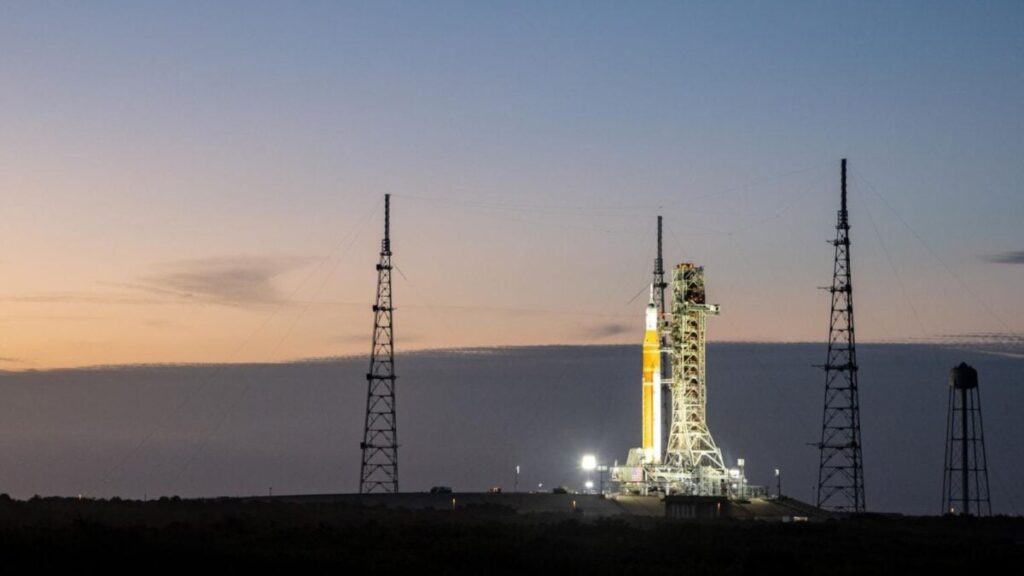
NASA is rocketing toward the launch of Artemis 2, targeting this weekend for a critical fueling test that stands as one of the last hurdles to clear before liftoff.
The agency was planning to conduct a “wet dress rehearsal” for the mission’s Space Launch System (SLS) rocket on February 2, but said Monday that it is now aiming to complete this test by Saturday, January 31, at the earliest. If it goes off without a hitch, Artemis 2 could launch as early as February 6, sending a crew of four astronauts on a 10-day flight around the Moon.
Anticipation for Artemis 2 has been building for years. Repeated delays have pushed humanity’s historic return to deep space back significantly, so this schedule boost is a welcome change. A February launch would mark a considerable acceleration from NASA’s previous timeline, which aimed for no earlier than April.
There is a catch, however. An Arctic blast and coastal storm system are set to bring uncharacteristically cold temperatures and gusty winds to NASA’s Kennedy Space Center in Cape Canaveral, Florida, over the weekend. This could thwart the agency’s wet dress plans.
“With cold weather sweeping the country and lower than normal temperatures expected in Florida Tuesday, Jan. 27, technicians are taking steps to ensure environmental control systems keeping Orion and SLS elements at the proper conditions are prepared for the cold,” NASA said Monday.
What is a wet dress rehearsal?
The SLS rocket and Orion spacecraft—which will carry the Artemis 2 astronauts—are fully stacked and sitting atop Launch Pad 39 B at Kennedy Space Center. Before the mission can launch, NASA must conduct a wet dress rehearsal to practice fueling and countdown procedures and verify that all integrated rocket and ground systems are functioning properly.
During the rehearsal, the launch team will load SLS with more than 700,000 gallons (2.6 million liters) of cryogenic propellant. They will then conduct a launch countdown without actually firing the rocket’s boosters, and practice safely removing propellant from the rocket. The Artemis 2 crew will not be inside the Orion spacecraft during this test.
NASA will perform several “runs” that will test the launch team’s ability to hold, resume, and recycle to different times in the final 10 minutes of the countdown, or “terminal count.” The rehearsal will count down to a simulated launch at 9 p.m. ET, but may continue until approximately 1 a.m. if there is a need for planned holds, troubleshooting, or additional checks.
How could cold weather interfere?
According to the National Weather Service, another Arctic blast will surge southward across the northern Plains Thursday night and reach the Gulf Coast by Friday night. This frigid air mass will bring significantly below-average temperatures to states as far south as Florida. As of Thursday morning, the low in Cape Canaveral on Saturday was forecast to reach 27 degrees Fahrenheit (-3 degrees Celsius).
Meanwhile, a strong storm moving from the Gulf of Mexico into the Western Atlantic is on track to reach the Southeast Coast by Friday. The system will help pull Arctic air across the Eastern U.S. and generate gusty winds that could send wind chill temperatures plummeting Saturday night.
According to NASA’s Artemis 2 weather criteria, the launch team cannot load SLS with propellant if the temperature at both 132.5 feet (40.4 meters) and 257.5 feet (78.5 meters) drops below 41.4 degrees F (5.2 degrees C). That’s because cold ambient temperatures can interfere with tanking by making seals and valves brittle, causing ice to form on hardware, and creating thermal gradients between the super-cold cryogenic fuel and other parts of the rocket.
If the temperature does drop below this threshold on Saturday, NASA will likely postpone the wet dress rehearsal. But with frigid temperatures expected to persist through the first half of February, it’s unclear when their next opportunity could arise.