
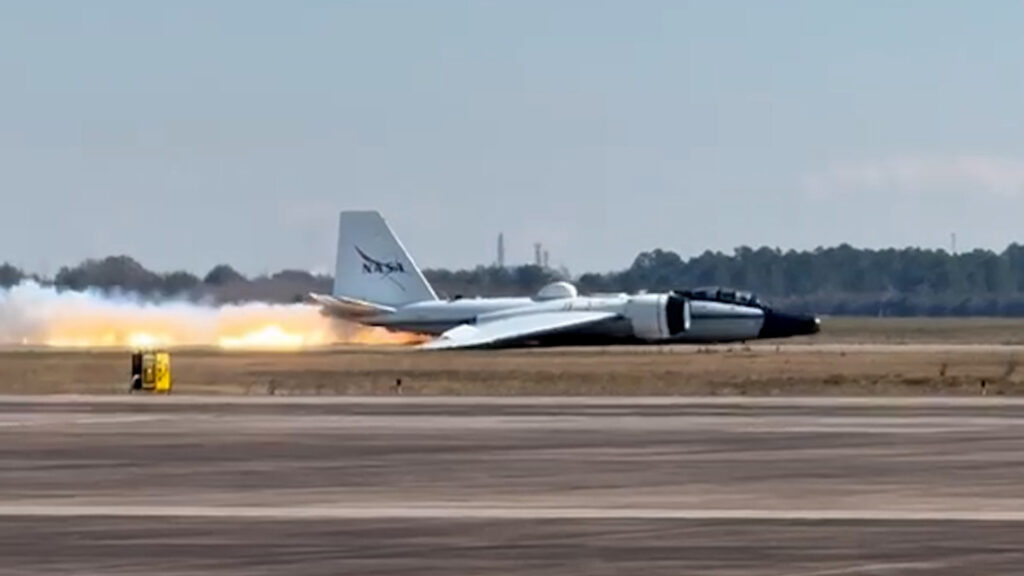
Viewer video captured a NASA research plane making a belly landing at Ellington Airport in Houston.
HOUSTON — NASA is releasing more information about a dramatic hard landing involving one of its research aircraft at Ellington Airport that sparked flames and smoke as it slid down the runway.
The agency says the two people on board — both NASA employees — were checked out after the incident and are in good health.
What happened during the landing
NASA says the aircraft was on a routine training flight when a mechanical issue forced a gear-up, or belly, landing late Tuesday morning.
Cellphone video shared with KHOU 11 shows the aircraft skidding down the runway without its landing gear deployed, with flames and smoke visible as it came to a stop. An aviation expert previously said the flames and smoke were caused by friction during the landing, noting the worst-case scenario would have been a post-landing fire.
According to a statement from Houston Airports, the incident happened around 11:30 a.m. as the aircraft was landing on Runway 17R–35L at Ellington Airport.
KHOU 11 crews arriving shortly after the landing saw two crew members exit the aircraft with help from emergency responders. One crew member appeared to visually inspect the plane before walking to an ambulance. NASA later confirmed both crew members are safe.
What we know so far
NASA says a mechanical issue resulted in the gear-up landing involving one of its WB-57 aircraft.
Video shows the aircraft sliding along the runway before coming to a stop as emergency crews responded. Houston Airports officials say first responders with a military subcontractor handled the response, and the runway where the aircraft remained was closed while crews worked to remove it.
NASA has not released additional details about the mechanical issue.
About the aircraft
The aircraft involved was a NASA WB-57 high-altitude research plane based at NASA Johnson Space Center near Ellington Field.
The NASA WB-57 High Altitude Research Program operates three WB-57 aircraft out of Ellington Field. The mid-wing, long-range research aircraft is capable of flying at altitudes above 63,000 feet and typically carries two crew members — a pilot and a sensor equipment operator — for scientific and atmospheric research missions.
Fly for about 6.5 hoursTravel up to 2,500 nautical milesCarry up to 8,800 pounds of payloadReach airspeeds of about 410 knots
Aviation expert John Celigoy said NASA pilots are among the best trained to handle emergencies, explaining that pilots are taught to flatten out the aircraft as much as possible during a gear-up landing to reduce impact.
He said a landing gear failure can range from something as simple as a switch to a larger mechanical issue, such as a hydraulic pump. He added that the aircraft’s age may have contributed to a maintenance-related problem, though the exact cause remains under investigation.
Artemis II not impacted
NASA says the incident will not affect Artemis II operations. The agency says the mission remains on track, with a dress rehearsal expected this weekend ahead of a mission around the moon in the coming weeks.
What happens next
NASA says it is leading a full investigation into what went wrong and will provide updates as more information becomes available.