
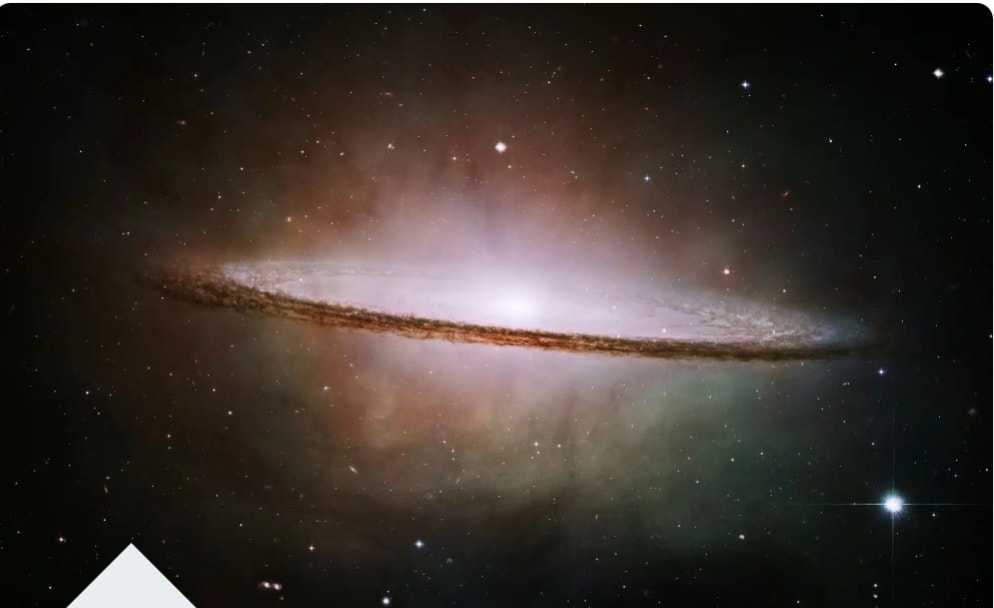
For decades, humanity has gazed into the cosmos, captivated by stars, galaxies, and nebulae. Yet, most of the universe has remained hidden—an elusive realm dominated not by light, but by darkness. Recent breakthroughs are beginning to lift this cosmic veil. After six years of meticulous observation, scientists have analyzed data encompassing 669 million galaxies, revealing the intricate structures of the universe’s mysterious “dark side.”
The findings are not just monumental in scale—they are reshaping our understanding of how the cosmos evolved, the role of dark matter, and even the fate of our universe.
Mapping the Invisible Universe
Traditionally, astronomers have relied on visible light to study the universe. But light accounts for only a small fraction of what exists. Roughly 27% of the universe is made up of dark matter, an invisible substance that exerts gravitational influence yet emits no light, and 68% consists of dark energy, a force accelerating the universe’s expansion. Together, these components form the so-called dark universe—a realm largely imperceptible to conventional telescopes.
The new study, spanning six years of data collection, used advanced weak gravitational lensing techniques. Essentially, as light from distant galaxies travels toward Earth, the gravitational pull of dark matter bends and distorts it. By measuring these subtle distortions across hundreds of millions of galaxies, scientists can infer the distribution of invisible mass, creating the most detailed map of the dark universe to date.
The Power of Six Years of Observation
The scale of this study is unprecedented. 669 million galaxies were cataloged across an enormous patch of the sky. Previous surveys examined only millions or tens of millions of galaxies, limiting the resolution and scope of cosmic maps. This new dataset allows astronomers to detect faint patterns in the cosmic web—the large-scale structure of the universe where galaxies cluster along filaments of dark matter, separated by vast voids.
“Seeing the universe in this way is like turning on a light in a room you thought was empty,” explained one of the lead scientists. “Suddenly, we can see the scaffolding that holds everything together.”
Dark Matter: The Cosmic Glue
One of the most striking revelations of this research is the behavior of dark matter, the invisible glue that holds galaxies together. By mapping the gravitational influence on hundreds of millions of galaxies, scientists have confirmed that dark matter is not evenly distributed. Instead, it forms a complex, filamentary network—a cosmic web connecting clusters of galaxies across billions of light-years.
These findings provide strong support for existing models of cosmic evolution. They show that dark matter not only dictates where galaxies form but also influences the universe’s growth over billions of years. Moreover, understanding dark matter’s distribution may help scientists probe new physics beyond the Standard Model, potentially unveiling properties of particles we have never directly observed.
Dark Energy and the Universe’s Accelerating Expansion
While dark matter holds the universe together, dark energy is pushing it apart. This mysterious force causes galaxies to move away from each other at accelerating speeds. By combining the dark matter map with precise measurements of galaxy distances, researchers can better understand how dark energy influences cosmic expansion.
The study’s preliminary findings suggest that dark energy’s effects are consistent with the widely accepted “Lambda Cold Dark Matter” model, but subtle anomalies hint at the possibility of new physics. These discrepancies could redefine our understanding of gravity, cosmic history, and even the ultimate fate of the universe.
Implications for Cosmology and Beyond
This research is more than a technical triumph—it represents a leap forward for cosmology, astrophysics, and our understanding of reality itself. With the ability to map dark matter on such a grand scale, scientists can now test theories of galaxy formation, refine predictions for cosmic evolution, and explore the interplay between visible and invisible matter.
Moreover, this survey lays the groundwork for future explorations. Next-generation observatories, such as the Vera C. Rubin Observatory and the Euclid space telescope, will expand on these findings, providing even sharper views of the dark universe.
Seeing the Unseen
For humanity, this is a profound moment. We have long been dazzled by the stars and galaxies we can see, yet they constitute only a tiny fraction of reality. By studying the universe’s dark side, scientists are illuminating the unseen forces shaping everything—from the smallest particles to the largest cosmic structures.
As we continue to explore the hidden universe, we move closer to answering fundamental questions: What is dark matter? What drives dark energy? And ultimately, what is the fate of the cosmos? Six years of patient observation and the data of 669 million galaxies have brought us one step closer to uncovering the universe’s deepest secrets.