
By Autumn Shelton, RealWV
CHARLESTON, W.Va. – The West Virginia House of Delegates, on Tuesday, passed a bill that would amend current state law on human trafficking and create a new state crime of human smuggling of “illegal aliens.” However, before the bill can become a law, it must make it through the Senate, an outcome that hasn’t happened with similar legislation in previous years.
House Bill 4433 was introduced on Jan. 16 by Del. Bill Ridenouer, R-Jefferson, and initial discussion on the bill occurred on Jan. 19 in the House Judiciary Committee. During that meeting, Ridenouer explained the bill.
According to Ridenouer, in addition to increasing the penalties for human trafficking, the bill defines human smuggling as “knowingly transporting, transferring, receiving, isolating, enticing, or harboring an illegal alien to avoid enforcement of immigration laws.”
Ridenouer continued that the law would exclude the voluntary transportation of an “illegal alien” by an immediate family member or any person acting within the scope of legal federal or state employment who is transporting the illegal alien consistent with United States law, provided that the “illegal alien being transported through this state shall not be transported to this state for permanent placement.”
Penalties for knowingly smuggling an adult ranges from a three to fifteen year felony sentence in a state correctional facility and a five to twenty year felony sentence for knowingly smuggling a minor, Ridenour said, noting that any vehicle used to transport the “illegal alien” is subject to forfeiture, seizure and sale – provided the vehicle’s owner knowingly engaged in human trafficking or smuggling.
The bill also sets forth additional penalties for human trafficking or smuggling that results in forced labor or sexual servitude, orders a convicted person to pay restitution to the victim, including third parties who incurred costs as a result of the offense, and provides exemptions for medical, mental health and legal services personnel.
After passing committee, and being read for a first and second time in the House, on Tuesday the bill was passed along party lines with 81 yes votes to 9 no votes. However, the bill’s constitutionality was questioned prior to its passage.
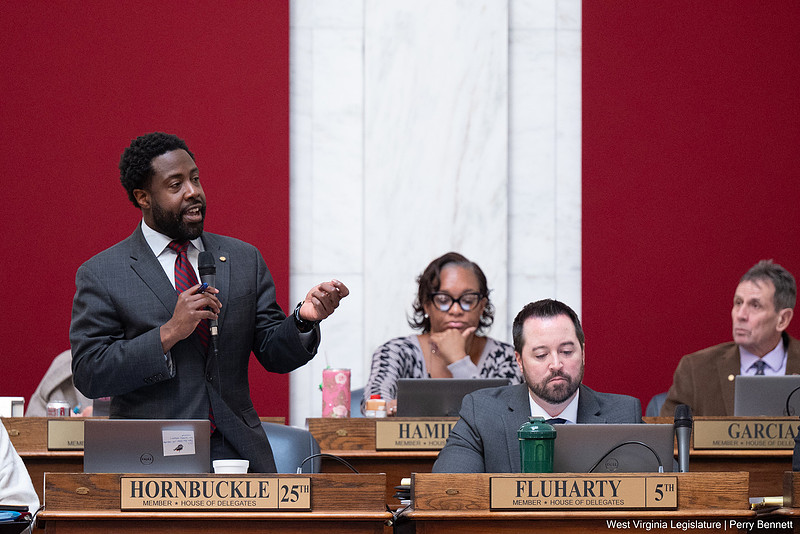
House Minority Leader Sean Hornbuckle, D-Cabell, said that this issue has been debated for three years because the bill is “flawed.”
“There is some good in this bill,” Hornbuckle began. “There are parts that we can all agree on and all support, or at least I hope, we have harsher penalties for human trafficking, got restitution in there, these are great things . . . But, I fear that the bad outweighs the good.”
Hornbuckle explained that this is a federal issue, not a state issue, and doesn’t address the real concerns of West Virginians, like providing jobs.
“This will create conflicting laws, we believe, and also it will infringe upon the U.S. government in the current federal administration,” Hornbuckle said.
“As this bill is written, it goes after West Virginians and not illegal aliens,” Hornbuckle continued. “It targets and captures innocent [people], not just those with ill intent. It’s going to infringe upon people practicing religious freedoms, people invoking their first and fourth amendment rights – the smuggling portion is far too vague and overly broad.”
Hornbuckle said that “times have changed,” adding that, today, it’s “all about ICE” (U.S. Immigration and Customs Enforcement) and the interactions that may happen in West Virginia.
“That is the reality of a piece of legislation like this,” Hornbuckle said. “We’ve all had our attention piqued this past week with another senseless murder. That’s what we’ve done in our country, and we won’t stand for it in our state.”
House Judiciary Chair J.B. Akers, R-Kanawha, responded that although this bill has received negative attention in the media for its perception as a “waste of the state’s time,” he finds the response “shocking” due to national trafficking statistics.
“We’ve heard talk about the upcoming World Cup that there are concerns about human trafficking with regard to that event, and we know that human trafficking has occurred in other countries with the FIFA World Cup and other sporting events,” Akers said. “These are real issues.”
Akers continued that this bill sends a message that West Virginia won’t tolerate human smuggling.
“Even if we are sympathetic to some of the folks who want to come to this country, who pay to be smuggled here, that money goes toward funding drug cartels that poison our country and our state,” Akers said. “And for every penny we spend fighting the Sinaloa Cartel and other cartels that smuggle people, that’s money that could be spent improving our roads, improving our schools, improving our infrastructure. The less we have to fight human smuggling and trafficking, the more money we have to help our state, and that creates jobs. More importantly, it protects lives, but there are economic benefits as well.”
Akers clarified that the bill is not about penalizing those who want to help illegal immigrants, like church groups.
“Under this bill, you could literally have a church with a sign out front that says, ‘Free food for illegal immigrants,’ and this bill would not criminalize that in any way shape or form,” Akers said. “You can provide as much help as you want as long as you’re not trying to break the law in the process. And that is consistent with federal law.”
House Bill 4433 is now headed to the Senate for their consideration.