
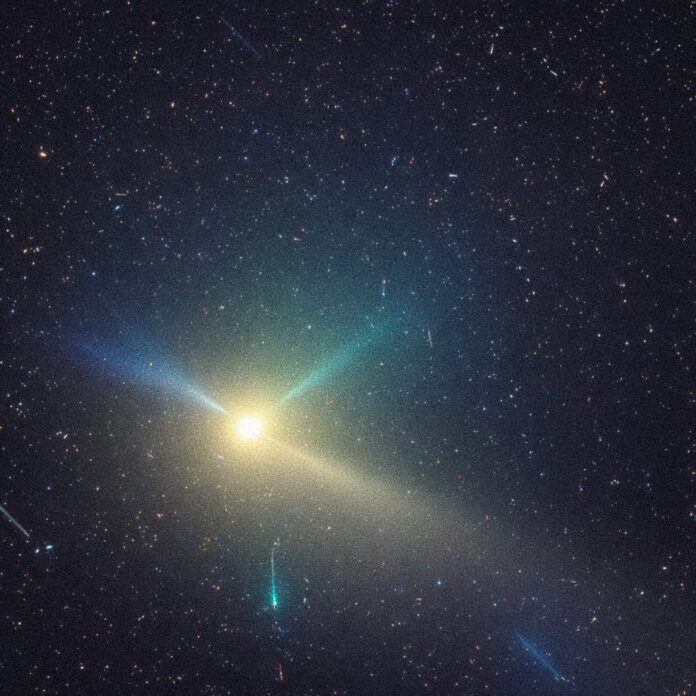
 Interstellar comet 3I/ATLAS captured by the Hubble Space Telescope on January 22, 2026. The image reveals asymmetric emission features and multiple jet-like structures extending from the nucleus, diverging from typical cometary morphology. Image credit: NASA / Man-To Hui, Shanghai Astronomical Observatory. Used for news reporting and analytical commentary under fair-use principles pursuant to 17 U.S.C. §107.
INSIDE THIS REPORT
The image is quiet at first glance, almost serene. A bright nucleus sits suspended in a dense star field, its luminous envelope tapering outward into space.
But closer inspection reveals complexity. Multiple emission features appear to radiate from the object at distinct angles, forming a geometry that is neither symmetrical nor easily explained by standard solar-driven outgassing.
For scientists and independent analysts tracking 3I/ATLAS, the image adds weight to a growing body of evidence that this interstellar visitor may not behave like any ordinary comet previously observed.
A high-resolution Hubble image captured on January 22, 2026 reveals asymmetric light structures and jet behavior in interstellar object 3I/ATLAS that diverge from conventional comet models.
[USA HERALD] – The image under review was captured by the Hubble Space Telescope on January 22, 2026, and released with credit to NASA and Man-To Hui of the Shanghai Astronomical Observatory. Hubble’s optical resolution and stable imaging platform make it uniquely suited for detecting faint structural details in cometary comae and tails, particularly at interstellar distances.
This image has not been materially altered for analysis beyond standard contrast normalization necessary for publication. No compositing, artificial colorization, or structural enhancement techniques were applied that would introduce artifacts or obscure native features.
Forensic Observations
At the center of the image, the nucleus of 3I/ATLAS appears as a saturated, high-intensity point source surrounded by a diffuse coma. Extending from this region is a dominant dust tail angled diagonally across the frame, consistent with solar radiation pressure acting on particulate matter.
What distinguishes this image, however, is the presence of multiple narrow emission features that do not align with the primary dust tail. At least two distinct jets are visible emerging from the nucleus region at sharply different orientations, forming a fan-like or bifurcated structure.
One emission feature appears faint and bluish, extending upward and slightly backward relative to the main tail. Another narrower structure extends downward, exhibiting a tighter collimation than typical dust dispersal. The angular separation between these features suggests discrete emission sources rather than a single isotropic outflow.
Such geometry is inconsistent with a uniformly sublimating surface and instead indicates localized, directionally constrained release mechanisms.
Departure From Conventional Comet Behavior
In standard comet models, jets form when solar heating activates volatile pockets on a rotating nucleus, producing emissions that curve and smear as the comet spins. Over time, these jets typically blend into broader structures or display predictable rotational modulation.
In this image, the emission features appear sharply defined and persistent, with no visible curvature or dispersion consistent with rapid rotation during the exposure window. This raises questions about whether the emitting regions are deeply recessed, structurally shielded, or governed by material properties not commonly seen in Solar System comets.
Additionally, the relative brightness of the secondary emissions compared to the main dust tail suggests that gas-dominated processes may be contributing significantly to the observed structure.
Compositional and Structural Implications
Previous spectroscopic observations of 3I/ATLAS have already indicated the presence of uncommon materials, including nickel-bearing compounds. When combined with the emission geometry observed here, the image supports the hypothesis that the object may possess internal compositional layering or heterogeneous material domains.
Such layering could allow for selective venting along fractures, seams, or mechanically distinct regions, producing the kind of directional emissions visible in this image. Unlike loosely aggregated “rubble pile” comets, this behavior is more consistent with a cohesive, internally structured body.
This does not imply artificial origin, but it does place 3I/ATLAS outside the behavioral norms established by decades of cometary observation.
Why This Image Matters Now
As only the third confirmed interstellar object detected passing through our solar system, 3I/ATLAS represents a rare opportunity to study material formed around another star. Every high-quality image contributes not just visual data, but constraints on physical models that must account for what is actually observed.
This Hubble image arrives at a critical moment, as researchers continue to debate whether existing comet frameworks are sufficient to explain the object’s behavior. The sharply angled, multi-directional emission structures documented here will likely factor into future peer-reviewed analyses and mission planning discussions.
Further monitoring of 3I/ATLAS, particularly as viewing geometry changes, will be essential in determining whether these emission features persist, evolve, or dissipate. If they remain stable over time, they may point to fixed structural characteristics rather than transient surface activity.
For now, the image stands as a compelling piece of visual evidence that 3I/ATLAS is not simply another icy wanderer, but a complex interstellar object whose physical story is still unfolding.
About the Author
Samuel Lopez is an investigative journalist and legal analyst with over two decades of experience examining complex evidence across legal, scientific, and policy domains. As a contributor to USA Herald, Lopez specializes in forensic-style reporting that applies evidentiary rigor to emerging issues in science, law, and public accountability.