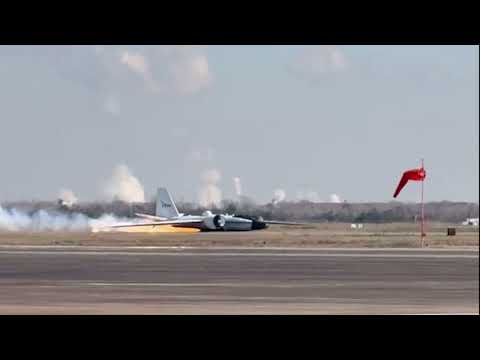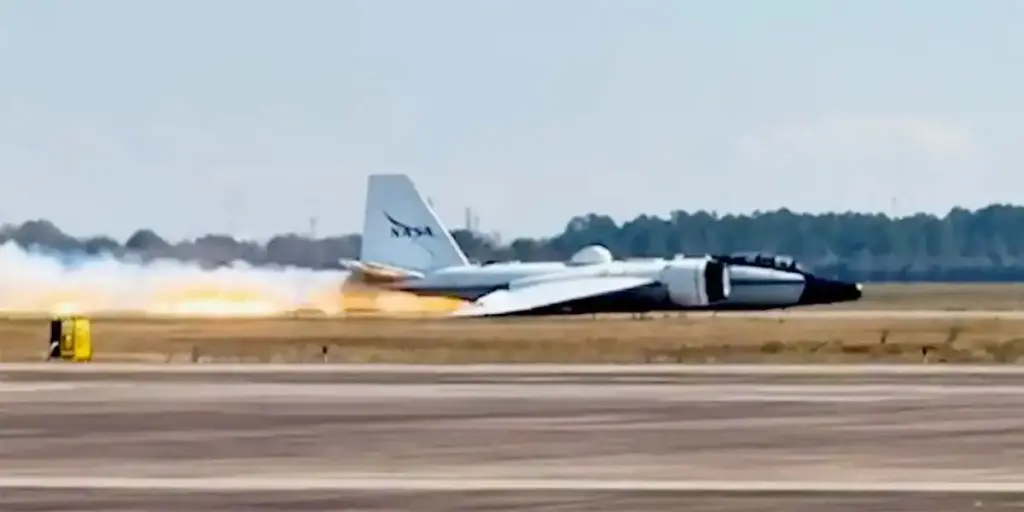
NASA WB-57 belly landing at Ellington Field
A NASA WB-57 research plane malfunctioned and had to touch down in Texas without landing gear on Jan. 27, 2026 sliding across the runway on its belly and sending plumes of flame behind it, the video featured in this post shows.
NASA said in a post on X that the crew landed the plane at Ellington Field, southeast of Houston, and are “all safe at this time,” and that there was “mechanical issue” that will be investigated.
As the video shows, the WB-57 slowly descended toward the runway, then touched down with a jolt, its wings bounced as yellow fire and white smoke bursts from beneath it. It steadily slid down the track, the flames burst and disappeared in a cloud of smoke. The aircraft began to slow before the ending of the video.
According to ABC News, local news footage from KHOU 11 shows the plane at a stop, the cockpit hatch open, fire trucks flashing nearby and emergency responders working around the black nose of the aircraft.
High Altitude Research Program
The NASA Johnson Space Center (JSC) in Houston, Texas is the home of the NASA WB-57 High Altitude Research Program. Three WB-57 aircraft are based near JSC at Ellington Field. The aircraft have been flying research missions since the early 1970’s, and continue to be an asset to the scientific community with professional, reliable, customer-oriented service designed to meet all scientific objectives.
The WB-57 is a mid-wing, long-range aircraft capable of operation for extended periods of time from sea level to altitudes in excess of 63,000 feet. Two crew members are positioned at separate tandem stations in the forward section of the fuselage.
Unique, high-altitude airborne platforms to US Government agencies
The pilot station contains all the essential equipment for flying the aircraft while the sensor equipment operator (SEO) station contains both navigational equipment and controls for the operation of the payloads that are located throughout the aircraft. The WB-57 can fly for approximately 6.5 hours, has a range of approximately 2500 miles, and can carry up to 8,800 lbs of payload.
The NASA WB-57 Program provides unique, high-altitude airborne platforms to US Government agencies, academic institutions, and commercial customers in order to support scientific research and advanced technology development and testing at locations around the world. Mission examples include atmospheric and earth science, ground mapping, cosmic dust collection, rocket launch support, and test bed operations for future airborne or spaceborne systems.