
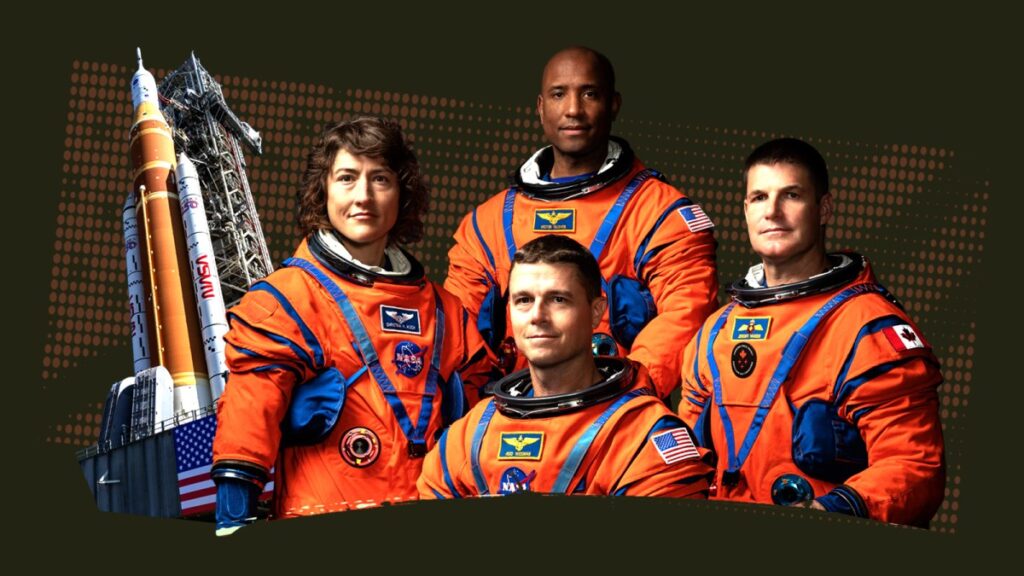
On every visit to Cape Canaveral, Nasa’s gateway to space, Reid Wiseman makes a point of visiting the bleak slab of concrete and rusting steel that once formed part of Launch Complex 34.
The scene of seven rocket launches in the 1960s, it was also where 59 years ago three astronauts were killed in an electrical fire that tore through their Apollo capsule during a launch rehearsal.
“In memory of those who made the ultimate sacrifice so others could reach for the stars. Ad astra per aspera (a rough road leads to the stars). God speed to the crew of Apollo 1,” a plaque on the abandoned pedestal reads.
On the eve of their own launch day practice in December, Wiseman, the commander of Nasa’s upcoming Artemis II mission to the moon, visited the deactivated site with his crewmates Victor Glover, Christina Koch and Jeremy Hansen.
It was a “moving, sombre, necessary” experience, Wiseman said, honouring the memories of Gus Grissom, Ed White and Roger Chaffee, whose deaths on January 27, 1967, forced Nasa to confront the human cost of exploration.

Reid Wiseman
UPI/ALAMY LIVE NEWS
That reckoning echoed again after the Challenger shuttle disaster 40 years ago this Wednesday, and the breakup of the Columbia space shuttle on February 1, 2003, which together claimed the lives of 14 astronauts. Each prompted institutional introspection and drove reforms that embedded safety and risk awareness more firmly into the agency’s culture.
That legacy underpins the decisions facing mission managers as they assess whether Nasa’s Space Launch System rocket and Orion spacecraft are ready to send the Artemis II crew around the moon and bring them safely home.
• Inside Nasa’s Artemis II mission to the Moon
“It is vital that we stay vigilant and remember those who made the ultimate sacrifice in the name of science and discovery,” the agency said.
By next week, technical teams aim to have conducted a critical “wet dress rehearsal”, loading the SLS rocket with 733,000 gallons of super-cooled propellant and running through launch procedures, stopping ten seconds short of ignition to help determine flight readiness.
Sixteen potential launch dates have been identified over the coming three months, starting with February 6, based on Earth-moon alignment.
On January 23, the astronauts entered quarantine in Houston, Texas, withdrawing from public contact, wearing masks and social distancing to reduce infection risk. If the February launch is ruled out, they will lift the health precautions until two weeks before a new target date.
The final stretch has been a reflective one. Wiseman, 50, a US navy aviator selected to be an astronaut in 2009, lost his wife to cancer in 2020 and raised their teenage daughters, Ellie and Katherine, while simultaneously training for the mission. He has not shielded them from the realities of risk. “I try to train them openly and honestly. It’s the best thing you can do,” he said.

The crew with children at Cape Canaveral before going into quarantine
JOE RAEDLE/GETTY IMAGES
A month before the launch, the crew’s families gathered at Johnson Space Centre (JSC) in Houston to learn more about the endeavour. Its aim is to test the vehicles with a 600,000-mile journey beyond the moon and back, to prepare for future missions that will establish a sustained human presence on the surface.
“Our kids know each other, spouses know each other … I know who everyone is going to lean on to get through this together while we’re up there,” Wiseman said. “Then there are the more personal touchpoints. I went on a walk with my kids; I told them: ‘Here’s where the will is, here’s where the trust documents are and if anything happens to me, here’s what’s going to happen to you.’”
Glover, 49, the pilot on Artemis II, is a former navy F/A-18 Hornet aviator, weapons test pilot, combat veteran and onetime navy legislative fellow in the office of the late senator John McCain.

Victor Glover
MIGUEL J. RODRIGUEZ CARRILLO/AFP/GETTY IMAGES
He is married with four daughters and the risk is “something I think about a lot’. He added: “Those are tough talks, but you have to have those talks.”
An astronaut escort has been assigned to each family for the duration of the ten-day mission, including at its launch from Kennedy Space Centre in Florida, “which can be this terrific and terrifying moment all at the same time,” Glover said.
Koch, 46, developed a love for engineering while working alongside her father in his shed as a child. She liked things that made her feel small: the ocean, the night sky, countries where there was no Walmart.
She worked at the South Pole and in Greenland, Alaska and American Samoa before becoming an astronaut, a profession for which she submitted her application in 2011 while 500 miles north of the Arctic Circle.

Christina Koch
MIGUEL J. RODRIGUEZ CARRILLO/AFP/GETTY IMAGES
Her husband Bob, a program manager in the US army corps of engineers, has immersed himself in the mission details. “He’s very inquisitive about the technical aspects … what are the big milestones, what are the risky parts, when can he sigh a sigh of relief, when does he need to be glued to the TV,” she said.
“I really have to make sure he knows that, not like the International Space Station where we can just make a phone call, he’s not going to be able to call me and ask where something is in the house. He’s going to have to find it. That’s been a big one for us.”
Hansen, 49, a physicist and former Royal Canadian Air Force CF-18 fighter pilot, is the only non-American on the crew and the only one yet to fly in space.

Jeremy Hansen
MIGUEL J. RODRIGUEZ CARRILLO/AFP/GETTY IMAGES
He sat down with his wife and three teenagers over Christmas to watch video from Artemis I, a non-crewed test flight of SLS and Orion in 2022 “to point out a few things that can catch you off guard. Like when the main engines light, it does look like for a few seconds the rocket is blowing up … so, letting them know about that,” he said.
The crew has trained since April 2023, logging thousands of hours in simulators, where they have practised everything from minor mishaps to near-disaster scenarios.
They undertook expeditions to the remote, lunar-like basalt landscapes of Iceland and a meteorite crater in Newfoundland, Canada, to hone geological observation skills.
They completed water survival training at the Neutral Buoyancy Laboratory at JSC and splashdown recovery exercises on a navy ship in the Pacific, where they shared a cabin to simulate Orion’s tight quarters. “To be honest, we’ve really become a family,” Koch said.

Nasa’s Artemis II crew
JOE RAEDLE/GETTY IMAGES
On January 22, Wiseman took a stroll through JSC’s Astronaut Memorial Grove where a tree is planted for every fallen space explorer.
“When I look at the future, when we talk about what is our legacy, I don’t want to look five years or ten years in the future,” he said. “I want to look a hundred or two hundred years in the future and honestly … I hope we’re forgotten.
“If we are forgotten, then Artemis has been successful. We’ll have humans on Mars, humans out on the moons of Saturn … maybe we’ve invented something we’ve never even dreamed of and maybe we inspired some kids somewhere. Maybe that’s our footnote: we inspired Susie or Johnny to do what they did. That would be magical.”