
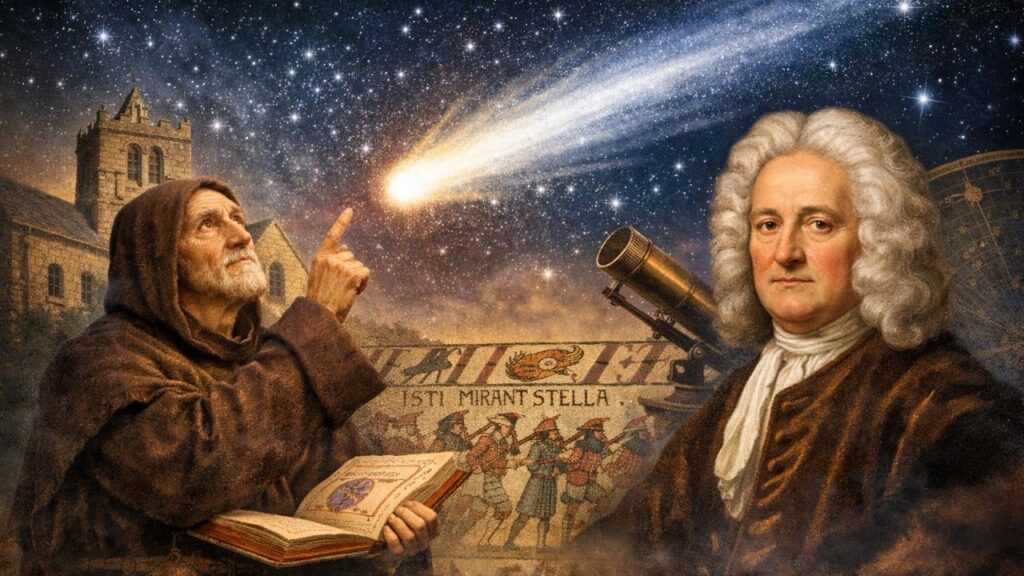
Halley’s Comet, one of the most famous recurring objects in the night sky, has long been credited to 18th-century astronomer Edmond Halley for its identification as a periodic comet. With an average return interval of about 76 years, the comet has been observed repeatedly throughout recorded history, most recently in 1986, and is next expected in 2061.
New historical research, however, suggests that the comet’s cyclical nature may have been recognized centuries earlier. Medieval evidence indicates that an 11th-century English monk, Eilmer of Malmesbury, linked two separate comet appearances, effectively identifying the same object nearly 600 years before Halley formalized its orbit.
These findings are prompting scholars to reassess the development of astronomical knowledge in the Middle Ages and to reconsider how early observational insights are credited in the history of science.
Why Halley’s Comet Holds Scientific Importance
Halley’s Comet is classified as a short-period comet originating from the Kuiper Belt, a region of icy bodies beyond Neptune. Its highly elongated orbit brings it into the inner solar system at regular intervals, making it visible from Earth under favorable conditions. Because of this predictability, the comet has served as a key reference point in the study of cometary motion and solar system dynamics.
In 1705, Edmond Halley used Isaac Newton’s laws of gravitation to demonstrate that comets observed in 1531, 1607, and 1682 were the same object. He predicted its return in 1758, a forecast that proved correct and marked a turning point in astronomy. From that moment, comets were understood not as random or atmospheric events but as celestial bodies governed by physical laws.
Evidence of Earlier Observations Across Civilizations
Historical records show that Halley’s Comet was observed long before the early modern period. Chinese astronomers documented a bright comet consistent with Halley’s orbit as early as 240 B.C.E., while Babylonian and later Islamic scholars also recorded similar events. These accounts preserved valuable positional and visual data.
However, most early records treated comet appearances as isolated events. While observers carefully noted their characteristics, they generally did not attempt to connect one appearance with another decades or centuries later. The concept of periodicity remained largely unexplored.
The 1066 Observation and Eilmer’s Insight
The new research focuses on medieval England, particularly on accounts preserved by William of Malmesbury in his chronicle Deeds of the Kings of the English. According to William, Eilmer of Malmesbury reacted to the comet seen in 1066 by declaring that he had witnessed the same phenomenon decades earlier.
The earlier appearance likely occurred in 989, placing the interval between sightings close to the comet’s known orbital period. This suggests that Eilmer did more than simply observe the comet; he recognized its return as part of a repeating cycle.
While Eilmer interpreted the comet within the medieval framework of omens and divine warnings, his ability to identify recurrence stands out as a rare example of analytical reasoning in an era without mathematical astronomy.
Comets, Omens, and Historical Context
In medieval Europe, comets were commonly viewed as harbingers of disaster. The comet’s appearance in 1066 coincided with political turmoil in England, culminating in the death of King Harold Godwinson at the Battle of Hastings and the Norman Conquest.
The comet’s cultural impact is reflected in its depiction on the Bayeux Tapestry, where it appears as a striking celestial sign accompanying major historical events. This widespread attention ensured that the sighting was remembered and recorded, increasing the likelihood that individuals like Eilmer could compare it with earlier experiences.
How Eilmer’s Observation Differs From Halley’s Work
Eilmer and Halley approached the comet from fundamentally different intellectual contexts. Eilmer relied on memory, chronicles, and approximate dating to recognize recurrence, while Halley used mathematical models and physical theory to explain and predict it.
Halley’s contribution transformed observational insight into a testable scientific framework. His work allowed future astronomers to refine orbital calculations and to study comets as dynamic components of the solar system.
Why the Comet Is Unlikely to Be Renamed
Some scholars have suggested that Eilmer’s role deserves greater recognition, even raising the question of whether Halley’s Comet should bear a different name. Scientific convention, however, typically prioritizes predictive and explanatory breakthroughs over early recognition.
Halley’s ability to forecast the comet’s return remains central to its modern identity. As a result, while Eilmer’s insight enriches historical understanding, it is unlikely to change established nomenclature.
The suggestion that an 11th-century monk identified Halley’s Comet centuries before Edmond Halley adds depth to the history of astronomy. Eilmer of Malmesbury’s observation demonstrates that medieval scholars could recognize long-term celestial patterns despite limited tools and theoretical frameworks.
Rather than diminishing Halley’s legacy, this research highlights the cumulative nature of scientific discovery. Observation, insight, and explanation often unfold across generations, each contributing to a fuller understanding of the natural world.
FAQs
Did Eilmer of Malmesbury truly discover Halley’s Comet?
Eilmer did not discover the comet in the modern scientific sense, but historical evidence suggests he recognized that the comet he saw in 1066 had appeared before, implying an understanding of its recurrence.
How accurate was Eilmer’s estimate of the comet’s cycle?
The interval between the sightings Eilmer likely referenced—989 and 1066—closely matches the comet’s known average orbital period of about 76 years, supporting the credibility of his observation.
Why is Edmond Halley still credited with the comet’s name?
Halley provided the first mathematical explanation and accurately predicted the comet’s return, a breakthrough that transformed astronomy and established the comet as a predictable object.
When will Halley’s Comet next be visible from Earth?
Halley’s Comet is expected to return to the inner solar system and become visible again around the year 2061.
Why is the 1066 appearance historically significant?
The 1066 appearance coincided with major political events in England and was widely recorded, including its depiction on the Bayeux Tapestry, making it one of the most documented comet sightings of the medieval period.

Aslam Imandar is a dedicated Indian content writer at BhandaraDCCB.in, with a keen focus on recruitment notifications, exam updates, government schemes, and result announcements. With an eye for detail and a commitment to accuracy, he simplifies complex updates for job aspirants and students across India.