
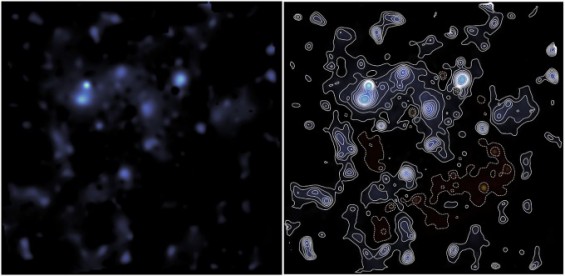
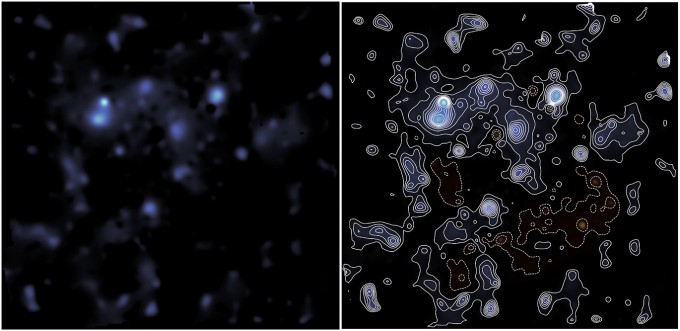
A dark matter map of a region in the constellation Sextans, created using observations from the Hubble and James Webb Space Telescopes. On the right, contour lines mark areas of similar dark matter density. The blue areas show the highest concentrations of dark matter. Courtesy of Gavin Leroy/COSMOS-Webb
An ultra-high-resolution map showing the mass distribution of the universe, including dark matter, has been released. With more than double the resolution of previous maps, it reveals the vast, invisible skeletal structure of the cosmos. The new map is expected to provide a benchmark for verifying how dark matter has influenced the growth of stars, galaxies, and the universe over the past 10 billion years.
A research team led by Diana Scognamiglio of the California Institute of Technology’s (Caltech) Jet Propulsion Laboratory (JPL) has created the highest-resolution dark matter map to date, publishing their findings on the 26th (local time) in the international journal ‘Nature Astronomy’.
According to the Standard Model of cosmology, the universe is composed of 68.3% dark energy, 26.8% dark matter, and 4.9% ordinary matter. Dark matter is a concept used to explain phenomena like the movement of celestial objects; it cannot be seen by eye or telescope, but it has mass and thus exerts gravitational force. Scientists theorize that dark matter first clumped together and then attracted ordinary matter to form stars and galaxies.
Light from distant galaxies is distorted by gravity before reaching Earth. By measuring the extent of this distortion, researchers can trace the distribution of mass along the light’s path. This method allows them to map the likely locations of dark matter based on the calculated mass distribution.
The research team used data from NASA’s James Webb Space Telescope (JWST) to measure the shapes of about 250,000 galaxies and reconstruct a detailed mass map. The area analyzed for the new map is located in the constellation Sextans and is about 2.5 times larger than the full moon.
The map revealed the ‘dark filamentary bridge’ network, a large-scale structure that forms the skeleton of the universe, as well as low-mass galaxy groups that were previously unobservable because they were too distant or faint.
“This is the largest dark matter map produced with JWST,” said Scognamiglio. “Thanks to JWST, we can see the invisible skeleton of our universe with stunning detail.”
Gavin Leroy, a researcher in the Department of Physics at Durham University in the UK who participated in the study, stated, “The map reveals the invisible yet essential role of dark matter, the true architect of the universe. It shows how the universe’s invisible components enabled the emergence of galaxies, stars, and ultimately, life.”
The team’s goal is to create a dark matter map spanning the entire universe using the European Space Agency’s (ESA) Euclid Space Telescope, launched in 2023, and NASA’s next-generation Nancy Grace Roman Space Telescope.
– doi.org/10.1038/s41550-025-02763-9
Copyright ⓒ DongA Science. All rights reserved.