
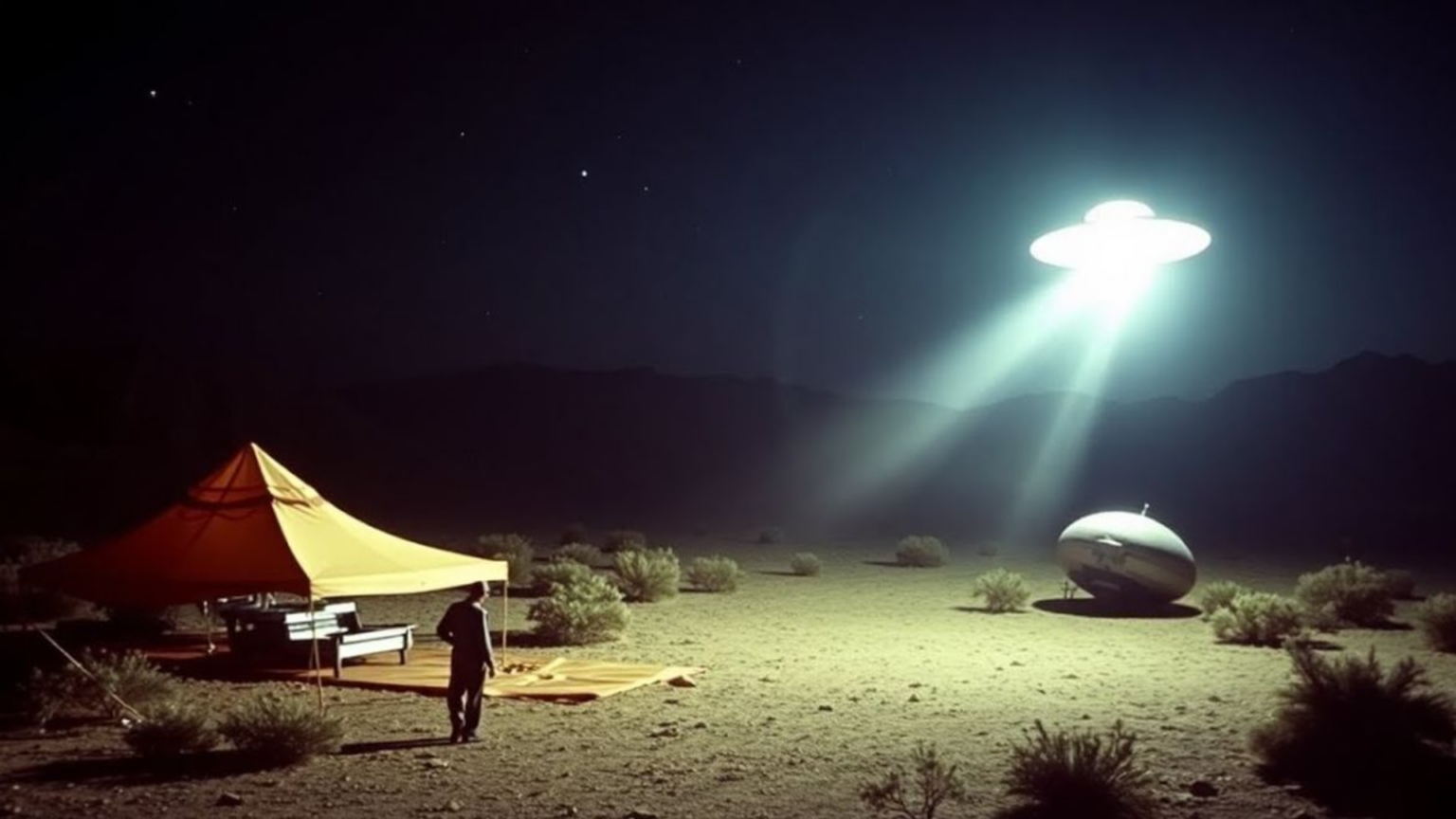
In the small town of Cláudio, Minas Gerais, a UFO chase in 2008 continues to puzzle experts and local authorities. The revelations, documented in exclusive interviews by researcher Lauro Miguel, provide a rare glimpse into an official pursuit of phenomena that remains unexplained.
Sergeant William recalls the first incident during a night shift near the landmark known as ‘The Four Crosses.’ The garrison, including Sub-commander Valdir and Lieutenant House, observed three luminous objects appearing through a dense white cloud. ‘Two balls vertically and one horizontally,’ William stated, describing movements that no conventional aircraft could achieve. The climax came when one of the spheres, radiating a star-like brightness, accelerated and decelerated to hover above a commercial airplane, then vanished in a flash.
The Sergeant emphasised the eerie precision of the objects: ‘It accelerated suddenly and decelerated, stopping right over the plane… The jet continued its trajectory and, suddenly, it left. It accelerated and disappeared.’ Witnessing an aerial manoeuvre that defied Newtonian physics left the officers grappling with both awe and duty.
Chaos Over the Power Plant
The second sighting occurred when William was off duty but summoned by Valdir to the local power plant. There, three spheres performed erratic motions reminiscent of subatomic particles, moving in patterns he compared to ‘electrons, protons, and neutrons.’ Pursuing them to Santa Inês Farm, the orbs descended to under 100 metres, emitting a peculiar ‘contained light.’
William described the optical anomaly: ‘It shone intensely like the Sun, but it did not illuminate the surroundings. The light was contained right there.’ During the encounter, the police vehicle suffered an inexplicable mechanical failure, further adding to the mystery. Experts suggest that the effect might relate to a phenomenon now described as an impedance horizon, where apparent motion and light behaviour decouple from conventional physics, creating an illusion of impossible acceleration.
Duty Over Disbelief
Lauro Miguel asked why officers would risk ridicule by reporting such extraordinary events. William’s response emphasised the primacy of duty: ‘We did not invent this. Something happened there, and it had to be put on paper.’ He continued, explaining the legal obligation to record such incidents: ‘From the moment the police were provoked, we could not neglect our duty. We had to report this fact to the superior command.’
Even amid the strangeness, the officers were motivated by responsibility rather than curiosity. Lieutenant House and Valdir were awaiting promotions, yet William insisted that career incentives were secondary to the obligation to document anomalous occurrences. The official reports, previously classified or ignored, now reveal a rare example of a disciplined and formal response to unexplained aerial phenomena.
Scientific Perspectives on the Phenomenon
Physicists analysing the Cláudio Case note that apparent violations of inertia or light speed may be explained by atmospheric effects or medium engineering, not true propulsion anomalies. Sergeant William’s description of contained light and hovering spheres could align with a type of impedance horizon, where the visual environment around an object distorts without moving the object in conventional terms.
‘It is technically medium engineering, not propulsion,’ explains one theorist. ‘A thing does not need to violate inertia, cancel mass or outrun light to appear to stop instantly or pace an aircraft.’ This insight provides a potential scientific framework for interpreting the Cláudio sightings, yet it does not diminish the witnesses’ credibility. Military officers and commercial pilots alike reported events in real time, with corroborating documentation and vehicle malfunctions adding weight to their testimonies.
The Cláudio Case remains a landmark in ufology, demonstrating that even highly trained and disciplined personnel can encounter phenomena that challenge our understanding of physics. As Sergeant William concludes, ‘We could not neglect our duty. What we saw demanded it be recorded.’ For researchers and enthusiasts, the case continues to highlight the thin boundary between documented military encounters and the mysteries of the skies above Brazil.