
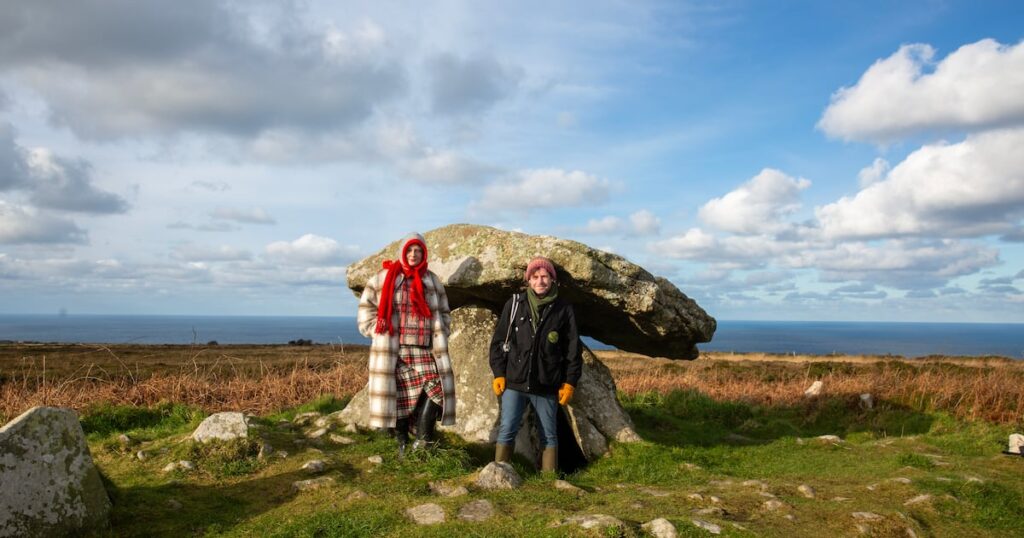
For travellers like me with a yen for the prehistoric, mystical or folkloric, the south-western corner of Britain’s Celtic fringe still hums with the unconventional energy that has magnetised off-gridders of all kinds to come to “Kernow” – Cornish for Cornwall – for hundreds of years.
Cornwall has a dense concentration of ancient stone sites. To nail down which to visit on my short trip to Cornwall, I contact Lally MacBeth and Matthew Shaw, a bohemian couple with an in-depth knowledge of the region. Both artists, the pair met through their mutual love of the Cornish landscape and in 2021 founded Stone Club, a place, they say, for stone enthusiasts to “congregate, muse and stomp to stones” (see stoneclub.rocks).
I feel lucky to have MacBeth and Shaw accompany me in a rented car day trip to their choice of Cornwall’s lesser-known prehistoric stone gems. MacBeth chats as the car dips and ducks through the gently valleyed Cornish landscape.
“Just after Covid lockdown,” she says, “when everyone was coming out to re-explore the world, we were doing lots of walking and we’d bump into people at stone sites. They felt like they had similar drives, in that they were asking questions about what it all meant. From that a kernel of an idea formed.”
First intended for their friends, Stone Club quickly spiralled to 4,000 members around the world. “We run an event once a month in London,” says MacBeth, “and we curate pop-up arts events and folk raves in Cornwall and around the UK.”
Given that Stone Club explores the past from angles that have historically been considered alternative by the mainstream, “it was a real moment,” MacBeth says, “when we saw that archaeologists were joining, because it added a layer of legitimacy. We’ve had people give talks about ley lines [the idea of invisible lines creating alignments between historic structures], UFO theory, slightly out-there stuff – but we’re not offering any judgment. We want to make a space that’s inclusive and welcoming to all.”
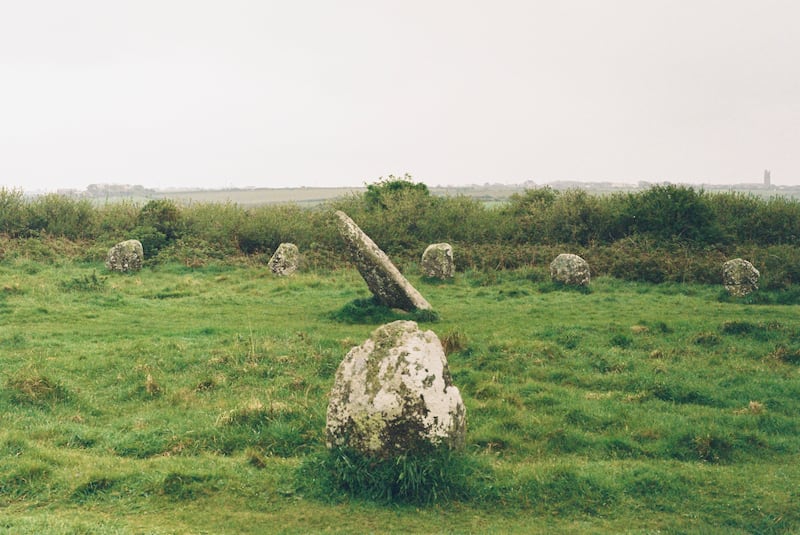 Boscawen-Un Bronze Age stone circle close to St Buryan in Cornwall
The first stop on our road trip is Boscawen-Un, a Bronze Age stone circle. I sense the processional nature of the pathway as we walk towards the site: a portal to an ancient past that continues to exert a powerful attraction for modern-day esotericists. In her 1957 book about Cornwall, The Living Stones, the occultist and surrealist artist and writer Ithell Colquhoun provided a detailed account of seeing bards in blue robes at a “gorsedd” or druid ritual that took place in 1950 at this very stone circle.
“That central stone: people used to think that it had sunk and tipped to the side,” says Shaw. “But now archaeologists think it was always supposed to be in that leaning shape, so that it would function astrologically or as a sundial.”
He points out two lozenge-shaped carvings beside each other on the underside of the sloping stone.
“They were obviously carved before the stone was in situ. The carvings look like Bronze Age axe heads, but there are similar ancient carvings in Brittany which represent feet. So another theory is that the Boscawen-Un carvings are feet rather than axe heads – not indicating conflict, but a pilgrim way; representing that you’re walking in someone else’s shoes, on someone else’s path.”
All the stones in this circle are granite, apart from one made of bright quartz. We put our hands on it. Pulsations from the quartz stone seem to throb through my hands. Shaw, MacBeth, and our friend accompanying us, folk singer Dina Ipavic, say they feel the stone’s energy pulses, too.
On the ground beside the quartz stone is a slim L-shaped branchlet – a divining rod left by a previous visitor. Shaw demonstrates how to use it to find a ley line running through the middle of the stone circle. Ipavic takes the rod as a memento when we leave, but she is compelled to return it to where it was found when she feels it twisting in her hand to point back towards the circle.
We drive through the small nearby community of St Buryan, home to Cassandra Latham-Jones, notable as the first person in Britain to have registered her occupation, 30 years ago, as a “village witch” with inland revenue.
In St Buryan Church, demons, pixies and a spotted unicorn are among the gargoylesque characters carved into the large medieval wooden “rood screen” that separates the altar from the church pews. Other striking pieces can be found in the picturesque village of Boscastle, where I visit the Museum of Witchcraft and Magic, established in 1960 by Cecil Williamson, a film-maker and occultist. Among the exhibits are photos and paraphernalia from 1950s Wiccan rituals; a two-headed piglet preserved in formaldehyde; multiple human “poppets” stuck with pins; and the “Cocke Rock” – a phallic-shaped flint stone “placed under the pillow on the night of the full moon” – passed down as a fertility aid until the 1920s.
Within a leisurely hour’s walk of each other are the burial chamber at the summit of Chapel Carn Brea, the unsignposted, exquisitely beautiful Carn Euny Holy Well, and the well-preserved remains of Carn Euny Ancient Village, inhabited from at least the Iron Age (circa 500 BCE) to about CE 400. At the village, Shaw points out a fine example of a “fogou” – a type of underground stonewalled chamber found nowhere else in the world but far-west Cornwall.
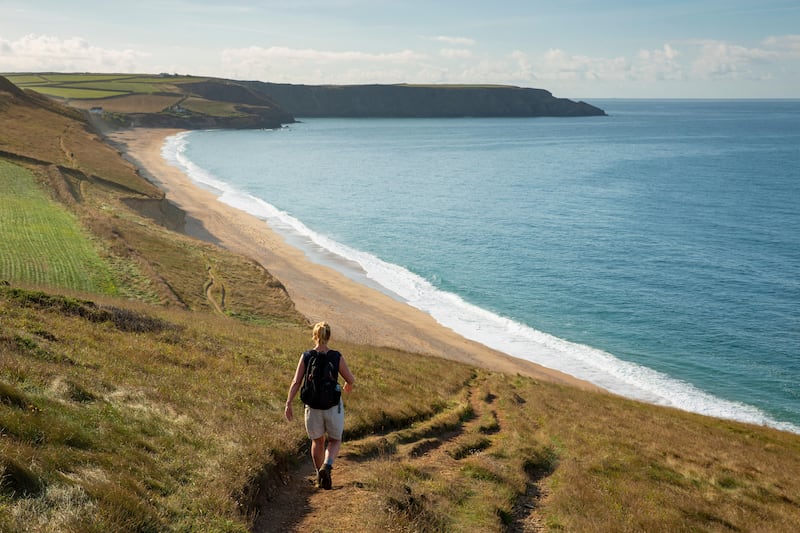 A hiker strolls along the South West Coast Path above Porthleven Sands in Cornwall, England. Photograph: Alamy/PA
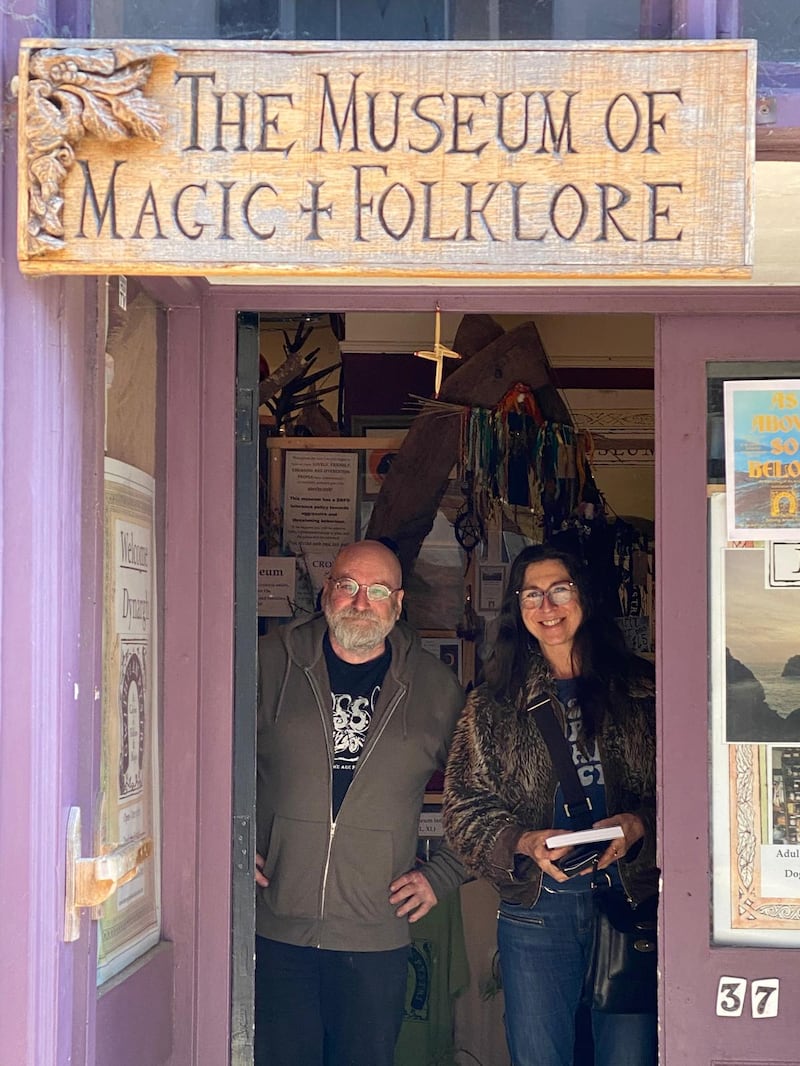 Adrienne Murphy with Steve Patterson at the Museum of Magic and Folklore
 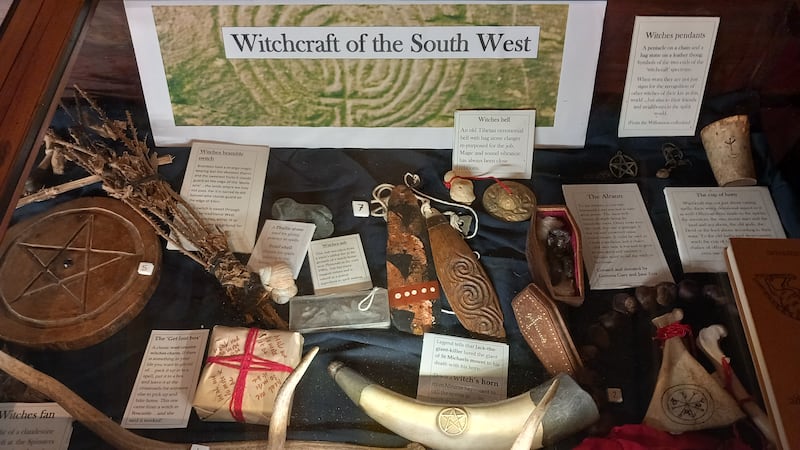 Witchcraft paraphernalia on display at the Museum of Magic and Folklore
“No one really knows what their purpose was,” says Shaw. “They slope down, and inside you’re often up to your ankles, if not your knees, in water, so it seems very inappropriate for storage. The only way you could access these fogous in antiquity was through what’s called a creep passage.
“There’s no easy way in. You could go feet first or head first, but you’d have to put your arms above your head and squeeze through, like going through a birth canal. You’d drop down into the chamber, and it would be wet. Once you were in there, you’d be able to stand up, because fogous are often over six feet tall inside and very spacious. But you would have been in complete pitch black and trapped inside this underground chamber.”
In more recent times the fogou was opened at a slope from the back, allowing us to enter the large stone chamber without falling head-first through a stone birth canal.
Inside the fogou, I’m mesmerised by the green neon flash of bioluminescent moss growing on the walls. Glowing, weird: like Cornwall to its occultural visitors, it feels as though the fogou’s otherworldly moss can transmit echoes of ancient mysteries to its modern day receivers.
Planning your trip: Listen to the Cornish podcast, Antiquarian Adventures in Meta-Reality, from Steve Patterson at stevepattersonantiquarian.com. Patterson runs his own Cabinet of Folklore and Magic in the southern coastal town of Falmouth. Visitors to Cornwall craving occultural events should check the Cabinet’s Instagram account under its Cornish name, Gwithti an Pystri. See also maps on darkcornwall.com; cornishancientsites.com; and Julian Cope’s themodernantiquarian.com.
Getting there: Aer Lingus and Ryanair fly return from Dublin to Cornwall Airport Newquay, where it’s straightforward to rent a car; or from Rosslare Port take the Stena Line ferry to Fishguard, or Irish Ferries to Pembroke, and drive to Cornwall.
Accommodation: For ancient, eco and boho self-catering, try Trematon Castle Lodge or Trematon Castle Cabin near Saltash; for haunted vibes, consider The Bodmin Jail Hotel.