
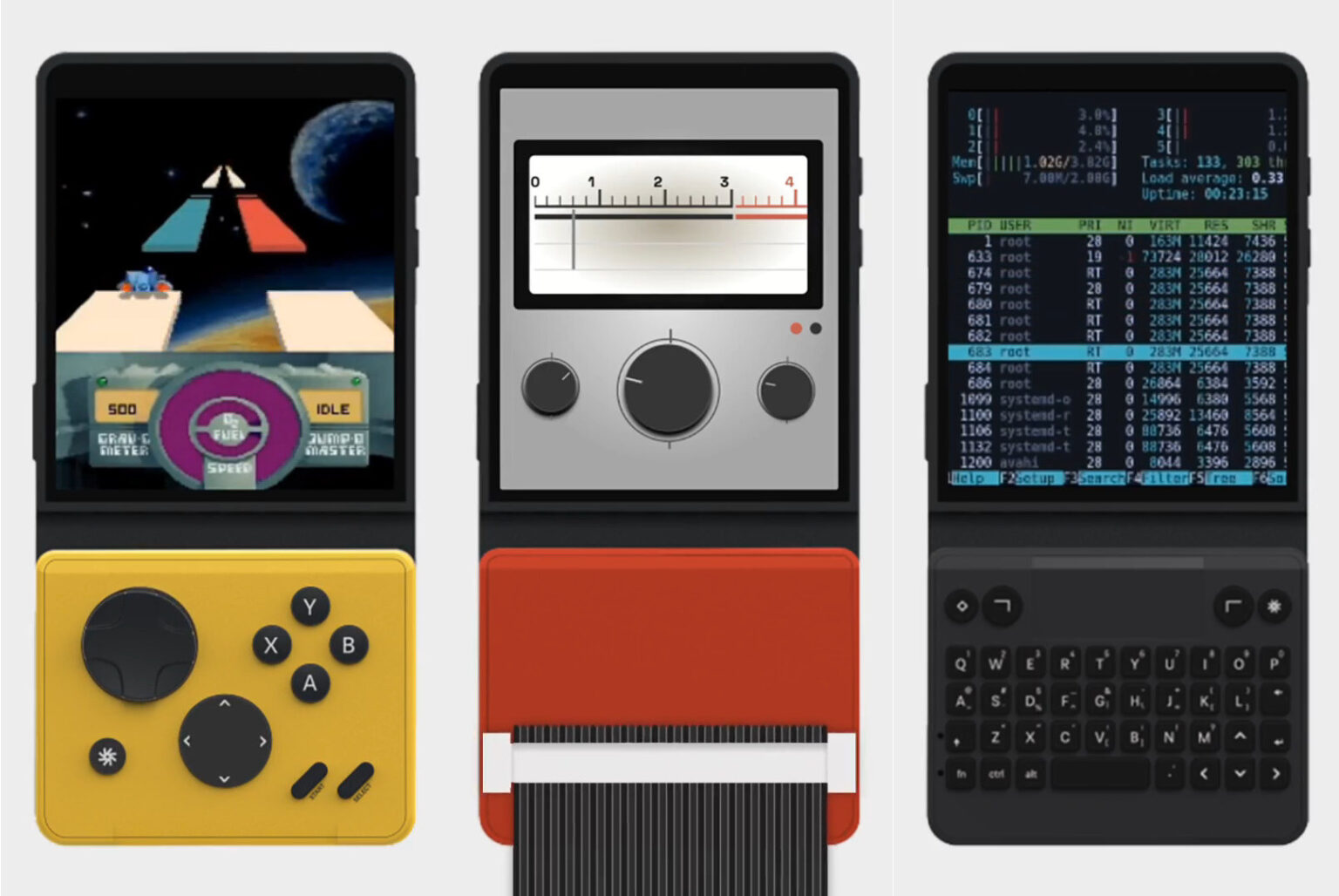
Mecha Comet open-source hardware modular Linux handheld computer can be used as a gaming console, a Linux terminal, an electronic measurement tool, and more, thanks to a 40-pin magnetic expansion connector for modules such as a gamepad, a QWERTY keyboard, a 40-pin GPIO header, and more.
The Mecha Comet is powered by an NXP i.MX 8M Plus or i.MX 95 Arm SoC, ships with up to 8GB RAM and 128GB flash, but also supports MicroSD and NVMe storage. It also features a 3.91-inch touchscreen display, a mini HDMI 2.1 port, an 8MP camera, a dual-mic array and a speaker, a 3.5mm audio jack, WiFi 5 and optional 4G LTE/5G cellular connectivity, as well as a few USB-C ports and built-in sensors.
 From left to right: Mecha Comet with gamepad, GPIO, and keyboard expansion modules
Mecha Comet specifications:
SoC (one or the other)
CPU – Quad-core Arm Cortex-A53 @ up to 1.8 GHz
Real-time MCU – Arm Cortex-M7 @ up to 800 MHz
GPU – Vivante GC7000UL 3D GPU, Vivante GC520L 2D GPU
DSP – HiFi 4 DSP for voice and natural language processing
VPU
1080p60 H.265, H.264, VP9 decode
1080p60 H.265, H.264 encode
AI Accelerator – 2.3 TOPS Neural Processing Unit (NPU)
CPU – Hexa-core Cortex-A55 @ up to 1.8 GHz
MCU cores
Arm Corex-M7 real-time core up to
Arm Cortex-M33 low-power safety microcontroller up to
GPU – Arm Mali-G310 V2 GPU for 2D/3D acceleration with support for OpenGL ES 3.2, OpenCL 3.0
VPU
4Kp30 H.265 and H.264 encode and decode
JPEG Encoder, JPEG Decoder
AI accelerator – 2 TOPS NXP eIQ Neutron NPU
Memory – 2GB, 4GB, or 8GB
Storage
64GB or 128GB eMMC Flash
MicroSD card slot
Optional M.2 NVMe SSD (2230)
Display – 3.92-inch AMOLED (550 nits), 1080 x 1240 resolution, 5-point capacitive touch
Video Output – Mini HDMI 2.1 port with eARC support
Camera – 8 MP IMX219 sensor up to 3264 x 2464 @ 60 FPS with auto-focus
Audio
2x digital microphones
1.2W/6 Ohm HD speaker
3.5mm audio jack
Wireless
Dual-band 2.4 GHz / 5.0 GHz 802.11ac Wi-Fi 5
Bluetooth 5.4
Optional 4G LTE Cat 4 via M.2 B-Key module and SIM card slot
USB
2x USB 3.0 Type-C ports
1x USB 2.0 Type-C port (TBC, shows up in datasheet, but not other parts of the documentation)
Sensors
9-axis motion sensors (gyroscope, acceleratometer, magnetometer)
Light sensor
Expansion
40-pin GPIO header for expansion modules
M.2 B-Key (PCIe 3.0) 2242/3042 socket
Security – Trust Anchor (CC EAL 6+)
Misc – RTC
Power Supply
5V via USB Type-C port (USD PD up to 24W)
4,100 mAh battery with fast sharing support, discharge up to 5A
Dimensions – 155 × 73 × 14 mm
Weight – About 225 grams
 Ports layout
 Mecha Comet prototype parts (the final product will be slightly different)
On the software front, the handheld device runs Mechanix OS based on U-boot 2025.04, Linux 6.12, and Fedora 43. The launcher is also customized for the unusual aspect ratio of the 3.92-inch display.
All software is already open-source, including the Mechanix GUI (Shell, Apps), Mecha Make build system, the Flutter-based Mechanix Dart GUI toolkit, and downstream Linux and U-Boot. The hardware is currently partially released with files for the outer housing and case, schematics for the EVT sample, and all files for the extensions (mechanical, board design, and software). However, Mecha Systems plans to eventually release everything include the internal design and components mechanical field, and the PCB source files and layout for the main unit. Check out the repositories on the company’s GitHub account to check out what’s already available, and you can also monitor the mecha.so website for the upcoming developer documentation.
 Mechanix OS launcher screenshots
The community project has been going on for around four years, but they’ve just launched a Kickstarter campaign for the Mecha Comet. It has already raised over $350,000 in a few hours from more than 1,000 backers. Rewards start at $189 for the i.MX 8M Plus model with 2GB RAM and 64GB eMMC flash, and $269 for the i.MX 95 variant with 4GB RAM and 64GB eMMC flash. You can add modules individually, or pledge $50 extra to get a bundle with the gamepad, keyboard, and IO breakout extensions, and it’s also possible to upgrade the RAM and/or storage capacities. Shipping adds $18 to $40, and rewards are scheduled to start shipping in May/June 2026 for the i.MX 8M Plus variant, and September 2026 for the i.MX 95 model.

Jean-Luc started CNX Software in 2010 as a part-time endeavor, before quitting his job as a software engineering manager, and starting to write daily news, and reviews full time later in 2011.
Support CNX Software! Donate via cryptocurrencies, become a Patron on Patreon, or purchase goods on Amazon or Aliexpress. We also use affiliate links in articles to earn commissions if you make a purchase after clicking on those links.