
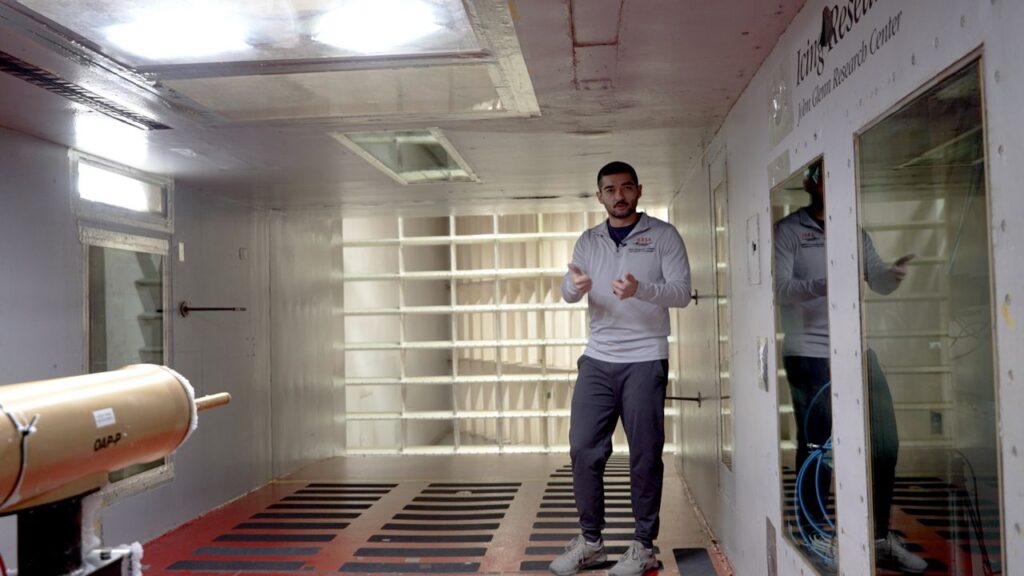
CLEVELAND — Entering the Icing Research Tunnel at Glenn Research Center is similar to taking off on a flight, ears popping as you wait to depressurize in a chamber before heading into the unique facility.
What You Need To Know
NASA’s Icing Research Tunnel started in 1944 after a need for ice-resilient planes was discovered during World War II
The tunnel is able to recreate conditions a plane might fly through thousands of feet in the air
The facility is used to test out parts of planes to esnure they can withstand icing while up in the air
“It’s only like going up to 5000 feet of altitude, so it’s not too much, but it’s enough to feel your ears pop just a little bit,” said Waldo Acosta, a lead facility engineer in the Icing Research Tunnel.
The facility can mimic conditions a plane would experience while flying through clouds. Manufacturers can use the facility year-round.
“They can come here and use our wind tunnel here, it’s a six by nine foot test section,” Acosta said. “We can actually put wing sections in there and test their ice protection systems so that they can go into flight testing and make sure that they have a robust system.”
Acostsa said, if you flown on a commercial flight, “there’s a good chance that, at some point, they came here to test their ice protection systems.”
The facility is meant to recreate all different kinds of conditions.
“That probe that you see in the tunnel is actually laser-based probe that’s helping us actually measure the drop sizes in the cloud,” Acosta explained, pointing to the golden instrument in the tunnel, “We have three main variables that are controlling the speed, the cloud parameters, like what is the drop size, how much water is there and then the temperature.”
The need for the facility became apparent during World War II, and it opened in 1944.
“They were losing [Planes] over the Alps, flying cargo missions in World War II, and they realized they were losing more planes due to icing than they were to enemy fire,” Acosta said.
“You’re going to feel a little pressure of cold air here, just like you’re outside,” Acosta said as he entered the icing tunnel.
Temperatures in the tunnel can lower to minus 40 degrees Fahrenheit.
“That is 14 times bigger over there,” Acosta said, motioning to the space directly in front of the tunnel, “So just like your garden hose, when you want to choke the flow to get it faster, that’s what the air is doing there. It’s getting compressed and speeding up. That’s so you can get the high speed.”
With new technology coming out, including the electrification of planes, over 80 years later the facility is just as necessary as it was in the 1940’s.
“This kind of facility is always going to be there, and I think it is always going to be necessary to have real world experience to get that real world data.”