
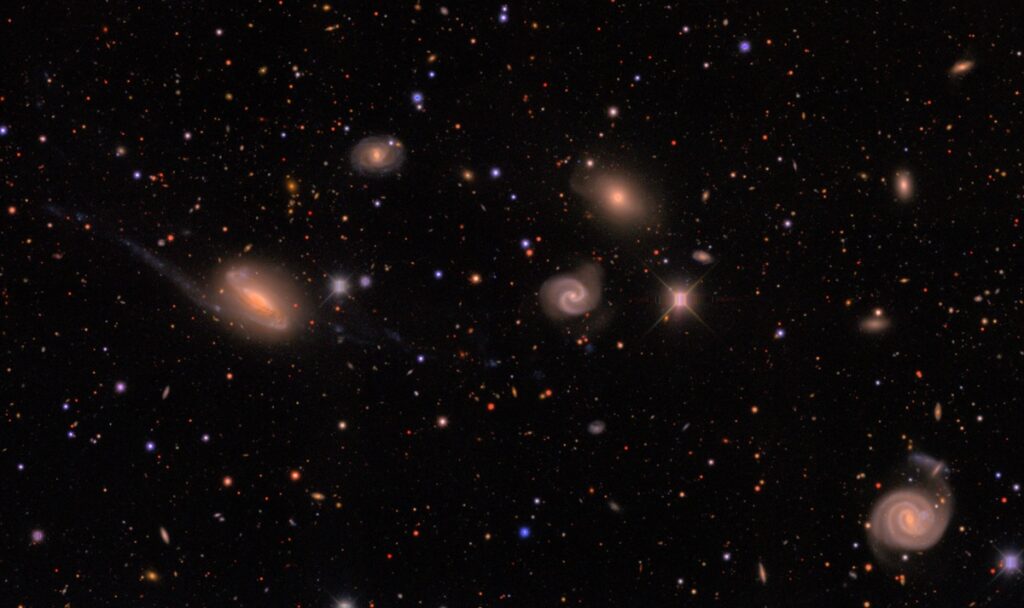
“The final DES lensing measurement includes around 150 million galaxies, an extraordinarily large data set. This is exciting, but it also brings a real responsibility to make sure that every part of the analysis is robust. In DES, we believe we have risen to that challenge. Through new methodologies and strong scientific results, the collaboration has delivered a measurement that will stand as a milestone for many years, and one that we can be genuinely proud of,” says Simon Samuroff, a postdoctoral researcher at IFAE, who co-led the cosmic shear analysis presented in these results.
In this analysis, DES tested their data against two models of the universe: the currently accepted standard model of cosmology—Lambda cold dark matter (ΛCDM)—in which the dark energy density is constant, and an extended model in which the dark energy density evolves over time—wCDM. DES found that their data mostly aligned with the standard model of cosmology. Their data also fit the evolving dark energy model, but no better than they fit the standard model.
However, one parameter is still off. Based on measurements of the early universe, both the standard and evolving dark energy models predict how matter in the universe clusters at later times—times probed by surveys like DES. In previous analyses, galaxy clustering was found to be different from what was predicted. When DES added the most recent data, that gap widened, but not yet to the point of certainty that the standard model of cosmology is incorrect. The difference persisted even when DES combined their data with those of other experiments.