

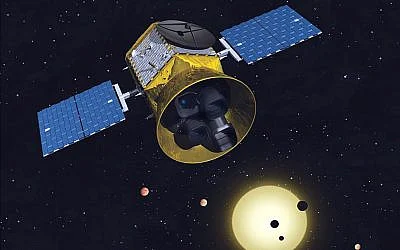
Image: TESS, a NASA space telescope designed to detect exoplanets using the transit method, surveys a wide area of the sky while focusing on nearby, bright stars.
Image credit: NASA / MIT / TESS Mission
NASA, via the TESS spacecraft, tracks 3I/ATLAS toward a quiet farewell? A Farewell Quarter for 3I/ATLAS.
Seven months after its discovery, 3I/ATLAS continues its journey out of the Solar System.
For me, it was the event of 2025 — and it may well leave its imprint on 2026 as well.
After passing Mars, slipping behind the Sun and approaching it closely, and gliding past Earth without saying hello, the object is now on its way toward Jupiter. There, on March 16, a small farewell moment will take place — after we assess whether it leaves behind a scientific object of study, or departs with or without any “inheritance.”
Yet the most interesting part may still lie ahead — precisely in the farewell.
Most scientists believe 3I/ATLAS is a natural comet. A small minority, however, has identified — so far — around eighteen anomalies in its behavior, suggesting it could be a technological object, or a natural comet guided or controlled by technology.
Without taking sides in this debate, there is one important point worth highlighting.
If we try to imagine the behavior of a technological research probe more than seven billion years old, arriving for the first time in our Solar System to observe and assess what is happening here — how would we expect it to behave?
Would it make noise and dramatic gestures, alarming inhabitants about whom it knows nothing — neither their nature nor their capabilities?
Or would it adopt the appearance of a natural comet, quietly calibrating instruments, sensors, and cameras, gathering data and drawing conclusions accordingly?
I would probably choose the second option.
And if, having chosen that path, I concluded that human society may not be particularly kind to itself, yet also incapable of causing me any harm — given its inability to pursue or intercept an object traveling through space at roughly 60 kilometers per second — I might then decide to leave a sign.
A kind of cosmic “casting bread upon the waters”: perhaps a small message, a note of goodwill or curiosity. After all, we are neighbors in the universe, even if we are unlikely to meet again for another billion years.
From this perspective, if 3I/ATLAS is indeed a technological object, as some scientists argue based on the observed anomalies, one might expect that in the coming two months — as it passes near Jupiter — some form of signal could be released.
If no message arrives, we will likely be able to conclude with high confidence that this was a natural celestial body, sent by chance to pass through our cosmic neighborhood.
I do not know how this possibility is viewed at NASA, but I do know that in recent days the TESS spacecraft was reassigned from its routine exoplanet-hunting mission to closely monitor ATLAS, our unusual visitor.
That alone may ensure that if 3I/ATLAS leaves behind a gift, a letter, or even just a faint signal, we will know.
And perhaps we will also know — definitively — that we are not alone in the universe.
In closing: whether natural or artificial, humanity has learned — and will continue to learn — a great deal during the “Atlas year,” from July 2025 through June 2026.
More studies will follow, findings will be analyzed, and new insights will emerge from the extensive data collected — long after the visitor itself has moved.
Rafi Glick is a writer, lecturer, farmer, and business executive with decades of experience at the intersection of academia, technology, agriculture, and international trade.
• He has served as a Senior Teaching Associate at Ben-Gurion University of the Negev, Ono Academic College, Ariel University, Ruppin Academic Center, and as a guest lecturer at Sofia University’s Faculty of Economics and Business Administration (FEBA). At Ben-Gurion University he also advised the BGU–NHSA Accelerator in the Faculty of Science.
• In business, Rafi was CEO of Bidsnet Ltd., a pioneer in deploying fiber-optic cables through unconventional infrastructure (in partnership with CableRunner), delivering high-speed connectivity to homes, enterprises, institutions, and cellular networks. Earlier he held senior roles at ECI Telecom and served on the board of RLF Venture Capital, working with partners such as Intel, Teva, and the Jerusalem Development Authority.
• He contributed extensively to Israel’s trade and investment ecosystem: he directed industrial and agricultural technology divisions at the Israel Export Institute, founded Israel’s AGRITECH as international exhibition, and served on the board of the Israeli Investment Center at the Ministry of Industry and Trade.
• In his early career, Rafi established and served as the first director of the Cargo and Aircraft Supply Security Department in the Security Division at Ben-Gurion Airport (1972–1976). He lived in Kibbutz Parod until 1974.
• Rafi has also been recognized for his writing: in 2008 he was named Best Economic Blogger by TheMarker, Israel’s leading business daily.
• Today he continues to publish essays and commentary—with a special passion for astrophysics, space exploration, technology, economics, and social issues.
From Kibbutz Parod to the global stage, Rafi Glick’s career reflects a lifelong commitment to building connections—between people, industries, and ideas.
Email: rafi.glick@gmail.com