
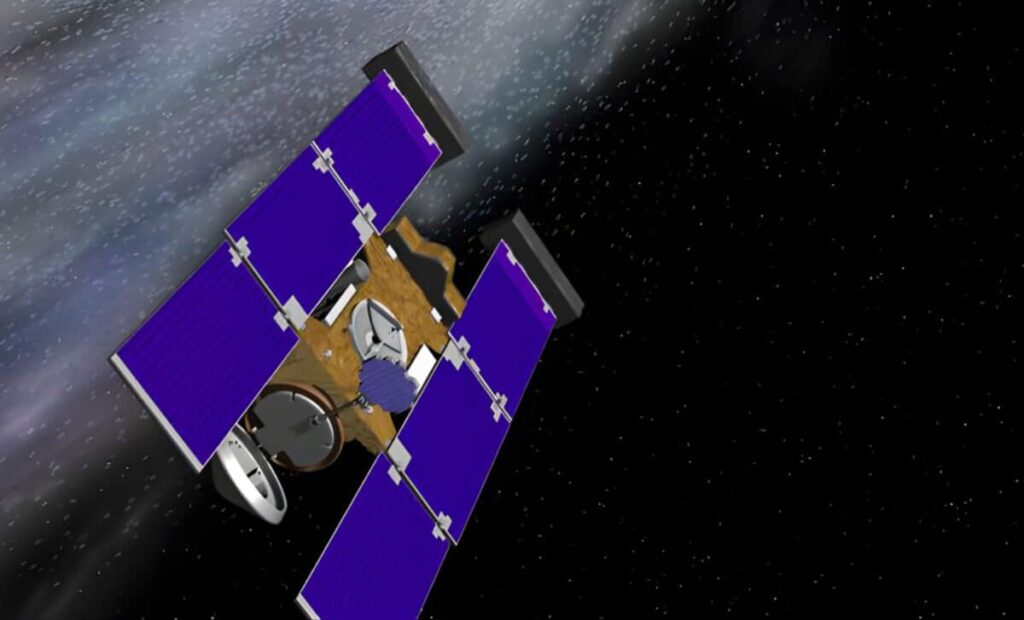
In 2006, NASA’s Stardust mission accomplished something no other spacecraft had done before: it returned solid material from beyond the Moon’s orbit. The samples it brought back included interstellar dust and particles from a comet’s coma.
The mission began with little fanfare but went on to deliver groundbreaking results. Designed to collect samples from Comet Wild 2 and interstellar space, Stardust was part of NASA’s Discovery Program, a series of low-cost, focused missions with specific scientific objectives. Despite its modest scale, the mission set a high standard for what could be achieved in sample return technology and deep-space navigation.
Collecting Dust with Aerogel and Precision
NASA launched the Stardust spacecraft on February 7, 1999, placing it into a heliocentric orbit. One year later, it performed a gravity assist around Earth to redirect its path toward its first target. Before reaching its main objective, it flew by the minor planet Annefrank, a planned maneuver to test the spacecraft’s instruments and trajectory systems.
To collect delicate cosmic particles, Stardust was equipped with panels of aerogel, a low-density silica-based material capable of capturing high-speed dust without damaging it. According to the U.S. Space Agency, this setup preserved both the physical structure and chemical composition of the particles gathered during close approaches to dusty regions.
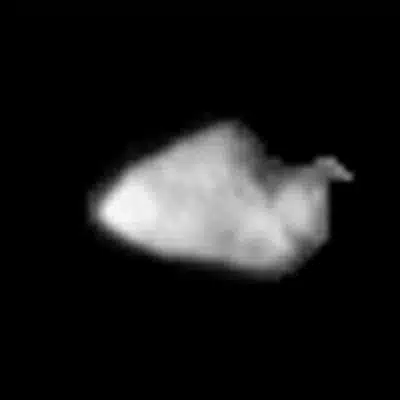 Minor planet Annefrank, photographed by NASA’s Stardust spacecraft. Credit: NASA/JPL-Caltech
In 2002, the spacecraft passed within 3,300 kilometers of Annefrank, capturing images that revealed the asteroid was about 8 kilometers long, twice the previous estimate. On January 2, 2004, Stardust made its closest flyby of Comet Wild 2, coming within 250 kilometers of the nucleus. It opened its collector just before the pass and sealed the samples six hours later, storing them in a return capsule that would remain dormant until reentry two years later.
Why These “Interstellar” Particles Matter
As reported in a NASA statement, the sample return capsule detached from the main spacecraft and landed safely on January 15, 2006, in the Utah Test and Training Range. This marked the first time material from beyond the Moon had been brought back to Earth, a milestone in NASA’s exploration history.
The returned material was analyzed over the following years. In August 2014, NASA announced that seven microscopic interstellar dust particles had been identified among the collected samples. These rare particles were believed to originate from outside the solar system and possibly dated back to its formation. The analysis also revealed a wide range of organic compounds, suggesting the early solar system was chemically rich in ways that could be relevant to the origins of life.
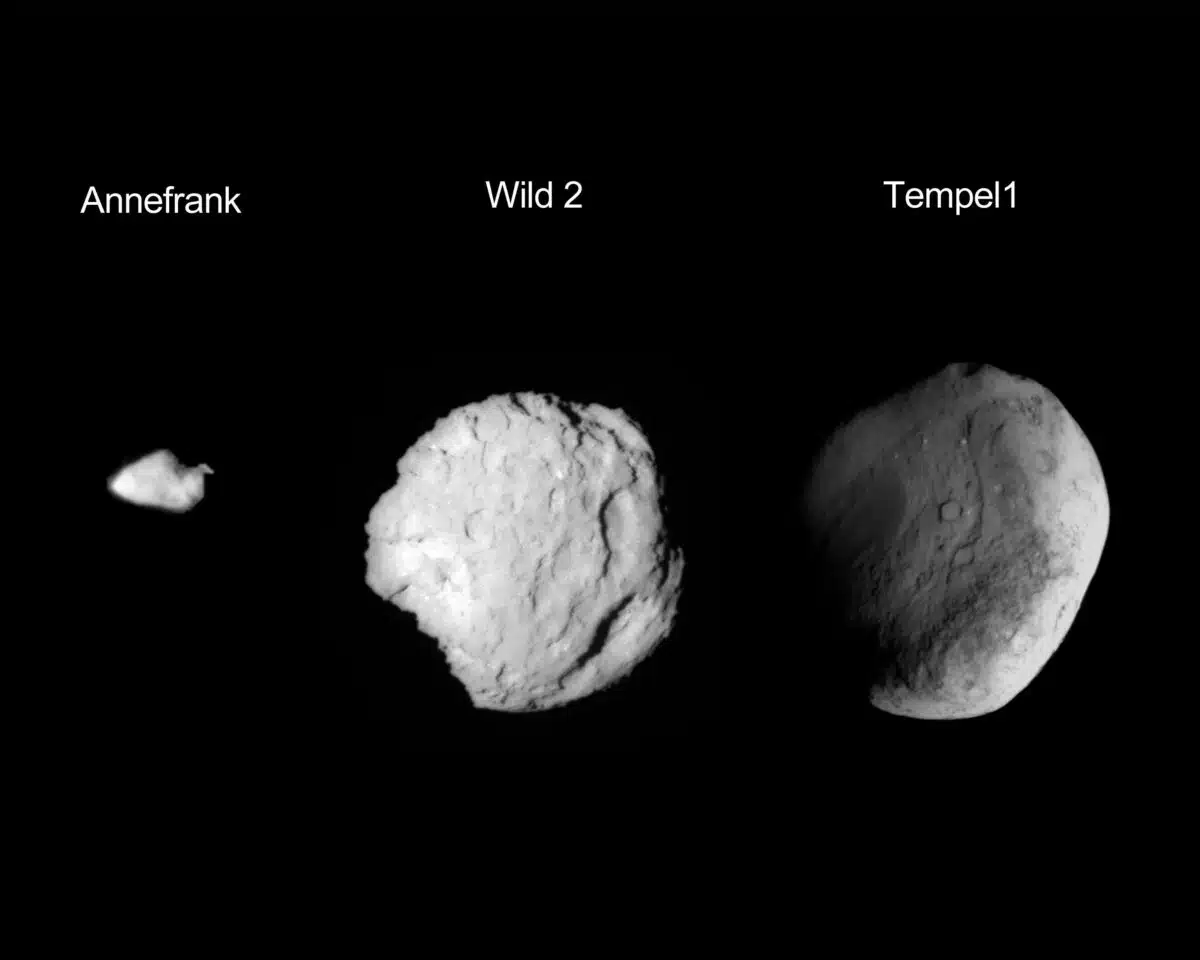 From asteroid to comet: Stardust captured Annefrank, Wild 2, and Tempel 1 in a single mission’s journey. Credit: NASA/JPL-Caltech/University of Maryland/Cornell
These findings underscored the mission’s significance and demonstrated the scientific value of returning physical samples, rather than relying solely on remote sensing or in-situ analysis.
Second Mission Reaches a Final Milestone
After completing its primary objective, NASA redirected Stardust for a follow-up mission. Renamed Stardust/NExT, the spacecraft was sent to revisit Comet Tempel 1, previously impacted by NASA’s Deep Impact probe. On arrival in February 2011, the spacecraft succeeded in imaging the impact site, providing a rare before-and-after view of a comet’s surface.
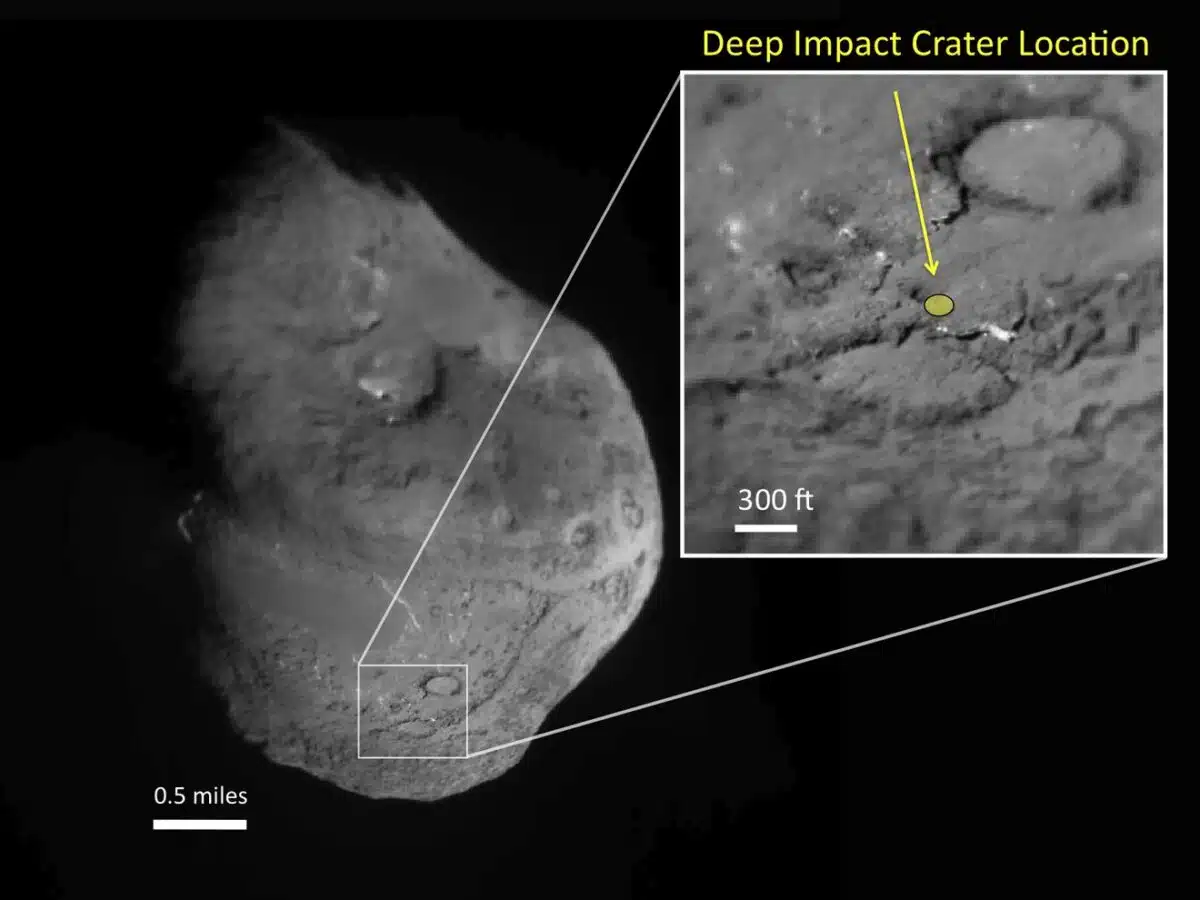 A map-like view of Tempel 1 showing where NASA’s Deep Impact probe struck, leaving a fresh crater. Credit: NASA/JPL-Caltech/University of Maryland
Pete Schultz of Brown University described the findings, noting a small central mound inside the crater, which indicated that much of the ejected material had fallen back into place.
“We see a crater with a small mound in the center, and it appears that some of the ejecta went up and came right back down,” he said “This tells us this cometary nucleus is fragile and weak based on how subdued the crater is we see today.”
This second mission made Stardust the first spacecraft to revisit a previously studied comet, a distinction that extended its scientific legacy. On March 24, 2011, the spacecraft sent its final transmission and was officially decommissioned after using up its remaining fuel.