
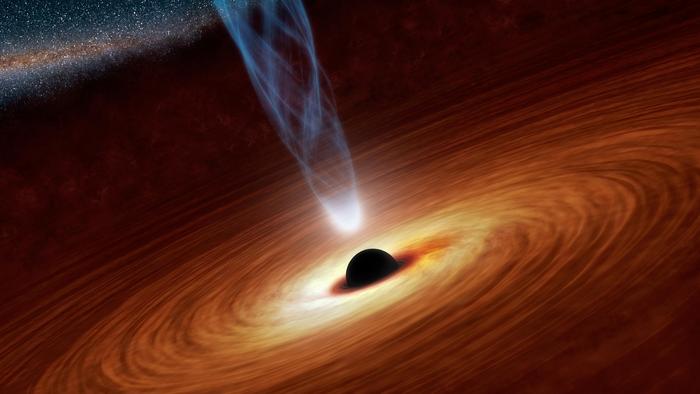
Somewhere 1.5 billion light-years away, there’s a black hole that shouldn’t exist. Not because it’s there, but because of what it’s doing. An international team of astronomers has just caught it red-handed, consuming matter at a ferocious clip while simultaneously blasting space with X-rays and radio waves. Theory says this shouldn’t happen. And yet here it is, forcing physicists back to the drawing board.
The object has the unglamorous name ID830. It sits nestled somewhere near the constellation Leo, and nobody would have noticed it at all without the eROSITA satellite’s X-ray survey. One catalogue entry among millions. But what makes it special isn’t obvious from the name or the coordinates. You need to know about the Eddington limit first. Then it all clicks into place.
Think of the Eddington limit as a cosmic speed bump. When gas spirals toward a black hole, the radiation from that infalling material starts pushing back. Hard. The pressure builds until it reaches a point where nothing more can fall in. It’s a natural governor, and supermassive black holes respect it. They feed steadily, greedily even, but rarely break this fundamental rule.
ID830? It’s breaking that rule. Consuming material at roughly 13 times the Eddington limit.
The theory is pretty clear on what should happen next. “In the current models, super-Eddington accretion should change the gas flow and suppress X-ray and radio wave production,” the research team explains. In other words: push a black hole past the limit, and you’d expect it to go quiet. The radiation pressure would choke off the X-rays. The jets would sputter. Nothing. But ID830 didn’t get the memo. It’s blaring in X-rays and firing radio waves across the cosmos, all while gorging itself at impossible rates.
To understand what they were looking at, the team pulled together data from multiple observatories. Subaru’s infrared spectrograph showed a dust-reddened quasar, suggesting the black hole sits in a thick cloud of material. When they calculated the mass, it came out to roughly 440 million suns. That’s big. But not massive enough to explain the light being produced if everything were proceeding normally.
The radio observations were equally telling. Five different facilities, frequencies ranging from 144 megahertz to 3 gigahertz, all painted the same picture: a powerful jet, young and hungry, hurling material outward at nearly the speed of light. But something was odd. The jet appeared compact. No vast lobes extending across the sky. This wasn’t a mature system. Something was still assembling, still in flux.
Piece it together and you get a picture of cosmic chaos. ID830 likely got hit by a sudden surge of infalling material. Maybe a star wandered too close and got torn apart. Maybe something else triggered a violent spike in the accretion rate. Either way, the system got shoved into the super-Eddington regime. Hard and fast.
This is where it gets genuinely weird. Theory says ID830 should have gone quiet by now. The radiation pressure should have choked the system. The X-rays should have died down. Instead, the corona is still blazing and the jet is still firing. The X-ray excess is about 1.4 times brighter than models predict. Which shouldn’t be possible.
So what’s happening? The team thinks ID830 is stuck in a moment of transition. After the accretion burst, the system hasn’t settled down yet. The corona is still hot. The jet is still firing up. It’s as if we’ve caught the black hole at the exact instant when both engines are running full throttle, before the whole thing gradually cools off and calms down.
This idea has unexpected support. A nearby galaxy called 1ES 1927+654 went through something similar a few years back. Likely a star got shredded. Astronomers watched what happened next. The galaxy cycled through different states. From extreme feeding, through a phase with excess X-rays (the phase ID830 seems to be in now), and finally toward a more normal feeding regime. The pattern looks familiar. Just on a vastly different timescale, because ID830’s black hole is so much more massive.
If they’re right, ID830 shows us something we’ve been struggling to understand. When the universe was young, supermassive black holes grew absurdly fast. Billion-solar-mass monsters assembled when there wasn’t time for it. Standard accretion is too slow. You need extreme feeding. You need super-Eddington phases. But we’ve never found good examples. ID830 might be one.
ID830 is like a fossil preserved in cosmic amber. But don’t mistake it for something delicate or quiet. That jet alone, with its estimated power of hundreds of trillions of megawatts, is enough to heat the intergalactic medium and snuff out star formation across entire galaxy clusters. Even in transition, even still settling down, it’s a cosmic engine of remarkable violence.
The implications are big. The team’s numbers suggest that radio-loud quasars like ID830 should be five to ten times more common at these early epochs than surveys show. If true, black holes were reshaping galaxies far more efficiently back then than we thought. The whole machinery of AGN feedback may have been running much harder in the young universe.
And there’s one more thing. ID830 breaks the models so thoroughly that it becomes a test case. When black holes feed at extreme rates, simulations suggest the accretion disk puffs up. Gets thick, develops intense outflows. There’s a warm corona region somewhere in between, predicted by theory but hard to catch in practice. ID830’s X-ray excess might be that region showing itself. Might be. We’re not entirely sure yet.
That’s the thing about anomalies. They show us where our understanding breaks down. ID830 isn’t just a rule-breaker. It’s an invitation. To understand the rules better. To revise them where they fail. Nature, it turns out, is quite good at finding solutions we haven’t thought of yet. The universe’s early black holes have figured something out. We’re still trying to work out what.
Study link: https://iopscience.iop.org/article/10.3847/1538-4357/ae1d6d
There’s no paywall here
If our reporting has informed or inspired you, please consider making a donation. Every contribution, no matter the size, empowers us to continue delivering accurate, engaging, and trustworthy science and medical news. Independent journalism requires time, effort, and resources—your support ensures we can keep uncovering the stories that matter most to you.
Join us in making knowledge accessible and impactful. Thank you for standing with us!