
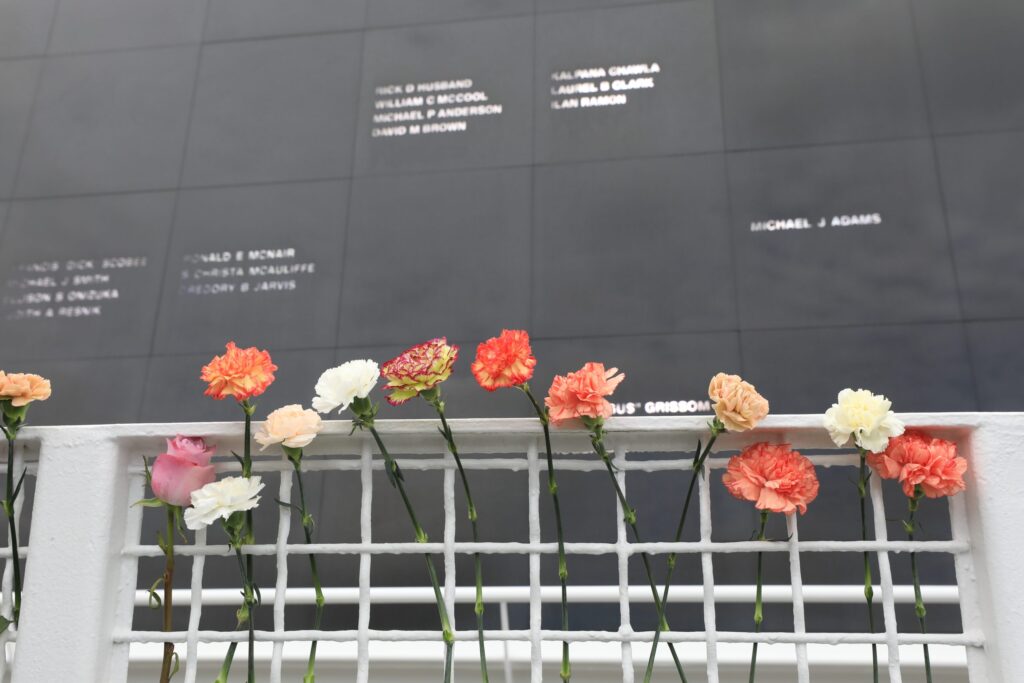
Bob Foerster understood the risks of the mission had he been selected.
In the summer of 1985, six months before the Space Shuttle Challenger launched, all ten finalists for the Teacher in Space program understood.
They had come from every part of the country, representing their profession and yearning to touch the cosmos. They had been stuffed into human-sized duffel bags and subjected to sensory deprivation testing. All Foerster could see was darkness. All he could hear was his own heartbeat. They’d endured the nausea of weightlessness at the Kennedy Space Center in Florida, and in Washington D.C., they learned to deflect the national media’s probing questions.
In the nation’s capital, they gathered in the hotel room of Challenger Commander Dick Scobee and heard the subtext for their strenuous training spoken aloud.
“I just want to make sure you all know you’re sitting on a really big stick of dynamite,” Foerster recalled Scobee telling his audience of teachers. “Things can go wrong. You just be prepared and know that, if you’re not, this isn’t for you.”
While the risks were knowable, the tragedy that followed would be incomprehensible.
On Jan. 28, 1986, after several delayed launches, the Challenger lifted off the launch pad at Cape Canaveral, Fla., with its seven crewmembers aboard. Their mission was to circle the Earth for six days, deploying a satellite to study Halley’s Comet.
Among them was the Teacher in Space, Concord’s Christa McAuliffe, a beloved high school social studies teacher who would be the first ordinary citizen to go into space.
The Challenger exploded 73 seconds after lift-off, ending their lives.
In Florida at NASA’s Day of Remembrance ceremony on Thursday, Jan. 22, Foerster patted the ‘Teacher in Space’ pin affixed to his blazer lapel as he remembered Christa.
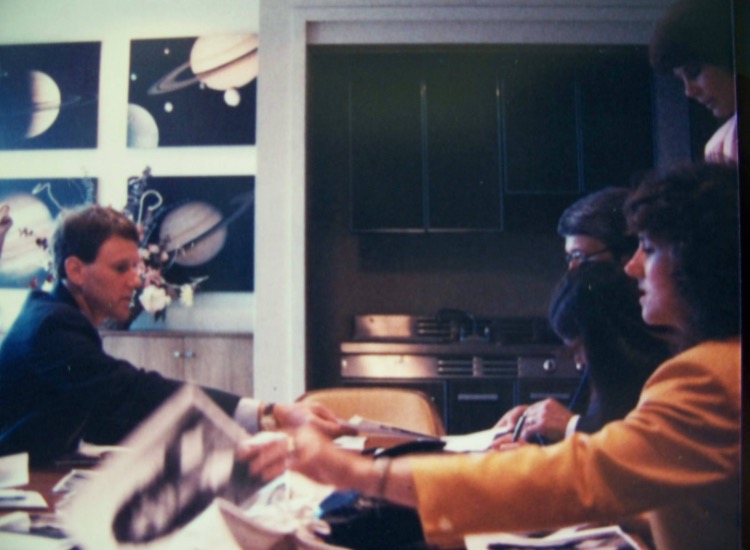 Bob Foerster (left) signs headshots with Christa McAuliffe (right) and the other eight semi-finalists for the Teacher in Space program in 1985. Credit: Courtesy Bob Foerster
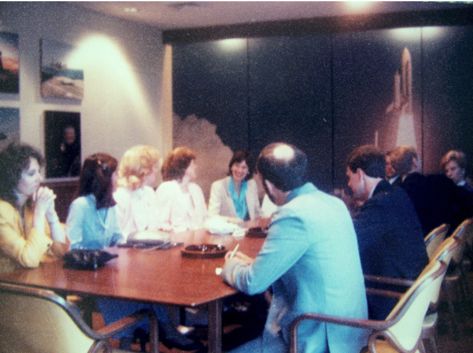 All ten semi-finalists for the Teacher in Space program gather in Washington D.C. in 1985. Credit: Courtesy Bob Foerster
Christa, brave but careful, who of the ten teachers had been the most timid about the weightlessness test. Christa, humble and gracious, who, when asked about the fame she could expect after completing her mission, had quipped: “Kids have a wonderful way of bringing you back down to Earth.”
Foerster, with his steel blue eyes, was a 33-year-old math and science teacher from Indiana when he heard of the Teacher in Space program. More than four decades later, a wash of white sits atop his head and signs of joyful age mark his face.
When he returned to his classroom after a year of working as a traveling ‘space ambassador’ for NASA following the Challenger disaster, uninhibited students would sometimes ask if he felt fortunate not to have been selected for the mission.
“Think about when you go to the airport to drop off your friends or family,” his answer would come. “Imagine if something were to happen to them, would you think of yourself?”
“We mourn the loss of our friends.”
Daring to stay the course
Even the road to the Kennedy Space Center pays eternal homage to NASA’s fallen astronauts.
Challenger Memorial Parkway, an elevated, single-track blacktop, slices through a lush cluster of pine trees, their crowns sitting level with the road. The following eight-mile stretch of Columbia Boulevard lays itself out like a flat, endless ramp.
White egrets, spindly little wading birds, stumble out of the roadside vegetation in pairs; animal crossing signs urge drivers passing through the Merritt Island Wildlife Refuge to ‘give ‘em a brake.’ With no embankments to interfere, the shimmering Atlantic laps at the margin of desiccated grass beside the road.
These days, the complex is as much a theme park as it is home to a working space center. On a bus tour of the visitor complex, world languages passed between families as the passengers’ tour guide pointed to a rust-orange launch vehicle in the distance, like a grain of rice against the horizon, yet the most powerful rocket NASA has ever operated.
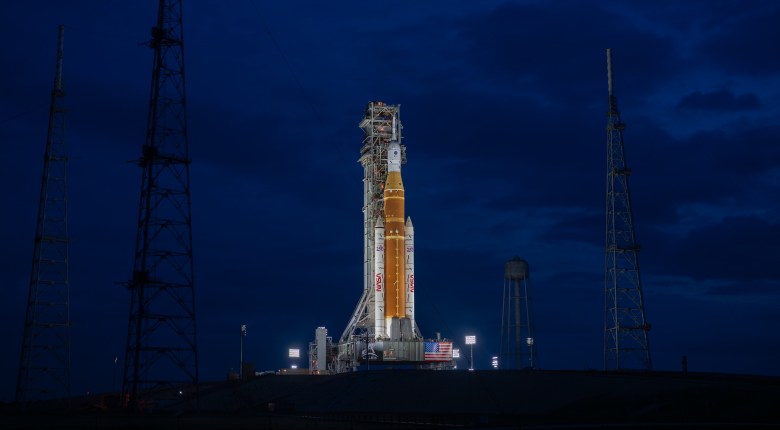 NASA’s Artemis II Space Launch System (SLS) rocket and Orion spacecraft are seen on Jan. 17, 2026 after being rolled out to the launch pad at NASA’s Kennedy Space Center in Florida. Credit: NASA/Brandon Hancock
The Artemis Space Launch System will carry four astronauts on a 10-day expedition around the Moon in NASA’s first crewed lunar mission since the Apollo days, more than 50 years ago. The launch could happen as early as Feb. 6, but for now, the rocket, capable of generating more than 8.8 million pounds of thrust at liftoff, sits at Cape Canaveral pointing to the sky.
At NASA, the promise of new frontiers, including hopes that man’s return to the Moon will provide a test-ground for supporting life on another planet like Mars, coexists alongside the severity of the organization’s past failures.
The 25 fallen astronauts honored during NASA’s annual ceremony — including the crews of Apollo 1 and the Challenger and Columbia space shuttles — were recognized for their intellect, courage and the strength of their moral character.
They were remembered especially for their unflinching belief in the mission that cost them their lives, a sacrifice Robert Cabana, former director of the Kennedy Space Center, stressed was not made in vain.
“The exploration of space beckons us. It calls us to rise above the ordinary and everyday and do the impossible. We make it look commonplace, but it’s not. It’s not easy,” he said. “It is in our DNA to explore and go beyond our limits and expand our knowledge. To stop would be a great disservice to these crews. It would mean they gave their lives for nothing. We must go on.”
Good intentions are “not enough,” Cabana said. Astronauts Suni Williams and Butch Wilmore’s nearly year-long stay at the International Space Station, the result of dangerous helium leaks and degraded thrusters in their Boeing Starliner capsule, is proof of progress at NASA and greater caution with human life, he said.
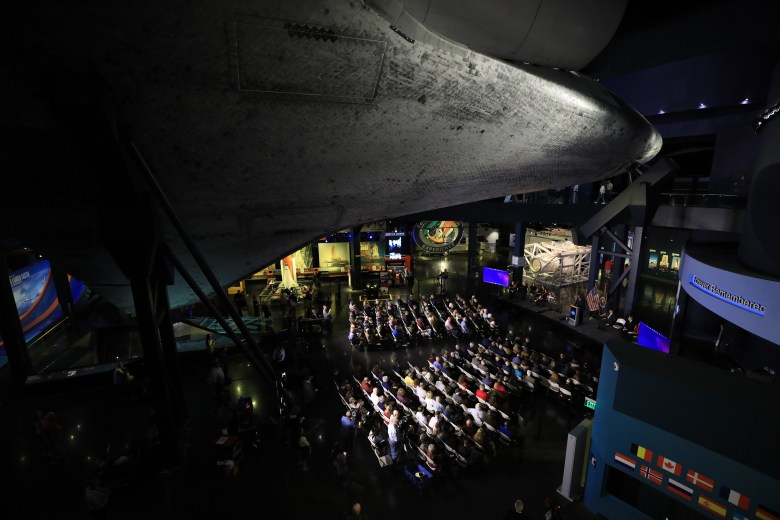 Guests gather to commemorate NASA’s Day of Remembrance on Thursday, Jan. 22, 2026, at the Kennedy Space Center Visitor Complex in Florida. Credit: NASA/Kim Shiflett
Audience members listened, gathered in rows beneath the retired Atlantis space shuttle, which flew on 33 missions before being decommissioned in 2011.
A gradient of silver tiles speckled the orbiter’s underbelly, like the scales of a giant fish. The building remained open to the public during the ceremony. Visitors lined the balconies to photograph the space shuttle. Children’s sneakers squeaked across the floor in complete dissonance with the Brevard Symphony Orchestra String Quartet’s rendition of “America the Beautiful.”
Nothing could be more appropriate, thought Foerster.
The purpose of space exploration, the innovation it begets and the world we create by pushing forward, is all for them, the children.
“Kids need something to hope for and dream about. When adults think it’s important to take these risks that are calculated, we give kids hope for the future,” he said.
Remembering the Challenger crew
Cabana was an astronaut candidate in 1986.
At the time, his friend and academy classmate was dating Challenger mission specialist Judy Resnik, a woman Cabana remembered as “bright, young, energetic, really smart.”
He reflected on a Saturday morning in the office, when coming out of the mail room, Ellison ‘El’ Onizuka looked his way and acknowledged the difficulties of moving to a new city. Onizuka, also a mission specialist aboard the Challenger, told Cabana: “I just want you to know I’ve got a garage full of tools. If you ever need anything, please come on over.”
Alison Smith Balch can never forget Challenger pilot Michael ‘Mike’ Smith; he was her dad. Smith enjoyed running, house remodeling and woodworking. A wooden plane he carved is on display in the ‘Forever Remembered’ exhibit at the Atlantis building.
But above all, his most abiding love was for his family.
“Often, when Friday came and his co-workers made plans after work, people knew what Mike Smith would choose: He would go home, that was simply where he wanted to be,” Balch said.
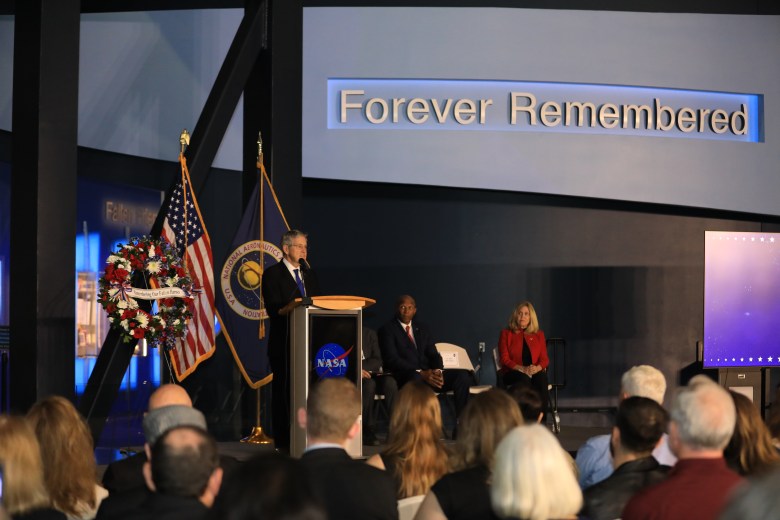 Former Kennedy Space Center director, Bob Cabana, speaks during NASA’s Day of Remembrance. To his right sit Kelvin Manning, the Center’s deputy director, and Alison Smith Balch. Credit: NASA/Kim Shiflett
McAuliffe, the Teacher in Space and the second payload specialist aboard the Challenger, is memorialized in the exhibit with ordinary things: a patch, a book about Concord by James Hobbs and another title about the history of her alma mater, Framingham State University.
She lives on in the memory of those who knew her.
Robert Veilleux was the other candidate for the Teacher in Space program from New Hampshire. A science teacher at Manchester’s Central High School, he remembered visiting UNH with Christa to video-tape their answers to a round of NASA’s interview questions.
His philosophy of education, he responded, was, “Don’t do something you consider a job or hard work. Do something you enjoy in life, that’s what I did by teaching.”
Christa, asked about the impact her selection would have on her life beyond the classroom, answered with her trademark honest enthusiasm: “Certainly, it will change my life. I have been a classroom teacher for all these years, but I’ve also been an adventurer.”
When Foerster thinks of Christa, he remembers her sitting across the table from him in Washington D.C. following their media training. They’d learned to take control of an interview gone astray; they’d also been encouraged to think of a slogan for themselves, a summary statement they could autograph by rote, repeatedly and without cramping.
Foerster chose to honor a gift from his aunt, a keychain that read “go for it.” Seeing his fellow finalists scramble for inspiration, he shared with them his alma mater, Purdue University’s, letterhead as an example.
The school’s tagline that year had been “Touching tomorrow today.”
Foerster, who insisted on taking no credit for inspiring the catch-phrase, recalled: “And Christa immediately said, ‘I like that.’ And then she said, ‘Well, I touch the future. I teach.’”
After the Challenger disaster, Foerster, Veilleux and the other Teacher in Space candidates toured classrooms and conferences to help America make sense of the shuttle program’s first tragedy. They offered reassurance that the nation, despite its hurt and sorrow, could return to space again.
President Ronald Reagan’s eulogy for the Challenger seven, given at the Johnson Space Center in Houston, Texas, became the blueprint for their words of consolation.
It was, as far as Foerster can recall, “the perfect response to a grieving world,” and it adapted another of Christa’s turns of phrase.
“Sometimes, when we reach for the stars, we fall short. But we must pick ourselves up again and press on despite the pain,” the president said. “Our nation is indeed fortunate that we can still draw on immense reservoirs of courage, character and fortitude — that we are still blessed with heroes like those of the space shuttle Challenger.”