
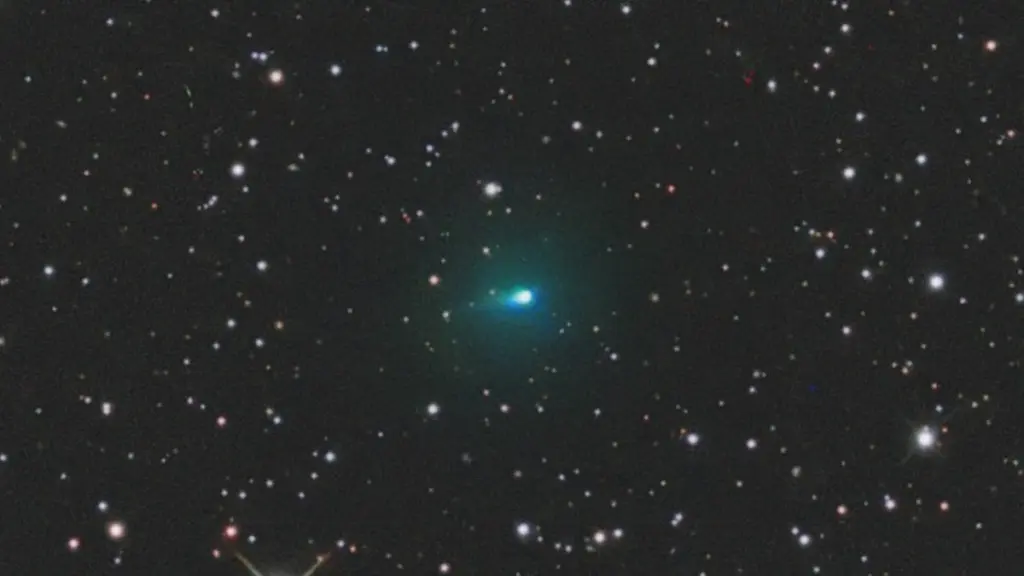
New infrared observations show that 3I/ATLAS now behaves like a typical comet, releasing water, carbon monoxide, carbon dioxide, and complex organics, offering the clearest evidence yet that interstellar comet material can rapidly transform once exposed to sustained solar heating.
The object has undergone a fundamental physical transformation since its pre-perihelion passage through the inner Solar System. Observations obtained in December 2025 reveal an object that is no longer dominated by cold icy grains, but instead exhibits the full spectroscopic and morphological signature of an active comet sublimating its bulk ice inventory.
The observations were carried out by the SPHEREx, operated by the National Aeronautics and Space Administration, during a dedicated observing campaign following the object’s perihelion on October 30, at 1.35 AU, equivalent to about 202 million km (125 million miles) from the Sun. By mid December, 3I/ATLAS was located at a heliocentric distance of 2.0–2.2 AU, roughly 300–330 million km (186–205 million miles).
The December observations show that water ice is now fully sublimating. Emission from water vapor near 2.7–2.8 micrometers increased by roughly a factor of 20 compared to August measurements, corresponding to a gas production rate of about 6 × 1027 molecules per second. This level of activity indicates that solar heating has penetrated well below the surface layers that dominated pre-perihelion behavior.
At the same time, several gas species were detected for the first time. A narrow emission feature near 0.93 micrometers is consistent with cyanogen gas and aligns with recent optical detections of CN emission near 0.39 micrometers, providing independent confirmation across wavelengths. Strong emission between 3.2 and 3.6 micrometers reveals abundant gaseous organic compounds, including methanol, formaldehyde, methane, and ethane, all common constituents of Solar System comets.
Carbon dioxide emissions remain prominent and spatially extensive. The CO2 coma continues to reach out to approximately 3 arcminutes in radius, comparable to its pre-perihelion extent. In contrast, carbon monoxide emission near 4.7 micrometers increased by about a factor of 20 since August, driving a sharp rise in the CO to CO2 abundance ratio. This behavior implies that a new ice reservoir became active after perihelion, in addition to the one that powered early CO2 release.
The relative abundances of volatile species now closely resemble those measured in typical Solar System comets. The ratios of CO to H2O and CO2 to H2O are each about 0.12 to 0.13, while the CO to CO2 ratio is approximately 0.92. The combined CO plus CO2 to H2O ratio of 0.25 falls squarely within the range observed for many long-period comets.
Spectrally, the object has also changed character. The near-infrared absorption feature associated with solid water ice, clearly present in August 2025, has largely disappeared. The continuum is now dominated by scattered sunlight at shorter wavelengths and thermal emission from refractory organosilicate dust at longer wavelengths. This shift indicates that ice mantles coating dust grains have been removed, leaving behind low albedo mineral and carbon-rich material.
Thermal modeling of the 3.5 to 5.0 micrometer continuum implies dust grain surface temperatures near −3°C (27°F). At these temperatures, volatile ice mantles are expected to sublimate rapidly in vacuum, explaining both the loss of ice absorption features and the emergence of a dust-dominated spectrum.
Imaging data provide further insight into the physical structure of the coma. All major gas species are spatially resolved, with comae extending between roughly 1–3 arcminutes in radius. Water, carbon dioxide, and carbon monoxide comae are nearly circular and symmetric with respect to the nucleus, suggesting direct release from near-surface regions.
In contrast, the dust continuum and organic gas emission show a pear-shaped morphology with the narrow end pointing toward the Sun. A subtle anti-tail component is also present. This solar pointing geometry, combined with the absence of a radiation pressure-dominated anti-solar tail, implies that the coma is dominated by relatively large dust grains, likely millimeter to decimeter scale, which are only weakly affected by solar radiation pressure.
Despite the increased activity, the object appears stable on short timescales. Geometry corrected flux measurements between 1.0–1.5 micrometers vary by less than 20% over the observing window from 8–15 December. No collimated jets or rapidly evolving structures were detected.
The observations highlight an important physical tension when compared with pre-perihelion data. In August 2025, gas production appeared to be dominated by icy coma grains rather than direct nucleus outgassing. To preserve unprocessed interior material against long-term cosmic ray alteration, such grains would need to be thicker than about 10 m (33 feet). However, grains of that size would imply an enormous dust mass, since the coma was observed to be about 100 times brighter than the nucleus in reflected sunlight.
At the same time, dust dynamics constrain grain sizes from below. The lack of a radiation pressure-driven anti-solar tail requires particles at least millimeter to decimeter scale. Reconciling these constraints suggests that the August coma was unlikely to consist of monolithic icy blocks and instead points to compositional layering or multiple volatile reservoirs becoming active at different temperatures.
The post-perihelion activation is consistent with a thermal wave penetrating below the estimated 10 m cosmic ray alteration layer. Once heating reached beneath this depth, bulk cometary material, including water ice, carbon monoxide, carbon dioxide, and organics, became available for sublimation. This behavior mirrors what is inferred for Solar System Oort Cloud comets, which experience similar cosmic ray processing during the vast majority of their orbits outside the heliosphere.
The December 2025 results are based on a preliminary analysis. A more comprehensive treatment is planned before 3I/ATLAS passes through SPHEREx’s nominal all-sky survey pattern again in April 2026, offering a chance to track how activity evolves as the object recedes from the Sun.
References:
1 SPHEREx Re-Observation of Interstellar Object 3I/ATLAS in December 2025: Detection of Increased Post-Perihelion Activity, Refractory Coma Dust, and New Coma Gas Species – C.M. Lisse et al. – Arxiv – January 11, 2025 – https://doi.org/10.48550/arXiv.2601.06759 – OPEN ACCESS