
Enabling & Support
22/01/2026
3 views
0 likes
In brief
The European Space Agency has signed another launch service contract under the Flight Ticket Initiative, just five months after the first batch.
The European Commission and the European Space Agency are offering companies and organisations an opportunity to fly their technology and demonstrate it in space.
The Lurbat mission will test new propulsion techniques and more
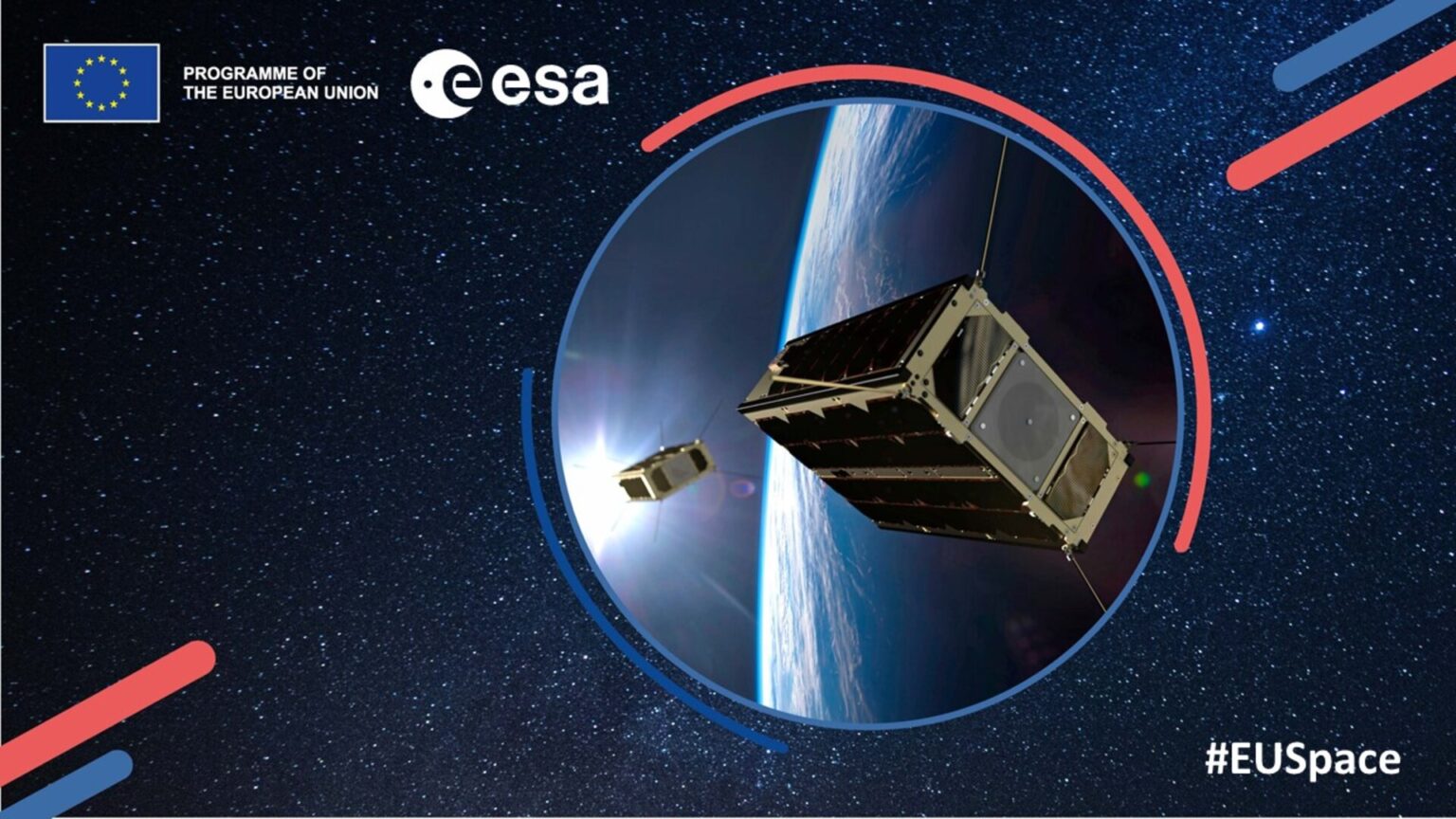
A second mission involves two CubeSats that will fly five experiments selected by the European Commission.
Both missions will be launched on Rocket Factory Augsburg’s One launch vehicle
In-depth
The Flight Ticket Initiative is a joint initiative of the European Space Agency (ESA) and the European Commission for European companies and institutions to test and prove new products and applications in space. It advances new European launcher systems through open competition and access to launch services for European missions starting with In-orbit Demonstration and Validation missions.
Testing prototypes in space provides valuable insight for research projects and unlocks the market potential of commercial applications. These types of missions are also called in-orbit demonstration or validation, abbreviated to IOD/IOV, as they are meant to demonstrate or validate hardware, services and satellite payloads in space.
Flying with Rocket Factory Augsburg
With these signatures between ESA and Rocket Factory Augsburg (RFA), two more missions will be launched with the RFA One rocket from Saxavord Spaceport in the UK as part of the Flight Ticket Initiative. ESA and the European Commission have thus once again placed their trust in RFA as a future launch service provider.
Lurbat – jack of all trades
The Lurbat mission will fly a collection of demonstrator technologies and is developed by Added Value Solutions based in Spain. Lurbat-1 will process Earth-observation data in space, before sending it to a group of research centres in Spain, reducing data download requirements. It will have two propulsion systems to demonstrate novel technologies to move the small satellite while in orbit. The Ice propulsion system developed by URA thrusters uses water generated through solar-powered electrolysis that is expelled from the satellite. The second propulsion system developed by Added Value Solutions in the UK is a Porous Emitter Electrospray thruster that uses porous material to generate ions that are expelled to move the satellite.
In addition, Lurbat will have a mechanical interface and markings so it can be captured in orbit for a clean retirement at the end of its life. It will also test a shaped memory alloy actuator for its hold and release mechanism, and even includes a single photon detector science instrument demonstrator. The mission is designed to be modular and scalable so the technology could be part of a constellation in the future.
Five experiments, two satellites
A second mission will see the launch of two CubeSats developed under ESA contract by the Spanish company Indra Space. The CubeSats will hold five experiments selected by the European Commission through the Horizon Europe IOD/IOV call for Expression of Interest:
A sweeping Langmuir probe to determine electron temperatures, density and ion density in plasma above our atmosphere, developed by the Royal Belgian Institute for Space Aeronomy.
A star tracker called Twinkle to allow satellites to orient themselves, developed by Arcsec in Belgium.
A solar array gimbal to position CubeSat solar arrays made by Revolv Space in The Netherlands.
A mechanically-pumped miniature cooling loop made by DEMCON Kryoz in The Netherlands.
An advanced payload processing unit by GMV Innovating Solutions in Spain.
The two satellites will be operated in orbit for over a year to gather data from the experiments.
Grab the initiative
The Flight Ticket Initiative fosters competition in the European space industry and provides regular opportunities for launch services on the IOD/IOV missions and more.
The Flight Ticket Initiative is a joint initiative of the European Commission and ESA under it’s ‘Boost!’ programme that secures the flights for the European Commission’s IOD/IOV programme.
Regular opportunities are announced, the next cut-off for application is 15 March 2026. More details are available on the ESA’s space transportation for business website and apply to fly your technology in space here.
About the European Commission
In the field of Space, the European Commission manages the EU Space Programme that includes, amongst others, the Galileo, Copernicus and the future IRIS2 (Infrastructure for Resilience, Interconnectivity and Security by Satellite) constellations, and carries out other initiatives to support the competitiveness of the EU industry. One of them is the IOD/IOV initiative, through which the European Commission offers industry, universities or scientists the opportunity to fly their innovation or experiment into space for demonstration or validation. The experiments can be stand-alone or ready-to-fly satellites. The services offered include the aggregation on a satellite, the launch and up to one year of operation. The initiative, financed by the European Commission, is implemented by ESA. So far, more than 90 projects have been selected and some of them have already been launched.
Like