
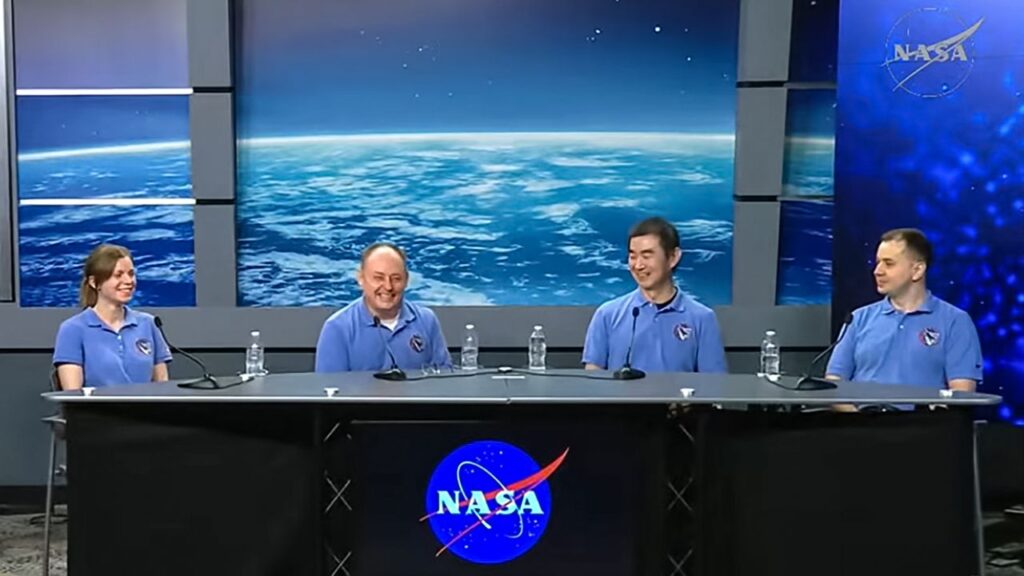
JOHSON SPACE CENTER — During a Wednesday afternoon press conference, the Crew-11 members talked about some of their experiments, but the focus was on the unnamed astronaut who had an unknown medical issue that cut the mission short by a month.
What You Need To Know
Crew-11 and NASA would not identify the astronaut or what the medical issue was.
“Just to start off, of course, we are back here a little earlier than we were expecting. And just to say up front, we are not going to be identifying the crew member or talking through the differential or any of the details of the medical situation. Thank you so much for respecting our privacy,” Cmdr. Zena Cardman said to the media at the start of the press conference.
She and fellow NASA astronaut and pilot Michael Fincke, and mission specialists Japan Aerospace Exploration Agency (JAXA) astronaut Kimiya Yui and Roscosmos cosmonaut Oleg Platonov spoke about some of the work they did.
Almost a week ago, on Thursday, the quartet splashed down in the first medical evacuation in the International Space Station’s 25 years of full service.
The health episode, which NASA Administrator Jared Isaacman called a “serious medical condition” last week, caused the U.S. space agency to cut the Crew-11 mission short.
It was set to end in February. The astronauts spent five months on the space station after they were launched on a SpaceX Falcon 9 rocket in August 2025.
The medical episode happened the day before a scheduled six-hour spacewalk, where Fincke and Cardman were going to install a modification kit and cables for a future rollout of a solar array on Thursday, Jan. 08.
Officials stated this was not an emergency de-orbit.
During a question-and-answer session, Cardman called the shortened mission an “unexpected timeline.”
“I hope to go back to the ISS for so many reasons. It’s just an incredible experience and I think even though we had an unexpected timeline, there’s so much that we are proud of and so much we did accomplish,” she told Spectrum News.
But she said that their training served them well during the medical event.
“As far as things we would do differently, I am very proud to say that we were as well prepared as we possibly could be, and that’s thanks to a lot of really excellent training that we get on the ground. And just being up there with really excellent operators and people who come together as a team really goes a long way. And that’s the crew on orbit as well as our ground support teams,” Cardman explained to Spectrum News.
She highlighted the research that they conducted and how a lot of cargo came and went from the floating laboratory.
In a question from another member of the press, Fincke revealed that the International Space Station’s ultrasound equipment was used during the medical episode.
“And having a portable ultrasound machine helped us in this situation. … So, when we had this emergency, the ultrasound machine came in super handy. So, I’d recommend a portable ultrasound machine in the future for sure, for all space flights. It really helped,” he said.
In a separate news article, Dr. Emmanuel Urquieta, vice chairman of the University of Central Florida’s Aerospace Medicine and associate professor of medicine, shared how each mission on the space station has an astronaut who is assigned as a crew medical officer.
He went into detail about the type of training and medical equipment.
Despite everything that has happened, Fincke said that even though Crew-11 will not be on the space station when Crew-12 arrives, they will still share greetings and advice on Earth.
“Yeah, we wouldn’t want Crew-12 to hit the ground running or hit the space floating, something like that,” he said, adding, “I think my only advice to them, just as we did with the change of command ceremony, was take time and stop for a group hug.”
With Cardman chiming in, “Group hugs and selfies.”