
Galaxies as massive as the Milky Way aren’t unusual — except when they appear in the early Universe. And according to current models of galaxy formation, that simply shouldn’t be possible.
At the dawn of time, vast halos of dark matter surrounded ordinary matter — gas — bound together by gravity. Galaxies formed within these structures by converting, at most, 20 percent of their gas into stars. That’s the standard theory, widely accepted by astronomers. But new observations described in Nature by an international research team could turn that theory on its head.
The findings come from a James Webb Space Telescope (JWST) program designed to study a full sample of emission-line galaxies — or ELGs — from the first billion years of cosmic history. These galaxies are identified by the brightness and intensity of their emission lines, which stand out against their dark spectra and allow scientists to measure their stellar content with precision.
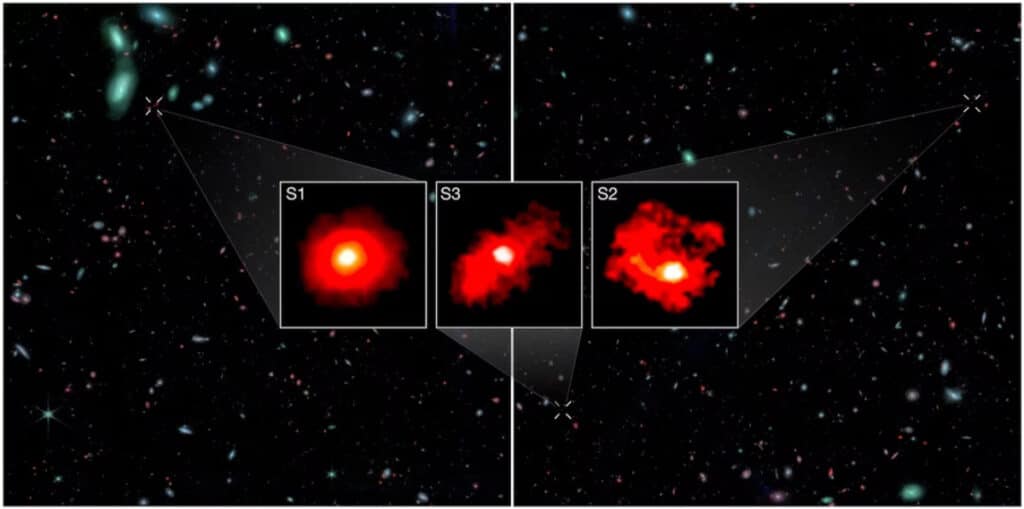
These extremely massive and dusty galaxies from the first billion years after the Big Bang were discovered by an international team of researchers using the James Webb Space Telescope. They indicate that the early Universe formed stars more efficiently than previously thought. © NASA, CSA, ESA, M. Xiao & P. A. Oesch (University of Geneva), G. Brammer (Niels Bohr Institute), Dawn JWST Archive
Galaxies that forge stars at incredible speed
Most of the galaxies studied fit comfortably within the existing model. But astronomers also discovered three striking outliers — “red monsters,” nearly as massive as our Milky Way. They appear glowing red in JWST’s images because they’re rich in cosmic dust.
Thanks to the telescope’s extraordinary capabilities, researchers were able to track how these galaxies built up their stellar mass over time. Their analysis revealed that these “monsters” formed stars almost twice as efficiently as smaller galaxies from the same era or as typical galaxies in later cosmic times.
“Many processes in galaxy evolution tend to slow the rate at which gas turns into stars,” explained Stijn Wuyts of the University of Bath. “But somehow, these ‘red monsters’ seem to have bypassed most of those limits.”
Are there more “red monsters” out there?
Three examples alone aren’t enough to topple the standard model of cosmology — but they certainly raise questions. Current models may need to evolve to account for mechanisms that allow some galaxies to grow so massive, so early in the Universe’s history.
More precise observations of these “red monsters” are already planned using the James Webb telescope and the Atacama Large Millimeter Array (ALMA) in Chile. Scientists hope to uncover additional ultramassive, ancient galaxies.
“These discoveries offer new insights into the conditions that shaped the earliest ages of our Universe,” said Mengyuan Xiao of the University of Geneva, the study’s lead author. “Our ‘red monsters’ are just the beginning of a new era in exploring the young cosmos.”

Nathalie Mayer
Journalist
Born in Lorraine on a freezing winter night, storytelling has always inspired me, first through my grandmother’s tales and later Stephen King’s imagination. A physicist turned science communicator, I’ve collaborated with institutions like CEA, Total, Engie, and Futura. Today, I focus on unraveling Earth’s complex environmental and energy challenges, blending science with storytelling to illuminate solutions.