
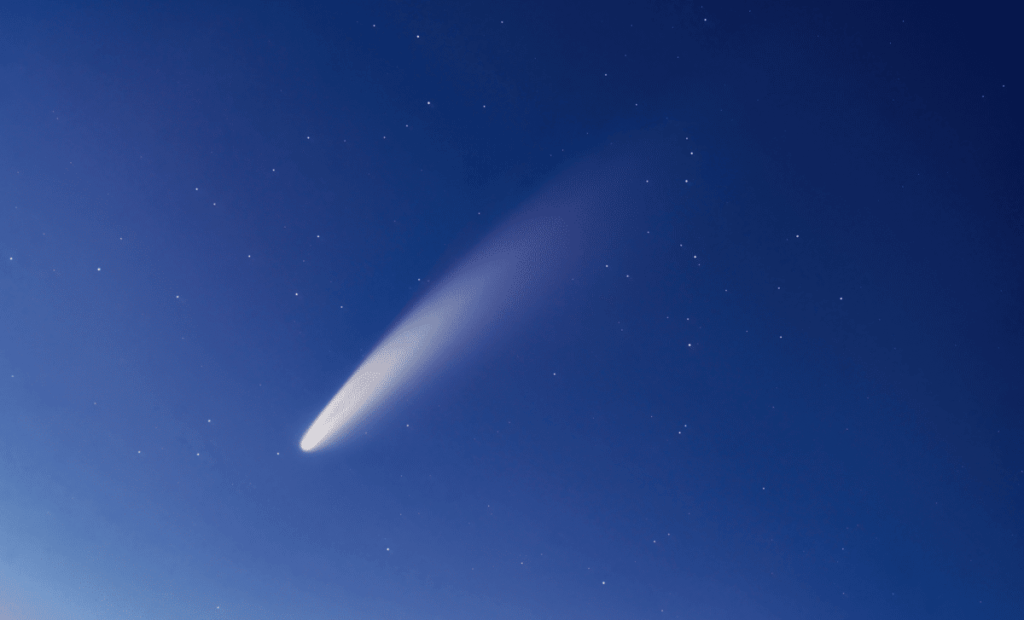
Comet C/2024 E1 (Wierzchos) will pass close to the Sun on January 20, 2026, in a brief but powerful solar encounter that will make it a temporary star of the astronomical world. While it isn’t visible to the naked eye, this icy object from the far reaches of the Solar System will make another appearance near Earth in February, potentially offering better viewing conditions for skywatchers and photographers.
A Dramatic Close Pass to the Sun
According to Space.com, Comet Wierzchos will reach its perihelion, the closest point in its orbit to the Sun, at 1:24 p.m. EST on January 20, passing just 52.6 million miles (84.6 million kilometers) from our star. As it nears the Sun, the comet will brighten significantly due to increased solar heating, reaching a peak brightness of magnitude +8.1. That’s too dim to be seen without binoculars or a telescope, but it’s still a notable event for astronomers.
Although the comet isn’t visible to the naked eye, it offers a rare chance for amateur astronomers to observe an active comet in real time. With a small telescope and a clear view of the sky, observers in the right parts of the world may still be able to track its progress. It’s a reminder that even distant icy objects like this one can have spectacular moments when they swing close to the Sun.
A Southern Hemisphere Show For Now
As of late January, Comet Wierzchos is moving through the southern constellation Microscopium, placing it mostly out of sight for observers in the Northern Hemisphere, including the United States. Viewers in the Southern Hemisphere are better positioned to spot it using binoculars or telescopes, especially under dark sky conditions.
But the story doesn’t end there. Wierzchos will re-emerge in the Northern Hemisphere sky in mid-February, offering another opportunity to see it. On February 17, the comet will reach perigee, its closest approach to Earth, coming within about 93 million miles (or 1 Astronomical Unit). During this pass, it will appear low on the southwestern horizon shortly after sunset, potentially making it easier to spot for skywatchers in the U.S.
En unos días el cometa C/2024 E1 (Wierzchos) saldrá de la conjunción solar y comenzará a dejarse observar con prismáticos, primero desde el hemisferio sur y más tarde desde el norte. Será el cometa más brillante en este inicio de 2026
ℹ️ https://t.co/WC5iEmUFtE
Imagen: Dídac Mesa pic.twitter.com/7jpHhWRRUk
— Pepe Chambó (@PepeChambo) January 16, 2026
A Young Discovery With a Long Journey
Comet C/2024 E1 (Wierzchos) was discovered in March 2024 by astronomers working with the Catalina Sky Survey, a NASA-funded project at the University of Arizona. This program is designed to scan the skies for potentially hazardous near-Earth objects, but in this case, it found something awe-inspiring rather than dangerous.
Wierzchos is believed to have originated in the Oort Cloud, a distant shell of icy debris surrounding the Solar System. As it made its way sunward, it was even observed by the James Webb Space Telescope, which analyzed its light spectrum. Surprisingly, the analysis revealed a lack of cobalt, a chemical signature that might have been lost long ago, possibly when the comet was pushed inward by the gravity of giant planets like Jupiter or Saturn.
February Brings Another Viewing Opportunity
While Comet Wierzchos is currently moving out of sight, its February return may offer the best chance to see it. During this phase, it is expected to shine at magnitude +8.9, still not visible with the unaided eye, but well within reach of backyard telescopes. It will appear just after sunset, making it a perfect target for evening stargazing.
Skywatchers hoping to spot Wierzchos should check tracking tools and real-time sky maps to locate its position. Because of its proximity and low sky position, a clear western horizon will be important. Astrophotographers may also find this a great opportunity to capture a rare visitor as it moves away from the warming power of the Sun.