
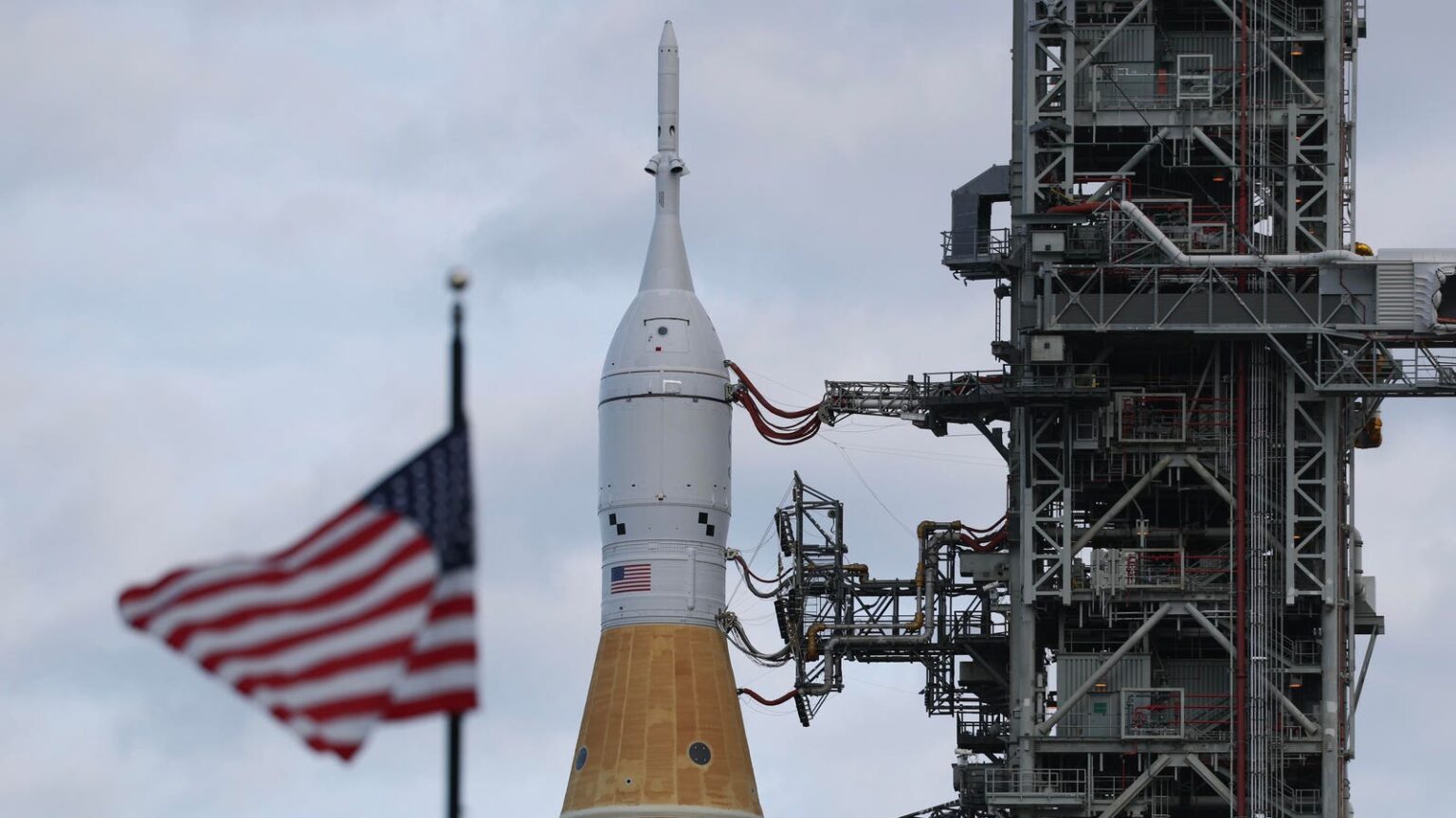
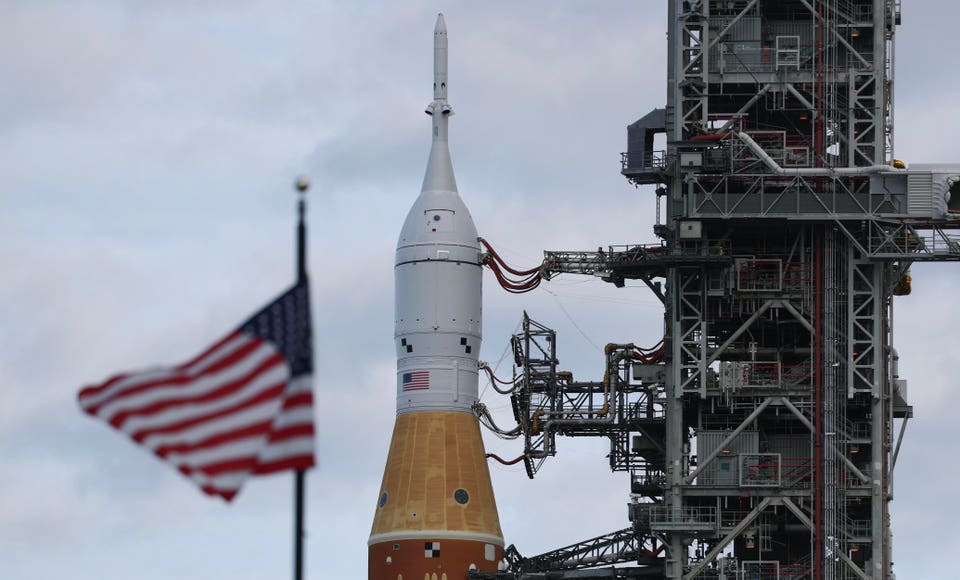
NASA’s Artemis II is rolled from the Vehicle Assembly Building at NASA’s Kennedy Space Center on January 17, 2026 in Cape Canaveral, Florida. (Photo by Joe Raedle/Getty Images)
Getty Images
NASA’s historic Artemis 2 mission reached its launch site at Kennedy Space Center’s Launch Pad 39B in Florida on Saturday, Jan. 17, marking a significant milestone in preparations for the first crewed mission to the moon in over half a century.
The four astronauts on the Artemis 2 mission won’t land on the moon, but during their 10-day journey beyond the moon and back, they’ll get farther from Earth than any humans have ever been.
ForbesNASA Eyes February For First Crewed Moon Mission Since 1972By Jamie CarterNASA Artemis 2 Mission: Launch Pad
After a long journey from NASA’s Vehicle Assembly Building, the fully stacked Space Launch System rocket, Orion spacecraft and European Service Module arrived at the pad at 6:42 p.m. EST on Saturday, Jan. 17. It was a slow journey, with NASA’s crawler-transporter 2 covering 4.2 miles in 12 hours, going at a top speed of 0.82 mph, according to NASA.
NASA announced in September that Artemis 2 would launch no earlier than Thursday, Feb. 5, 2026 — though for that to happen, a wet dress rehearsal would need to pass without problems.
Artemis 2’s arrival at the launch pad comes just weeks after Jared Isaacman was appointed as the 15th administrator of NASA.
ForbesFirst Crewed Moon Mission Since 1973 Is ‘Go’ For 2026 — What We KnowBy Jamie CarterNASA Artemis 2 Mission: The ‘Wet’ Dress Rehearsal
With the SLS, Orion and the European Service Module now on the launch pad, NASA engineers will spend the coming days conducting final preparations for the wet dress rehearsal — a simulation of the fueling and countdown sequence. Scheduled to take place no later than Feb. 2, this two-day test will see the rocket loaded with cryogenic propellants before simulating a countdown and draining sequence. If there are any issues, NASA can return the SLS and Orion to the VAB for more work. Only when the wet dress rehearsal goes perfectly can a final countdown to launch begin.
NASA Artemis 2 Mission: Launch Date
Set for launch between Feb. 5 and April 2026, Artemis 2 will send four astronauts on a 10-day journey around the moon, marking the first time since Apollo 17 in 1972 that humans will travel beyond low Earth orbit. The mission will follow a free-return trajectory, looping around the moon and returning to Earth.
The crew includes NASA astronauts Reid Wiseman, Victor Glover and Christina Koch, along with Canadian Space Agency astronaut Jeremy Hansen. Koch will make history as the first woman to orbit the moon, while Hansen will become the first non-American to do so.
NASA’s Artemis II Space Launch System (SLS) rocket and Orion spacecraft are seen illuminated by lights at Launch Complex 39B, Saturday, Jan. 17, 2026, at NASA’s Kennedy Space Center in Florida. Photo Credit: (NASA/Keegan Barber)
NASA/Keegan BarberNASA Artemis 2 Mission: A Pathfinder Mission
Artemis 2 will take the crew at least 5,000 nautical miles (9,300 kilometers) beyond the moon — the farthest humans have ever traveled from Earth. It’s a pathfinder mission for Artemis 3 — an attempt to land astronauts at the moon’s south pole, currently targeted for 2027.
Using the same NASA (SLS and Orion) and European Space Agency (European Service Module)-built hardware, Artemis 2 will test life-support, communication, navigation and propulsion systems ahead of Artemis 3. Later missions will also include hardware from Elon Musk’s SpaceX and Jeff Bezos’ Blue Origin.
After Artemis 2 is complete, the crew will splash down in the Pacific Ocean, just off the coast of San Diego.
When NASA Will Land Artemis Astronauts On The Moon
The Artemis program’s timeline includes several key missions:
Artemis I (completed in November 2022): An uncrewed test flight of the SLS and Orion spacecraft, successfully placing Orion into lunar orbit and returning it to Earth.Artemis II (February-April 2026): Planned as the first crewed test flight, this mission will carry four astronauts on a lunar flyby, testing life support systems and demonstrating crew capabilities.Artemis III (2027): Aimed at achieving the first crewed lunar landing since 1972, this mission intends to land astronauts near the moon’s South Pole.Artemis IV (2028/2029): This mission plans to deliver a habitat module to NASA’s Lunar Gateway — an orbiting lunar space station that doesn’t yet exist — and conduct another crewed lunar landing.Artemis V (2030/2031): Aims to deliver additional modules to the Lunar Gateway and conduct a crewed lunar landing.
Wishing you clear skies and wide eyes.